
On a Certain Gnostic Tendency in UAP Studies

Friday 3 October 2025 the Society for UAP Studies presented a colloquium with Professor Jörg Matthias Determann on UAP in the Muslim world. Determann’s presentation (about which I may have more to say when the Society shares it on its YouTube channel) was wide-ranging and often fine-grained. As anyone moderately informed would have guessed, Determann remarked how the UFO phenomenon has been interpreted in relation to the Arabic figure of the Jinn. Just as Jacques Vallée and others attempt to draw parallels between modern UAP sighting and entity encounter reports and what Evans-Wentz famously called “the fairy faith,” so commentators in the Arab world understand the UAP phenomenon as a modern-day encounter with the Jinn. But what concerns me here is a not-unrelated exchange that occurred in the post-presentation conversation (and continued between myself and another participant via email). The thesis proposed (after some helpful added articulation by moderator Mike Cifone) was that, in light of the modern “Phenomenon,” religion is revealed to be (however obscurely) the story of human interaction with occult (i.e. mysterious) Non-Human Intelligences. In what follows, I sketch out (or essay, drawing on the root of the word) the profile and ground of this notion of religion…

This view is generally attributed to Jacques Vallée’s Passport to Magonia (1969), which modifies if not develops the Ancient Astronaut literature that explodes at the same time Vallée’s book appears (however much the Ancient Astronaut “theory” goes back to the first appearance of Flying Saucers). For writers such as (most famously) Erich von Däniken, the gods of the premodern world were all primitively-apprehended extraterrestrial visitors. Vallée’s thesis runs deeper, in a sense, seeing all these (gods, angels, daimons, fairies, extraterrestrials…) as different appearances of one species of crypto-entity, a position later modified to propose that these same entities may themselves be only illusory products of an even more cryptic agent, merely elements of a Control System. (One might wonder how much of Vallée’s thinking here springs from the French anticlericalism he was raised in…). However much Passport consistently fails to make its case (as a vigilant close-reading reveals), its main contention has proven to be and remains influential.

I find this view of religion to be unsupportably literalist and reductive, and I am earnestly puzzled to see scholars of religion not only entertaining it but seeming to take it seriously. The locus classicus of this kind of thinking is the Vision of Ezekiel, which, most famously since Erich von Däniken (and, most creatively, Josef F. Blumrich!), has been claimed by some to be a premodern UFO sighting report, Ezekiel describing a(n) UAP and his interactions with the intelligence behind it according to the concepts and language at his disposal. Von Däniken sums up nicely the literalist reading of the opening of the Book of Ezekiel. He writes in Chariots of the Gods concerning Ezekiel’s likening “the din made by the wings and wheels to a ‘great rushing.’ Surely this suggest that this is an eyewitness report?” (39). There is much, however, that complicates matters. First, however much the Book of Ezekiel is the first written prophecy in the Hebrew Bible, its authorship is uncertain; the book attributed to “Ezekiel” is quite possibly the work of several hands. Then, the vision itself, for all its rococo detail is famously obscure in its complexity, as the many and varied attempts to concretely depict it attest, which suggests the description is perhaps more or other than a flabbergasted one of an alien object. Even if we take the vision to be an “eyewitness report,” the witness himself is not very reliable. As Michael Lieb writes in his invaluable Children of Ezekiel

Scholars marvel at Ezekiel’s experience of bodily paralysis and periods of trances (Ezek. 3:15, 4:4-6); his accounts of levitation (Ezek. 3:12-14, 8:3, 11:1); his cutting, weighing, dividing, burning, binding, and scattering his hair (Ezek. 5:1-4); his sudden clapping of the hands and stamping of the feet (Ezek. 6:11); and his belief in his power to destroy with speech (Ezek. 11:13). (14)

Jacques Vallée would likely point to Ezekiel’s paralysis, trances, and levitation as consistent with the kinds of paranormal after-effects often associated with close encounters. But Ezekiel’s other behaviours (above) are part of a more concerning pattern (if we insist on taking the book at face value):

He is told to shut himself within his house. He is bound with cords, and his tongue cleaves to the roof of his mouth so that he is dumb (Ezek. 3:24-26). He is given to prepare his food with dung (Ezek. 4:15) and to accuse his enemies of worshiping dung balls (the term dung ball is found more often in Ezekiel’s prophecy than anywhere else in the Hebrew Bible). (14-15)

Unsurprisingly, “[s]uch circumstances have prompted some scholars to see in Ezekiel evidence of an especially pronounced pathology.” Today, such an “eyewitness” would not be believed, even by believers in the Phenomenon.

However, such troubles are somewhat clarified when we understand how illegitimate it is to spontaneously take Ezekiel’s vision to be an “eyewitness” report by understanding that an “eyewitness report” is a modern genre of discourse and that of the book of Ezekiel another. As I have been at great pains here at the Skunkworks, it is an error to project an historically, culturally, and socially local communicative convention (here, the “eyewitness report”) onto temporally and culturally distant texts and artefacts. Simply, one need first situate the text in the context of the discursive practices of its day; even if it should, as something radically new, break with these conventions, that departure can only come into view in light of what the text leaves behind. Logically, Ezekiel’s vision is either exoteric (visible to Ezekiel and anyone else within visual range of the phenomenon), esoteric (visible only to Ezekiel, consistent with the vision’s being a variety of religious experience or an hallucination), or, perhaps, a powerfully original work of religious poetry with prophetic import and intent. That is, I propose, the “truth” of the Book of Ezekiel is not in its “facts” but in the consequences of its revelations for the spiritual life of its intended readership, which is to read the book rhetorically (which is unavoidable, even for the “literal”—whatever that might finally mean—reading). It is my contention that precisely such philologico-rhetorical reflection is demanded of all culturally and temporally distant “accounts of encounters with Non-Human Intelligences” and that such accounts cannot be admitted as warranted evidence until that due diligence has been undertaken. Why otherwise learned scholars tend to such literalism reflexively is another, however interesting, matter….

The revision of religion I term gnostic (or, perhaps, neognostic) is founded on the testimony of Experiencers coeval or historical. If we take our concept of gnosis from Hans Jonas’ The Gnostic Religion: the Message of the Alien God and the Beginnings of Christianity (1958), gnosis is an immediate acquaintance with the divine (unlike that knowledge bestowed by faith or theological speculation). Not only is “[t]he ultimate ‘object’ of gnosis…God,” writes Jonas (35), but “its event in the soul transforms the knower himself [sic] by making him a partaker in the divine existence.” Gnosis, then, is a radically-transformative experience of the divine. Surely, the Experiencer (if we take their words prima facie) has experienced a Non-Human Intelligence and been changed by the encounter. In this sense, the tendency I explore here rests on a variety of gnosis. Insofar as this neognosticism rests on testimony distant in time and culture, that foundation is questionable; insofar as it appeals to contemporary, “Western” reports, its founding revelations are a variety of religious experience whose veracity is (to the say the least) contested, not merely on dismissively sceptical grounds. In either case, those who entertain this neognosticism, the conjecture that the history of religion is the history of encounters with Non-Human Intelligences, cannot claim to know this version of religion to be true, they can appeal only to the gnosis of those they designate as Experiencers.

If, however, we “bracket” the question of the (questionable) truth of the speculative revelation at the heart of this neognosticism, certain, curious implications come into view. In nuce, like the appearance of Flying Saucers within the horizon of the Cold War, neognosticism “stands in compensatory antithesis” (as Jung said of the Flying Saucers) not to the threat of atomic warfare (as after the Cold War) but the existential threat of global warming and ecological degradation. This neognosticism then appears reactionary, fleeing the chaos of the present and a threatening future into a premodern, paranoid (however “enchanted) “past;” positing a certainty (gnosis) in the face of anxious uncertainty; and taking flight from time (history) into an a-historicity, a timelessness if not an eternity.

The thesis that modernity is “disenchanted” does not go uncontested. What is less likely to be resisted is the relative material security of life in the so-called developed world. Vaccines and antibiotics defend us from viruses and bacteria that in the premodern world were unknown and often mortal, for example. Urbanization, agriculture, transportation, and communication domesticate the countryside at large, so that the experience of getting lost in a selva oscura differs dramatically from that in Dante’s day. Examples can be multiplied. This is not to say modernity is absolutely secure, the being of Dasein is Sorge, as Heidegger reminds us. But the objects or character of that worry differ markedly from that of premodernity. Relative to today, one might posit that the premodern, “demon-haunted,” enchanted world is paranoid, peopled by unseen, inscrutable agents responsible for all that out of human control (“Nature”). In such a world, one might see religion, its myths and practices, as a means to deal with an uncontrolled, uncontrollable, and, by extension, threatening nature. I do not mean to reduce religion to a kind of bartering (however much the etymology of ‘bless’ suggests at times it is), but rather to suggest one function of religion is to orient the human soul or society in the world-at-large. The present, post-Holocene moment, however, is devastatingly ironic, for it is precisely our harnessing that knowledge and know-how that exorcised those premodern threats that has unleashed a nature now even more menacing and uncontrollable than the one we so temporarily seemed to have tamed. The modern(ized) mind, however, does not fall back into the premodern paranoia (however much it succumbs to its own, “postmodern” versions in the face of occult forces, social and natural, malevolent or indifferent). The neognostic, however, does, believing in an unseen world peopled by Non-Human Intelligences of uncertain intent let alone morality. Jacques Vallée’s Control System Hypothesis is a case in point, as likely to be found in a novel by Thomas Pynchon or William Burroughs (where one does read of “Control”) as arising from the extensive files of a ufologist. Indeed, the neognostic seems all-too-Gnostic, as the classical versions expressed a belief in a malevolent cosmos controlled by daimonic Archons, a paranoid parody of the Babylonian astrological religions. In the face of the anxieties of a social world developed beyond comprehension, whose very natural roots are withering in the heat of the furnace of its own development, the neognostic fears not the real-world, social and natural threats but an Other world whose agents however inscrutable are at least palpable in their ephemeral, however sometimes terrifying, appearings.

Ours is surely an uncertain time, from the furor over “Postmodernism,” to post-truth, “fake news,” and deep fakes, to the disturbingly chaotic climate regime to unfold in the coming centuries, like none Homo Sapiens—indeed the earth—has experienced. In this situation, wherein nothing seems knowable, the Experiencer possesses gnosis, an apodictic certainty. The Experiencer’s gnosis, however, is radically other, in a way less, than their classical forebears’, for whom the experience of the identity of the soul with the essence of the Alien God was at the same time knowledge of “everything that belongs to the divine realm of beings, namely, the order and history of the upper worlds, and what is to issue from it, namely…salvation” (34). The Experiencer, rather, paradoxically is given access via the gnosis of the encounter to a mystery. What is their nature? What do they want? Are they benevolent, malevolent, or indifferent? Are they terrestrial, extraterrestrial, transtemporal, or interdimensional? This mystery, however, is grounded in a certainty, at the very least a self-assuredness, such as that on display at the most recent Rice University Archives of the Impossible conference, when an Experiencer shouted out, “We know there is another world!” Amid the present, real, threatening uncertainty, the gnosis of the Experiencer serves as a First Principle, an Archimedean point, or at least an anchor of real, unassailable knowledge borne of direct, first-person experience (the historical foundations of which certainty, again, are laid down in the inheritance of an historically, culturally local tradition…).

Just as the neognostic flees the disenchanted, out-of-control world for a premodern, enchanted-if-demon-haunted world and exchanges the deeply unnerving uncertainty of the present and foreseeable future for an unassailable if paradoxical certainty, they take refuge from history in an ahistorical simulacrum of eternity. At least since Kant and Heidegger (the first for whom time, with space, is the form of intuition and inner sense; the latter for whom Dasein is not only temporal but historical) the temporal situatedness of human understanding is a given, i.e., one whose concrete determinations are unfathomable, never to be exhaustively brought to the light of consciousness. The consequences of this temporal finitude play themselves out in our brief study of the Vision of Ezekiel. For the neognostic, temporality is assumed to be transcended in the unquestioned (unreflected) obviousness that, as the opening of the History Channel’s Ancient Aliens reminds us, “We have never been alone,” or, in the refrain of the neognostic, “The Phenomenon has always been with us.” On the one hand, perhaps, it is merely a common-sense, naive realism that underwrites this temporal blindness, a belief in human nature, as it were. More profoundly, this certitude in a “perennial philosophy” gestures toward that “other world,” which, if not exactly outside of space and time, lies outside (if however much aside) our own. This neognostic atemporality is, of course, from the point-of-view informed by philosophical hermeneutics (at least), a naive projection and imposition of the present horizon on those of the past, a kind of unconscious epistemic imperialism or colonialism, which blithely liquidates cultural difference in the assumed naturalness of its own universality. In the post-Holocene, unforeseeable but undeniable change aggravates a sense of temporariness to the point of imaginably foreclosing history itself in the misanthropic, schadenfreudlich fantasy of Near-Term Human Extinction. Little wonder the neognostic flees in fancy to some unchanging order amid a world civilization on the wane (just as the Gnostics themselves did).

As any reactionary tendency, neognosticism is unwittingly ideological, affirming the status quo at the hidden centre of society in spite of the marginality of its explicit beliefs. From a disenchanted, disillusioned present threatened by known, terrible forces the neognostic flees to an enchanted but paranoid world of occult agents. Over an abyssal uncertainty, they cling to a thread of gnosis, itself anchored, paradoxically, to mystery. In the face of an epochal shift, a timeless order is affirmed. But these understandable compensations twist around a root grounded in an affirmation of the very conditions that give rise to the disorder that motivates them, however unconsciously, and that is the very character of the Non-Human Intelligence it posits. As I have laid out repeatedly here at the Skunkworks, these “Non-Human Intelligences” are human-all-too human, whether with regards to their anthropomorphism or the fact of mutual recognition. What, further, remains unremarked and unexamined is the use of ‘intelligence’ to designate awareness, consciousness, or, more properly, soul. For what seems at work here is an Abrahamic/Gnostic assumption that centres human awareness as paradigmatic, essentially of the same order if not magnitude as that of God and those other created beings, celestial or infernal, between Man and God, Man being made, thus, in God’s own image. What is decentred here, pushed not only to the margins but out of sight, is the very real “nonhuman intelligence” of all the other nonhuman forms of life presently suffering a mass extinction, a Molochian sacrifice of biodiversity arguably underwritten by a certain strain of just this Abrahamic anthropocentrism that places the human being at the sole centre of creation as master over all other forms of life on earth. In this way, the neognosticism I sketch here colludes with the values that determine the social behaviour that results in the climate and ecological crises that determine its own advent. Ironically, it’s just the discourse that submits this neognosticism to critique of this kind that may rightfully call itself shamanic, if, by the shaman, we name the one who mediates between the human and truly nonhuman world.


Disclosure & Utopia

When “Flying Saucers” (as such) appeared in the skies, they were, at first, a national security issue (a matter whose implications Dr Kimberly Engels has recently addressed). As the mystery of their origin and nature persisted, they became as much an object of scientific inquiry. At the same time, their presence became a matter of psychological and sociological interest and even religious significance. Some few, however, have ventured reflections on the social or political dimensions of the phenomenon, among them A. M. Gittlitz and Walker Jaroch.

In his most recent article, Jaroch probes “the leftist instincts driving UAP disclosure.” I must confess I find the thread of Jaroch’s argument as fragile as it is difficult to follow. Nevertheless, he seems to argue that the longstanding hostility to left-leaning thought and activism (be it organized labour, Anarchism, Communism, or Socialism) in the U.S., which, during the Cold War, resulted in some UFO groups being suspected of harbouring Communist sympathies, has led to a suppression of “socialist” thinking, which, Jaroch writes, leaves “most people today without the tools to describe and confront the issues in their lives adequately,” i.e., at least as far as certain corners of social media appear to suggest. For this reason,

For many, disclosure is being conflated with a society where people don’t have to worry about their bills, healthcare and aren’t forced to work jobs they hate.

Disclosure culture is functioning as a surrogate political language, expressing socialist desires without naming them.

The utopia dangled in front of those fascinated by Disclosure by its advocates (including Hal Puthoff, Tom DeLonge, Steven Greer, and Luis Elizondo) is underwritten by exploiting the technology behind UAP, particularly what is said to power them, Zero Point Energy. In general, Disclosure promises, as Jaroch puts it, “a world transformed by hidden alien tech.”

He most clearly makes his point when he writes concerning Disclosure that:

It’s undeniably a con to peddle fantasies of an alien tech utopia to people desperate for real societal change but who lack the knowledge to accurately describe or enact these changes in real life for themselves.

While no longer taboo, socialism is still a dirty word today for many. Yet, what people in the disclosure movement actually want is a more socialist society. They’re asking for affordable lives, accessible healthcare and decreasing the gap between the wealthy and poor. They want a revolution — and they’re being told it’ll come via disclosure.

Surely, Jaroch touches on some truth in his article. Many Americans are anxious for a way out of deepening precarity. Some explicitly look to “socialism,” while others, succumbing to “the politics of despair,” opt for authoritarianism and outright fascism. Those, on the other hand, “desperate for real societal change” without being able to name that change (at least with an -ism) grasp a knot of contradictions even more revealing than Jaroch himself seems to understand.

An obvious contradiction is stated clearly by Jaroch himself: “The real gains of the disclosure movement haven’t been societal — they’ve been commercial.” That is, the peddlers of Disclosure have successfully commodified an idea, ironically selling the promise of a “socialist” utopia. More deeply, however, the utopia alien tech promises is withheld by its monopolization by government or what might be termed today a “deep state.” The idea is hardly new: Philip J. Corso’s The Day After Roswell (1997) made similar claims concerning the origins of the technology that underwrote the digital revolution, chips and fibre optics, for example, in the reverse engineering of debris retrieved from crashed alien spacecraft. What remains unrealized in the present-day Disclosure chatter is that the technological breakthroughs alluded to by Elizondo or Greer would, were they real and disclosed, be no less monopolized and commodified by corporate interests in the same way computer technology was, not to the benefit of society at large but to that of the diminishing 1%. In grasping at what promises deliverance from capitalist exploitation the very nature and workings of that exploitation are overlooked.

But the “socialist desires,” as Jaroch calls them, are even more deeply betrayed by the object of their desire, as the very idea that technology can solve what is essentially a social problem is precisely the idea being sold by the Tech Bros and techo-optimists. Even more fundamentally, Jaroch’s unconscious socialists, the Disclosure hucksters who dupe them, and Silicon Valley all buy into an unquestioned fetishization of technoscience, an unquestioned faith that that which has led to a Sixth Mass Extinction and has disrupted the temperate climate of the Holocene that nurtured the emergence of agriculture and settled, civic life (in a word, civilization) is that which will solve the problems it itself has caused. The Disclosurists dangle the same solution before their dupes that the technologically-invested ruling class dangles before their constituents in general, an imaginary solution (whether fictional in fact or whose facts are only fictionally, i.e., falsely, a solution) to a real problem, the very definition of ideology (in the Marxist sense). Those fascinated by Disclosure are, indeed, “people desperate for real societal change but who lack the knowledge to accurately describe or enact these changes in real life for themselves,” changes not, however, science-fictionally technological but radically and inescapably social.

Shadow play: Jacques Vallée’s Control System Hypothesis and D. W. Pasulka on the social engineering of the UFO mythology

Among thoughts provoked by my recently reading James Madden’s Unidentified Flying Hyperobject: UFOs, Philosophy, and the End of the World (2023), aside from those concerning the hyperobject, were others regarding Madden’s about Jacques Vallée’s Control System Hypothesis and D. W. Pasulka’s contentions about the intentional steering of the UFO mythology. I have already probed some ideological implications of two variations of Vallée’s Control System Hypothesis; here, I address Madden’s presentation of Pasulka’s “troubling thesis” (105) from her American Cosmic (2019).

For Madden, Pasulka’s position is that “we are in the midst of a religious transformation, and this process is something that is being done to us…[using] the newly honed tools of media technology.” This “manipulation looks like it has been transacted, at least in part, by quite mundane powers.” This “religious transformation” is characterized by “a particular system of belief centering on ‘nuts-and-bolts’ UFO technology manned by extraterrestrial, rational animals.” For Madden, Pasulka is inspired to investigate this “religious transformation” first by Jung’s observation that with the modern “flying saucer” era “We have…a golden opportunity of seeing how a legend [for Pasulka, a religion] is born” (103).

Despite Madden’s seeing Pasulka and Jeffrey Kripal as “the avant garde for academic ufology in the humanities and social sciences” (9), the religious dimensions of the UFO and its pilots have a long, rich history of academic, scholarly investigation (interested readers are directed—for a start—to the essays collected in The Gods Have Landed: New Religions from Other Worlds (1995)). Be that as it may, what strikes Madden is Pasulka’s conjecture that the UFO mythology is being intentionally engineered. Madden quotes American Cosmic:

The creation of a belief system is now much easier to accomplish than it was two thousand years ago, when people didn’t possess smartphones and were not exposed to the ubiquitous screens of a culture that now teaches us how to see, what to see, and how to interpret what we see…I [Pasulka] was beginning to research the ways in which the virtual and digital media were being used for political purposes under the auspices of information operations. how the military employed media, social media, and all types of electronic media for purposes of national security. All these media have played major roles in the creation of a global belief in UFOs and extraterrestrials. It is in the world of media that the myth is created, sustained, and proliferates. (104)

Surely, the myth is, in a sense, “created…in the world of media:” there would be no “flying saucers” had not a journalist coined the term. The “visionary rumour” has been spread through print, electronic, and now digital media (newspapers, magazines, books, radio, television, cinema, and the internet). Indeed, the dissemination, formation, and reception of the myth in the media is a study of its own. At the same time, that the authorities (at least in the United States) have not been absolutely forthcoming and have actively engaged in spinning the topic is old news. Already in his first book, The Flying Saucers are Real (1950), Donald Keyhoe first expressed the view that the air force knew (or had, at least, concluded) that flying saucers were interplanetary spacecraft but was covering up this knowledge and dissuading public belief in it until a later date when through various public relations efforts the “ontological shock” of the revelation that “we are not alone” could be sufficiently cushioned and controlled. Keyhoe’s books planted the seeds for the ideas of “the flying saucer conspiracy” (the title of his 1955 book) and the push for “Disclosure” (the authorities’ admitting publicly what they know about our interstellar visitors), something Keyhoe actively worked toward in his lifetime.

Today, the locus classicus of such dissimulation is the Army Air Force’s first claiming a flying saucer had crashed near Roswell, New Mexico, only to quickly retract the story and explain what had been found on Mac Brazel’s ranch were the remnants of a weather balloon. No less pertinent if perhaps less famous is Allen Hynek’s being urged to explain the sightings in Exeter, New Hampshire as swamp gas. More gravely, stories of intentional deception by military and intelligence agents are well-known (Jerome Clark’s The UFO Book (1998) includes a two-dozen page entry “The Dark Side” with a thirty-seven entry bibliography). Among them, most notoriously, are the cases of Paul Bennewitz, who was driven to insanity and suicide by an Air Force disinformation campaign (as well-researched and documented by Greg Bishop in his Project Beta: The Story of Paul Bennewitz, National Security, and the Creation of a Modern UFO Myth (2005)) and that of William L. Moore, who was actively recruited both to provide intelligence on his fellow ufologists and to disseminate disinformation, an important actor in the whole MJ-12 affair. Jacques Vallée’s 1991 Revelations: Alien Contact and Human Deception delves into these and other, international stories, while the late Robbie Graham’s Silver Screen Saucers: Sorting Fact from Fantasy in Hollywood’s UFO Movies (2015) is arguably the deepest dive into government actors’ actively playing a role “in the creation of a global belief in UFOs and extraterrestrials” (Graham, curiously, absent from the pages of American Cosmic).

What needs be remarked is that already in his 1975 volume The Invisible College: What a Group of Scientists Has Discovered about UFO Influences on the Human Race Vallée was reflecting on the manipulation of the myth by both human and nonhuman agents, writing about both the UMMO affair (an elaborate hoax committed by unknown parties for unknown reasons) and developing his Control System Hypothesis (that some UFO sightings and encounter events are intentionally staged by the intelligence behind the “real” phenomenon to act as stimuli to modify social behaviour). These two manipulations are humorously represented in the X-Files episode “José Chung’s ‘From Outer Space'” (1996) where two air force pilots, disguised as Greys abducting a young couple, are interrupted and abducted themselves by a real alien from (perhaps) inner earth. Indeed, that the American (and other) governments have had a hand in manufacturing UFO events and manipulating the mythology is, itself, an important part of the X-Files‘ UFO mythology. (One might be moved to ask if Chris Carter’s series is, then, a moment of postmodern reflexivity, where the medium of manipulation makes an open secret of its manipulations). The matter is, indeed, complex…

Setting aside the possible deceptiveness of the Phenomenon itself, even the human steering of the mythology is far from simple. (I have ventured some reflections on the matter, here). First, there are a number of parties involved, national (e.g. the United States) and private (e.g., those responsible for the UMMO hoax). Even within a single nation state, there are a number of agencies, not all of which are necessarily acting in unison or even necessarily aware of each others efforts (e.g., the navy, the air force, the various intelligence agencies). Are all these pushing the same agenda? More generally, it seems not unlikely that various nation states will exploit the mythology each for their own ends. Indeed, one reason the United States Air Force was so concerned about flying saucers was it feared the Soviet Union could use a flurry of “uncoordinated targets” as cover for an air assault. Exactly how various international actors might in fact be exploiting the mythology is a question.

As the cases of Paul Bennewitz and others attest, at least in the United States, various actors have in fact worked to maintain and guide the mythology, but to what end or ends? In the case of Bennewitz, it was to cover up highly-secret transmissions Bennewitz had detected but couldn’t understand. Further, we do know that the idea of extraterrestrial spaceships buzzing the skies has served as a cover story to hide test flights of experimental aeroforms. Other uses are imaginable, but uncertain. Even if the myth is part of a larger, long term plan, perhaps the interested powers-that-be, even without an immediate use, seek to maintain the myth of interstellar visitors as a potential weapon in the psychological, propagandistic arsenal for some eventual, unforeseen use.

However, as the X-Files episode mentioned above shows, the mythology is, in a sense, out of control. The manipulation of the myth, as well, at least among a portion of the population, is even already out of the bag. One might ask, moreover, if it is imaginable that any one government can have an agent in a steering role in every movie and television studio. Anyone who has worked in the motion picture or television industry will attest just how aleatoric the process of movie production is, how hard it is to control and determine the final product, so many having a vested interest. Of course, an iron-fisted control is likely not even needed; all that’s necessary is to nudge the mythology as necessary, as long as the reigning idea is that of extraterrestrial visitation. As long as the idea is sufficiently profitable, it will be creatively exploited. (Arguably, a less paranoid and more interesting question is just why this idea holds so much fascination…).

At the same time, however ubiquitous the “visionary rumour,” exactly how powerful is it? What exactly is the value of steering “our collective unconscious toward [this] particular system of belief” by a “co-opted popular media” (105)? However true that such co-option is in fact at work, the production of the mythology is out of any one party’s hands, not to mention its reception by audiences who are hardly mindlessly passive receivers, rendering the predictable and, hence, controllable effects of the myth uncertain to a questionable degree.

What Pasulka fails to question are the conditions of possibility for the persuasiveness of the myth’s central idea in the first place, social conditions which imply a deeper function of the idea of technologically-advanced extraterrestrial civilizations. First, the “plurality of worlds” is an old idea; the belief in the possibility of “intelligent life” on other planets goes back to antiquity. Thus, ideas about aliens and their spaceships were already in the air when the United States Army Air Force cast around for possible explanations for the sightings of flying discs in the wake of Kenneth Arnold’s report of “flying saucers.” That this science-fiction theme already thrived quite vitally in the media of the day suggests there would have been little need for it to be cultured to whatever end, however much there is in fact evidence of such meddling. And, as I have argued here consistently, the myth of anthropomorphic extraterrestrials and their technologies is an all-too understandable projection of the self-understanding of the so-called “advanced societies,” especially within the context of their having “progressed” to the point of being able to annihilate themselves. On the one hand, these alien societies are images of a possible future the other side of the critical threats facing the modernized world; on the other, as SETI researchers themselves have proposed, extraterrestrial civilizations “more advanced” than our own might very well have solved the very problems that threaten ours, a belief shared by advocates of Disclosure eager to exploit those free energy technologies they believe world governments have retrieved, reverse engineered, and exploited to their own ends. This more profound view of the UFO mythology perceives it not so much as a new religion (though it has surely inspired New Religious Movements) but as a quite understandably spontaneous outgrowth of the ideology underwriting technoscientific society, a fantasy that imagines that, because such societies are natural (a universal feature of the evolution of life, from its appearance to its developing “intelligence”), technological “progress,” at least potentially, can solve the problems it itself gives rise to, an imaginary answer to a real problem. In this regard, it seems those aspiring social engineers that so concern Madden and Pasulka could very well have saved themselves the trouble.

A note on the Hyperobject

This reflection does not intend to supplement or contradict the reviews of Unidentified Flying Hyperobject, for example, those of Michael Zimmerman or Travis Dumsday. Rather, it is occasioned by my reading through Madden’s Unidentified Flying Hyperobject in preparation for a session of the SUAPS monthly reading circle. In the course of my preparation, one aspect of Madden’s book that caught my attention is the way he puts to work Timothy Morton’s notion of the hyperobject.

My approach is critical—not fault-finding but probing the conditions for and implications of a notion, position, or practice. For example, conversations around “Artificial Intelligence” (“AI”) tend to be either practical or theoretical. Developers and engineers concern themselves with building, training, and “improving” “AI,” while others reflect on its implications for society or our conceptions of intelligence or consciousness. A critical perspective, however, focusses on the historical, social, and material conditions that determine the phenomenon. In the case of “AI,” one can point to Matteo Pasquinelli’s book The Eye of the Master:  A Social History of Artificial Intelligence or Muldoon’s and Wu’s study “Artificial Intelligence in the Colonial Matrix of Power,” which “theorises how a system of coloniality underpins the structuring logic of artificial intelligence (AI) systems,” bringing into view the “regimes of global labour exploitation and knowledge extraction that are rendered invisible through discourses of the purported universality and objectivity of AI.” Note how practical and theoretical considerations are included in critique, however much their apparent spontaneous objectivity is stripped away in the process.

Madden’s argument strikes me as a bricolage. He borrows freely from Plato, Aristotle, Heidegger, Wilfred Sellars, Jakob von Uexküll, Nietzsche, and others what he needs to jerry-rig a working, speculative framework of his own. This method of construction tends to overlook the implications of its component parts, risking an incoherence (into which it seems to me Madden’s speculations fall, at least in so far as they are presented). But apart from this problem, the notion of the hyperobject possesses some intriguing implications, especially in the way Madden develops it.

With regard to the hyperobject, Madden, following object oriented ontologist Graham Harman, first argues that “If a thing has effects novel with respect to its components (including control of those components) and an identity that survives their replacement, and it controls its parts, then that thing is real—without qualifications” (70). Madden employs Harman’s example of a particular Pizza Hut franchise:  “The entire staff, management, and equipment can be changed over while we still have the same Pizza Hut restaurant” (71). Madden infers that, therefore, “we can make a case that a particular Pizza Hut has a life of its own…things we originally do or set in motion, e.g., a Pizza Hut franchise can actually go their own way independently of us, and even while controlling us.”

The substantial agency of such an object is then transferred to a plane of transcendently large complexity. Madden cites Morton’s description of the hyperobject, its being

…things that are massively distributed in time and space relative to humans. A hyperobject could be a black hole. A hyperobject could be the Lago Agrio oil field in Ecuador, or the Florida Everglades. A hyperobject could be the biosphere, or the Solar System. A hyperobject could be the sum total of all the nuclear materials on Earth… A hyperobject could be the very long lasting product of human manufacture such as Styrofoam or plastic bags, or the sum of all the whirring machines of capitalism. Hyperobjects, then, are “hyper” in relation to some other entity, whether they are directly manufactured by humans or not. (72).

A close, rhetorically-vigilant reading of Madden’s development of Morton’s notion reveals a telling tropology. Madden begins with Harman’s example of the Pizza Hut franchise as, as it were, a synecdochic “part” of the Pizza Hut Corporation hyperobject. Moving on from the passage from Morton, above, Madden then writes of the environment, the economy, and the war in Ukraine as hyperobjects (73). Later, this list becomes “economies, wars, nations, [and] corporations” (74), a passage preceding Madden’s writing of the UFO hyperobject that “maybe…now it’s on the loose under its own steam.”

If we read Madden here both taking him at his word and against the grain we might perceive that the very idea of the hyperobject is a precipitate of the social moment of its articulation, for thinking of the hyperobject socially (as the economy or a corporation) seems indexical of that moment in late capitalism when the sacrosanct, independent agency of the economy resembles some zombie version of Adam Smith’s Invisible Hand and, at least in the United States, corporations are legally persons. That is, it should come as little surprise that this idea of the hyperobject should come to consciousness within a context of social conditions characterized by socially contingent entities’ (the economy and corporations) possessing a fetishized, reified independence and agency, a time marked, further, by the climate crisis (the hyperobject par excellence), a development whose cause can be traced to the metabolic rift that characterizes capitalism’s relation to the natural world from which it extracts wealth and, most immediately and tellingly, to the Industrial Revolution and its steam-powered “Dark Satanic Mills.”

Does this realization imply the notion of the hyperobject is false? Not at all. However, what is revealed is how its articulation is an instance of how social conditions determine consciousness and how the products of that thinking consciousness can work in an unintentional collusion with those conditions under and within which it labours. At the very least, the hyperobject cannot, as if it were a hyperobject itself, pretend to transcend and illuminate (determine) the (social) world that determines its genesis and orients a now vigilant reception of its being put to use.

Another not an Other

A friend recently shared this meme of “What-the-Dalai-Lama-told-John-Mack” (which I haven’t fact-checked), which, along with the recent publication of Diana Pasulka’s Encounters: Experiences with Nonhuman Intelligences prompts this post.

As readers here will know, one engine of thought here at the Skunkworks is the thesis that the very idea of technologically-advanced, extraterrestrial civilizations is ideological, that is, treating a profoundly contingent cultural formation (namely, that of the earth’s so-called “advanced” societies) as if it were somehow natural or universal. The Extraterrestrial Hypothesis (ETH) for the origin of UFOs/AUP merely projects “First World” humanity as a paradigm of “intelligence” and “technology” onto the cosmos.

However, recent reflections on “the Phenomenon,” taking their cue, arguably, from Jacques Vallée’s Passport to Magonia combined, sometimes, with more recent, original research, depart from the conjecture that UFOs/UAP hail from an extrasolar civilization. Following Vallée, it is proposed that the mind-boggling variety of entities encountered in relation to flying saucers, UFOs, and UAP are part of a broader, human tradition of interaction with nonhuman intelligences. As Pasulka writes in the introduction to her new book (in her characteristically breezy style): “Traditional religions, including Christianity, Islam and Judaism, as well as Buddhism, and Hinduism, in addition to Indigenous communities, include some recognition, in parts of their histories and traditions, either acknowledging or pondering the existence of extraterrestrials or nonhuman intelligence, or do not discount it” (8).

In this notion of “nonhuman intelligence” there seems something unreflected, and that is the very (reported) fact of human/nonhuman interaction, an interaction that is more like human-to-human interaction than that between different species. If these entities are not of the family Homo (and even within that family mutual recognition is restricted), then the grounds of the mutual recognition between human and nonhuman beings is mysterious (if not downright mystical). I have argued this point with regards to intelligent extraterrestrials: there is no obvious reason why They should recogize Us as their technologically-advanced, intelligent Other. The same reasoning is arguably applicable to the nonhuman intelligences posited by Vallée, Pasulka, et al.

Within the context of the Abrahamic religions, the interaction between humankind, angels, and demons is not suprising, however, given that they all spring from the same Creator, Man being made in His image. Just how an analogous thinking is operative in the traditions Pasulka lists above, she—the religious studies scholar—would know better than I, but my hunch is this analogue is present in one inflection or other in them all. It follows, then, that myths, traditions, stories, or reports of “face-to-face” interaction with nonhuman intelligences, at least within the context of a Darwinian understanding of life, intelligence, and consciousness, betray an anthropomorphism if not an anthropocentrism. In our average-everyday reality, human-to-human interaction differs from interspecies interaction, and interaction between human and nonhuman “intelligent” beings would be an instance of the latter, not the former.

This reflection reveals a deeper, unquestionable anthropocentrism. The very idea of “nonhuman intelligence,” as it is deployed in talk about “the Phenomenon,” excludes out of hand the “intelligence” of all other forms of life on earth (which is ironic given the way that non-Abrahamic traditions—“Buddhism, and Hinduism, in addition to Indigenous communities”—think of nonhuman beings in ways markedly more empathetic). As I have argued, there’s no such thing as intelligence. That is, the concept of “intelligence” denotes not some quality or characteristic in-itself, but is a piece in some language game (e.g., that of various fields of psychology, artifical intelligence research, etc.) possessed of significance only relative to its particular use. Just as the concept of technology is unreflectively inflated and projected onto the cosmos by the thinking that goes on in the ETH and the Search for Extraterrestrial Intelligence, too often in ufological talk, even in this latest inflection, “intelligence” appears blindly applied only to human, all-too-human (so-called) Others.

Sightings Friday 4 August 2023

The Grusch Affair continues to suck up the air in ufological space. The usual suspects continue to keep the story spinning (see this “roundtable” with George Knapp, Jeremy Corbell, Ross Coulthart, and Bryce Zabel, for example). In the mass(er) media, News Nation (…) isn’t much better, bringing together “experts” Sean Cahill, Steven Greer, and Avi Loeb for a yack. At least PBS for its part went to a journalist author of a forthcoming book on the matter, Garrett Graff. Even more serious thinkers are scratching their heads: Bernardo Kastrup (in a not very informed or profound manner) and Mike Cifone more scrupulously.

Those who swallow Grusch’s tale do so, it seems, for the most part, because they want to believe or on the grounds of the man’s credentials. Anyone who watched to the end a recent conversation between Mick West and Steven Greenstreet, however, would have been treated to a link that waves five red flags with Grusch’s story. The one that should catch the eye of everyone interested in the topic is that “in accordance with protocols, Grusch provided the Defense Office of Prepublication and Security Review at the Department of Defense with the information he intended to disclose.” Nothing Grusch has said is considered secret by the U.S. Department of Defense. So, is he blowing a whistle, or smoke?…

Some, such as those I’ve noted here earlier, Luke Harrington and Caitlin Johnstone, are able to look awry at the matter to consider its societal implications aside from the question of the factual truth of Grusch’s claims. Günseli Yalcinkaya, too, insightfully raises the point that “In this new and uncharted era of disinformation, it’s easy to see how stories of technologies of unknown origins, non-human intelligence and unexplained phenomena can fan the flames of cover-ups and conspiratorial thinking…” Thus, “it’s hard not to question the motives behind how this information is being fed to us – and why.”

Yalcinkaya is informed enough to recognize that the suspicion of cover-ups goes back to the beginning (however much she points to Roswell as the watershed event…). In fact, it’s in 1950 Frank Scully publishes tha archetypal crash-and-retrieval tale Behind the Flying Saucers; Donald Keyhoe publishes The Flying Saucer Conspiracy five years later, a title that underlines suspicions he’d been voicing from the start, in The Flying Saucers are Real (1950). In this regard, she quotes Mark Pilkington: “This UFO belief is intrinsically tied to notions of a government and military cover-up, and is powerful and pervasive within society,” a society wherein (as Yalcinkaya writes) “social media chips away at any notion of a consensus reality,…which amplifies fringe beliefs and makes it harder to distinguish what’s real or not.” Cannily, she observes that “Even the positioning of UAP sightings as classified information plays into this narrative, with officials capitalising on our collective distrust of mainstream media to uncover hidden truths,” this skepticism toward mainstream media further eroding a shared sense reality. “It’s important to consider why these conversations are entering the mainstream now” she goes on to write, “and it’s not a coincidence that it’s during a time when space tourism is on the rise and conversations around AI and non-human intelligence are reaching their peak and posing very real existential threats.” However much I find there to be more pressing concerns than those Yalcinkaya remarks, we would surely agree that The Grusch Show serves to keep “us distracted from anything more shadowy beneath the surface.”

Aside from distracting from graver problems (I’ve remarked Tim Burchett’s and Anna Paulina Luna’s skepticism about global warming…) and further dissolving consensus reality, the Grusch Affair stirs a deeper, troubling current, a particular, bipartisan suspicion of government. The roots of such distrust go to the very founding of the Republic, and, unsurprisingly, sprout after the Second War, one flower of which is precisely the myth of a UFO cover-up as articulated by Keyhoe. More acutely, “Big government” has been the target of Neoliberal attacks: Ronald Reagan famously stated that “government is not the solution to our problem; government is the problem.” This overt ideology has been behind the drive to rollback those gains made by working people after the war, particularly in the institutions of the welfare state. The consequences of such thinly-veiled laissez faire capitalism have not been for the best. And, at a time when then nations of the earth need work together over decades to mitigate and adapt to climate change (and other threats to life on earth), such a distrust of public institutions is, to say the least, counterproductive.

There is, morever, a blindness at work in this suspicion. “If there’s not a cover-up, the government and the Pentagon are sure spending a lot of resources to stop us from studying it,” Burchett told The Hill.  His Republican colleague, Luna, adds, “We know that enormous sums of money are being spent on UAP-related activity, whether it’s retrieval/recovery, research and reverse-engineering, or just security for whatever the government is hiding.” This exclusive focus on government is curious, given that Grusch claims that “recoveries of partial fragments through and up to intact vehicles have been made for decades through the present day by the government, its allies, and defense contractors” [my emphasis]. The private sector, therefore, is no less guilty of a cover-up than government. Indeed, corporations have shown themselves no more transparent, when quarterly profits are at stake. Big Tobacco lied about nicotine’s being addictive, Big Oil knew about global warming, Boeing’s cutting corners crashed several 737 Max aircraft, and, more recently, Johnson and Johnson ignored research that linked its talcum powder to cancer. Ironically, it’s only via public institutions, such as the courts, that such corporate malfeasance can be brought to justice (not to mention the role of the much-maligned mainstream media in investigating corporate deceit).

Ideology (in the sense I use the term here) is revealed in such contradictions and omissions. By these same fissures and silences, UFO talk, as a social phenomenon, can’t help but betray, too, the “necessary fictions” that keep in place and reproduce the present order. “Disclosure,” therefore, is a mere distraction, from the true cover-up, of what’s at work in social reality, a reality of which UFOs/UAP are inescapably a part.

Talk of “nonhuman biologics” doubtless to many brings to mind “extraterrestrials” (however much the more informed might as much think of cryptoterrestrials, extradimensionals, or extratemporals). Wade Roush, in the excerpt from his book Extraterrestrials, surveys ideas about “the plurality of worlds” from the ancient Hellenic philsophers Leucippus and Democritus on down to the present day. Leucippus and his student are often credited with founding Atomism, “the belief that the visible universe consists of tiny, indivisible, indestructible atoms, churning in the void without purpose or cause.” Atomism, later, grounds the ethics of Epicurus and orients the great, scientific-epic poem of his follower Lucretius, On the Nature of Things. Roush quotes a telling passage from the poem:

If store of seeds there is
So great that not whole life-times of the living
Can count the tale …
And if their force and nature abide the same,
Able to throw the seeds of things together
Into their places, even as here are thrown
The seeds together in this world of ours,
’Tmust be confessed in other realms there are
Still other worlds, still other breeds of men,
And other generations of the wild.

Surely striking is how much the thinking here resembles that of contemporary astrobiology. The spatiotemporal immensity of the cosmos and the universality of the physical laws that govern it imply a likelihood of “Still other worlds, still other breeds” of life, sapient and “wild.”

I’ve proposed that the line of thought that posits that chemistry gives rise to life, which evolves to awareness and intelligence, which in turn develops technology is metaphysical, Platonic. And the deep, historical roots of the basic astrobiological schema, as evidenced in Lucretius’ poem, suggests, possibly, a no less deep, subterranean inheritance of related ideas in the sciences that are part of today’s Search for Extraterrestrial Intelligence (SETI). One could as well recognize in the thinking at work in Lucretius and SETI a version of the Eternal Recurrence of the Same, that the churning of matter over vast periods of time gives rise to the same patterns, especially if the universe is thought to be in a state of constant creation. The important question, in this regard, is if the thinking here is merely probabilistic or if this strictly statistical thinking is not, at the same time, however unwittingly, determined by a stubborn, metaphysical residue. Interestingly, Henri Poincaré posited that “certain dynamical systems, such as particles of gas in a sealed container, will return infinitely often to a state arbitrarily close to their original state.” Surely a matter for further research…

“Existence precedes essence”: culture, society, and the Extraterrestrial Hypothesis

Among those who should know better, namely those engaged in the attempt to scientifically investigate UFOs or UAP, the idea that what they study represents spaceships from some extraterrestrial civilization is all too common. Regardless of whether this Extraterrestrial Hypothesis (ETH) turns out to be true or not, its central assumption, that there exist extraterrestrial civilizations of intelligent, technologically-advanced beings (whether organic or artifactual), is ideological, presupposing as natural the cultural formation of but one kind of society on earth, one which, should it continue on the way it has the past four centuries or so, threatens to perform a practical argumentum ad absurdum, demonstrating its falsity by bringing about its own catastrophic collapse and perhaps the extinction of Homo Sapiens in the bargain.

I have essayed the idea that this central presupposition is an unconcious Platonism, appearing to believe that essence precedes existence, that there is some inherent teleology in life that drives or leads it to “intelligence”, tool use and technology, and that technology, too, is governed by some essence that shapes and guides it along a more or less universal vector of progress, so that it is possible to speak intelligibly about civilizations’ being more or less “advanced”. One would have hoped it would have been enough to point out that this is precisely the view of Maitreya Raël whose Elohim are “25,000 years in advance” of contemporary terrestrial technology, but no such luck.

Putting aside the classical philosophical question as to why there is something rather than nothing, we have yet to determine how life appeared on earth and how this life came to be conscious (indeed, how consciousness might be said to evolve—an aspect of the “hard problem of consciousness“). Of course, it’s not giving too much away to grant that there is in fact sentient life of earth; it came to be and evolved to this point. “Evolved” is the key term here; however much we might observe examples of convergence and take into account recent research that seems to suggest a certain predictability to evolution, I wager your garden variety evolutionary biologist will maintain that evolution is a precariously aleatoric process.

If evolution is a pack of wild cards, how much more so is cultural change (n.b., not “development” let alone “progress”…)? The conjectures of sociobiologists notwithstanding, culture and the story of its change over time, history, argues not that essence precedes existence (beings aim at fulfilling some predetermined form or end) but that existence precedes essence. As Hegel, and, lately, Žižek, have observed: the apparent necessity of history (“It had to turn out that way!”) is a function of retrospection, not undetermined, among other things, by even the narratological rhetoric of articulating that retrospection, historiography; as history unfolds it is chaotic, aleatory.

Yet, for some reason, those given to entertaining the ETH seem to imagine that life gives rise to “intelligence”, which, of itself, gives rise to tool-use, of which technology is only an elaboration. However, only a slightly more fine-grained scrutiny reveals that technology as we know it is bound up with the natural sciences. The sciences in turn are grounded not only on observation but rely on mathematics, arithmetic and geometry, to express those relations and laws observation and experiment discover. But what of mathematics? In the case of both “pure” mathematics and geometry, praxis preceded theory. Arithmetic was first developed for use in taxation, trade, and astronomy (used, in turn, in the creation of calendars); likewise, geometry is developed to facilitate surveying, engineering, and, again, astronomy. It’s Pythagoras and Euclid, at least in the Mediterranean, who abstract pure mathematics from this practical know-how.

The way pure mathematics abstracts from the praxes of bureaucratic government, i.e. those of the social formation of its day, underlines that science is always a social endeavour, made possible (determined) by a social and cultural mileu always local in space and time. For example, arithmetic is a special instance of writing, a “technology” developed to facilitate trade (e.g., to keep inventories), a behaviour in turn made possible only due to surpluses the product of agricultural society and the division of labour that makes it possible, a society, in turn, whose condition of possibility most generally was the relatively stable, temperate climate of the Holocene, which, in turn was itself determined by all the features of earth’s geology and even its relation to the sun that have allowed life to appear and thrive on the planet so far.

A similar case can be made for the advent of Newtonian physics and the knowing subject of the natural sciences. The social matrix for Newton is no longer the polis of Pythagoras and Euclid but capitalism and the commodity form. It was Slavoj Žižek’s The Sublime Object of Ideology (1989) that brought my attention to the work of Alfred Sohn-Retel, especially his Intellectual and Manual Labour: A Critique of Epistemology, who makes the case. As Žižek so ably summarizes:

…The apparatus of categories presupposed, implied by the scientific procedure (that, of course, of the Newtonian science of nature), the network of notions by means of which it seizes nature, is already present in the social effectivity, already at work in the act of commodity exchange. Before thought could arrive at pure abstraction, the abstraction was already at work in the social effectivity of the market….

Before thought could arrive at the idea of a purely quantitative determination, a sine qua non of the modern science of nature, pure quantity was already at work in money, that commodity which renders possible the commensurability of the value of all other commodities notwithstanding their particular qualitative determination. Before physics could articulate the notion of a purely abstract movement going on in a geometric space, independently of all qualitative determinations of the moving objects, the social act of exchange had already realized the ‘pure’, abstract movement which leaves totally intact the concrete-sensual properties of the object caught in movement: the transference of property. And Sohn-Rethel demonstrated the same about the relationship of substance and its accidents, about the notion of causality operative in Newtonian science—in short, about the whole network of categories of pure reason. (10-11)

Regardless if one is persuaded by Sohn-Rethel’s argument, the point is that science and technology, including the ways they feed into each other, are woven from the fabric of the society within which they appear and operate; they are cultural phenomena through and through. As such, they cannot be subsumed under universal, natural laws that would enable us to predict their appearance and development under any other circumstances, on or off the earth. The ETH grows from a rootless abstraction (about science and technology), unaware of the profound, contingent determinations of our own situation, how one civilization on earth arrived at its present moment, a moment that scrupulous examination suggests is singular.

Reflections on two variants of Vallée’s Control System Hypothesis

My last post argues that the UFO phenomenon, including the Unidentified Flying Object itself, is given to us as a text. This position segues nicely into (at least) Jacques Vallée’s thinking in at least two respects. Since coming to know Jeffrey Kripal, Vallée has become interested in Kripal’s approach to the paranormal that grasps it as hermeneutical (hermeneutics, the discipline or art of interpretation), or so Kripal relates in his Authors of the Impossible (2010). Moreover, Vallée himself, beginning with The Invisible College (1975), has speculated that UFO events are not what they seem but are, rather, if not attempted communications exactly, staged dramas intended to influence human culture if not “consciousness”. I have reflected on the implications of this proposal here a number of times, most recently, here.

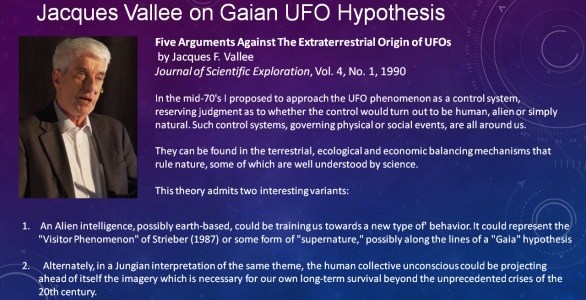
A prompt to pursue this matter further presented itself a while back. I came across the meme that serves as this post’s featured image when it was generously shared as a comment on the announcement of a recent Fireside Chat podcast. I’d read Vallée’s valuable and, in a sense, canonical paper mentioned in the meme a number of times, but had forgotten the addenda the meme cites. To venture a “doubling” of Vallée’s text (to paraphrase it): some Other (a terrestrial nonhuman intelligence, either another species (?) or the planet itself (Gaia), or the Jungian Collective Unconscious) by means of symbolically-charged interventions (variously ufological or more recognizably religious, e.g., visions of the Blessed Virgin Mary) is either “training us to a new kind of [unspecified] behaviour” or “projecting…the imagery which is necessary for our own long-term survival beyond the unprecedented crisis of the Twentieth century.”

Vallée’s Control System Hypothesis has recently come under what to me seems relatively cogent criticism. Nevertheless, any considerations as to the meaning or meaningfulness of the phenomenon is welcome here. That being said, Vallée’s Others who address us range from the speculative to the not-so-hard science fictional: Jung’s Collective Unconscious, Gaia, and Strieber’s visitors (or Tonnies’ Cryptoterrestrials?). Rather than probe these posited sources for the phenomenon’s communication or manipulation, thereby avoiding having to reflect on the hermeneutics let alone semiotics of their respective communications, I’d like to, all too quickly, consider Vallée’s variants from the perspective of their social effects.

Passport to Magonia (1969) presents a telling narrative. In Chapter Five, Vallée relates the story of Singing Eagle / Juan Diego, who in 1531 encountered what appeared to be a supernatural “young Mexican girl” who came to be known as Our Lady of Guadalupe. She is said to have performed both a miraculous healing and the no less miraculous creation of the holy relic of a tilma adorned with a representation of the Lady herself. Aside from “the magnificent symbolism” of the story Vallée hones in on is the fact that “[i]n the six years that followed the incident, over eight million Indians were baptized.” In Chapter Seven of The Invisible College Vallée presents the story of Joseph Smith, the founder of Mormonism, who, too, after (as Smith claims) a number of visionary experiences, is given a supernatural artifact, a chest of gold plates upon which, written in a strange language, is the text of what will become The Book of Mormon. This newest testament, among much else, states, “the Indians are the remnant of an Israelite tribe…” The social effects of both these (in Vallée’s view) symbolic interventions by some Other are well-known—and utterly unremarked in either book. The vision and attendant stories around the apparition of Our Lady of Guadalupe served to colonize the indigenous population, supplanting its spirituality with Roman Catholicism. In a similar fashion, Smith’s revelation effaces the unique difference of the First Nations of Turtle Island, ideologically smoothing the way for the “settlement” of the Utah Basin by the Mormons under the racist Brigham Young, dispossessing an estimated population of 20,000 Indigenous inhabitants.With respect to these two stories and their effects, Vallée’s Control System seems on the side of settler colonialism…

What of Vallée’s second variant, that in the UFO, at least, the Collective Unconscious is “projecting…the imagery which is necessary for our own long-term survival beyond the unprecedented crisis of the Twentieth century”? The imagery and its effects are ambivalent in this regard at best. Jung himself posits that the circularity of the flying saucer is an archetypical mandala, an image of wholeness and unity, that psychologically compensated for the anxiety brought about by a world split into two, murderously-adversarial camps. However, however dramatic, such a visionary intervention is hardly an answer to the mortal problem it emotionally assuages. Indeed, it fits almost perfectly one definition of ideology: an imaginary solution to a real problem. But more disturbingly are the ideological implications of the UFO mythology as it by and large came to be developed since 1947. The flying saucers were taken to be extraterrestrial spaceships possessed of a technology vastly in advance of our own. As such, the flying saucer functions, again, ideologically, reifying—making seem natural and universal—the reigning character of the so-called First World. If the growing menace of climate change and the ecological crisis are anything to go by, the imagery of the UFO mythology seems at odds with our long-term survival, entrenching a kind of techno-optimism that serves not so much to suggest a way beyond the urgent environmental crises of the moment as to stabilize the present social order enriching Silicon Valley and capitalists such as Elon Musk.

Admittedly, the interpretation of those interventions Vallée’s work presents is far from so cut-and-dried. The matter demands difficult work on presenting the mythology in its wild variety, and reflecting long and hard on the semiotics and hermeneutics proper and sufficient to this mythology considered as a communication or intervention from or by a nonhuman other. That being said, anyone undertaking this task needs muster an ideologically-sensitive vigilance to the ways the myth works and more importantly for whom regardless of its ultimate source.

Sightings: Sunday 5 December 2021: Why it matters how we think about intelligence and technology

Watching a certain kind of article turn up on my news feeds gets a little like binge-watching The Walking Dead or one of its numerous spinoffs: how many times can one watch another zombie shamble into view to be dispatched? Surely, some readers here might justifiably feel the same when the topic of the search for extraterrestrial intelligence (SETI) or the very notion of an advanced, extraterrestrial civilization is raised and cut down.

Until such time as I can win a forum for my arguments as public as that of a certain Harvard professor of astrophysics I can’t help but persist in the exercise, at least to keep my brain fibres warmed up and limber and my critical machete honed. On (in?) the other hand, it might be time to clarify what my reflections on this topic intend…

Two articles that caught my attention this week and that provide good opportunities in this regard are Joelle Renstrom’s from Wired “Looking for Alien Life? Seek Out Alien Tech” and another from FuturismScientists Say There May Be ‘Humans’ All Over the Universe“.

Nanosats

Renstrom’s article collates ideas already addressed here (that SETI might prove more fruitful were it to search for technosignatures rather than signals from extraterrestrial civilizations) along with remarks and reflections from Seth Shostak and Susan Schneider that speculate about the implications for SETI of an extraterrestrial species’ having become post-biological: “Maybe they experienced what many scientists believe is in store for Homo sapiens—the merging of biological beings and machines. Maybe they’ve become nanosats. Maybe they’re data or are part of a digital network that functions like a collective consciousness….”

The critical fissure, however, is right there in that first sentence: “Maybe they experienced what many scientists believe is in store for Homo sapiens”, and even more in the article’s subtitle: “Shifting the search for extraterrestrial life from biological to technological signs could break us out of anthropocentrism and help guide humanity’s future.” Ironically, the “paradigm shift” Renstrom outlines (“shifting the search for extraterrestrial life from biological to technological signs”) is itself anthropocentric, modeled as it is on the self-understanding of one, very recent and by-no-means global, culture of Homo Sapiens. The unconscious narcissism (anthropocentrism) is evident in the way Renstrom outlines his argument:

If we assume that biological life of some sort emerged on other planets, then we can also make some educated assumptions about how that life evolved—namely, that other species also invented technology, such as tools, transport vehicles, factories, and computers. Maybe those species invented artificial intelligence (AI) or virtual worlds. Advanced ET may have reached the “technological singularity,” the point at which AI exceeds human or biological intelligence. Maybe they experienced what many scientists believe is in store for Homo sapiens…

Despite the fact we have yet to determine how life arose on earth and have yet to detect it off-world (provided we could even recognize it when we encountered it…), one would have to be perversely stubborn not to be moved if not convinced by the sheer number of even earth-like planets so far discovered not to grant the assumption that life-as-we-know-it has emerged elsewhere in the cosmos. But note the leap Renstrom makes: “namely, that other species also invented technology, such as tools, transport vehicles, factories, and computers.” Aside from the far-from-unquestionable concept of technology at work here, that equates technology with (or reduces it to) tool-use, how is it an “educated assumption” that life gives rise to technology, especially that exemplified by factories and computers not to mention the complex society and culture that underwrite them? It is, from the available evidence, not only anthropocentric to imagine life develops technology (in a more educated sense), but chauvinistic, in as much as one (perhaps short-lived) inflection of human culture (namely that of the so-called “advanced” societies) is posited as a norm or model. The critical move occurs when a vector of “development” is projected from the present into an imagined future (“what many scientists believe is in store for Homo sapiens…”). If evolution, governed by the laws of nature, is so chance-ridden as to be unrepeatable, how much moreso the story of human culture? That is, “histories” that naturalize cultural patterns, e.g., the advent of technology and its “progress”, are arguably self-serving narratives of the cultures that compose them (i.e., depicting these cultures and their order as somehow necessary or destined to be) let alone of the ruling classes of those cultures whose privilege is premissed on precisely the pretense of their cultures’ being part of the inevitable, natural order of things.

“…human-like evolution has occurred in other locations around the universe”.

But what if those natural laws of physics, chemistry, and biology that govern evolution entailed that the morphology of life were more harmonious if not uniform, such that extraterrestrial, humanoid organisms were well within the realm of possibility? The theory of evolutionary convergence posits, roughly, that similar conditions can and will entail similar evolutionary developments. Mammals and cephalopods both possess eyes, though they do not share a common, eyed ancestor; likewise, birds, bats, insects and pterosaurs all developed flight independently. On these grounds, evolutionary biologists believe that “they can ‘say with reasonable confidence’ that human-like evolution has occurred in other locations around the universe“.

But some evolutionary biologists cannot resist the temptation to take the next step. An example is Ari Kershenbaum, the author of The Zoologist’s Guide to the Galaxy who conjectures:

Some planets are just going to have simple life on them. Many, maybe even most. But let’s assume that we found a planet with something we would call intelligent life. No one gets intelligence just because it would be a cool thing to have; their ancestors must have benefited from that intelligence. If they reached the stage where they can build a radio telescope, then they must have been through the stages where it was advantageous to be curious, where it was advantageous to communicate.

Kershenbaum’s speculation seems offered in a blithe spirit, but it’s precisely its light-heartedness that betrays the shallowness of the thinking at its foundations. First, there is the failure to reflect on “intelligence”; for Kershenbaum, it’s merely what “we would call intelligent life”, apparently an “intelligence” like our own, or, more precisely (and narrowly), like that ability to solve technical problems, instrumental reason, that leads to the construction of radio telescopes. It’s as if, e.g., David Stenhouse hadn’t published his Evolution of Intelligence in 1974 (!) that sought to articulate intelligence as “adaptively variable behavior,” a conception that recently has been applied to research into plant cognition. More gravely is the way Kershenbaum’s conjectures dovetail from evolution (natural selection) to culture, as if the latter were unproblematically reducible to and explainable by the former….

undermining a position…

For the most part, discussions around UFOs, Unidentified Aerial Phenomena (UAP), and SETI are divided between “believers” (UFOs are manifestations of the technology of extra-, ultra, or cryptoterrestrials, interdimensionals, or time travelers…) and “skeptics” (UFOs are a purely social or psychological phenomenon). Many who have encountered what I write here at Skunkworks slot it into the latter category, but, in doing so, really misread me.

At the end of the day, the questions posed by, e.g., The Galileo Project, are to be answered empirically. It may be that someday unequivocal evidence of nonhuman technology will be secured. However, at the same time, it is a legitimate question to ask just how such technology will be recognized as technology in the first place, just as it’s a legitimate question how we might recognize intelligent life (let alone life) if and when we encounter it offworld, let alone be recognized by that intelligent Other as its Other. What’s at stake in these questions is not a matter that can be resolved empirically, through observation or experiment; such questions address the concepts that are at the very basis of thinking about extraterrestrial life: What is technology, life, intelligence? As such it falls to philosophy to reflect on the assumptions and implications of the unconscious (assumed) content of these concepts as it is at work in the discourse about UAP and SETI.

The implications of how life, intelligence, technology, and related matters are thought are not merely “academic”, but reveal how the society and culture that deploy these concepts thinks about itself and other forms of life, human and otherwise. Speculations about advanced, extraterrestrial civilizations or the future of our own are more science-fictions than evidence-based predictions, and, as such, function as mirrors that show ourselves to ourselves but in an indirect, distorted or estranged, way; like dreams, they may be said to reveal the unconscious of how we think about the world, and, like the unconscious, such thinking is not, strictly, rational. Indeed, these ideas can be shown to function ideologically, making seem inevitable and natural (and thereby defending and entrenching) a way of life that in fact is contingent and that favours one species or social group. Perhaps in this light what I write above is now more understandable:

It is…not only anthropocentric to imagine life develops technology but chauvinistic, in as much as one (perhaps short-lived) inflection of human culture (namely that of the so-called “advanced” societies) is posited as a norm or model… If evolution, governed by the laws of nature, is so chance-ridden as to be unrepeatable, how much moreso the story of human culture? That is, “histories” that naturalize cultural patterns, e.g., the advent of technology and its “progress”, are arguably self-serving narratives of the cultures that compose them (i.e., depicting these cultures and their order as somehow necessary or destined to be) let alone of the ruling classes of those cultures whose privilege is premissed on precisely the pretense of their cultures’ being part of the inevitable, natural order of things.

Thus, speculations about extraterrestrial life, intelligence, and civilization are in fact inextricable from and revelatory of the most urgent crises facing life on earth, climate change, environmental degradation, extinction, and the role of humankind (or certain of its societies) in this crisis. How we imagine extraterrestrial life is how we think about life on earth, the other species with which we cohabit it, and the ways of living with them that Homo Sapiens has invented over the millennia.

Sighting: Sunday 25 April 2021: Justin E. Smith’s “Against Intelligence”

I don’t know how he does it. Philosopher Justin E. Smith, very much my contemporary, and even once a faculty member of my alma mater here in Montreal, not only functions as an academic in a French university, teaching, researching, and writing articles and books, but he maintains a Substack account where he posts juicy essays weekly. With regards just to that writing, he tells us

In case you’re curious, I spend roughly six hours writing each week’s Substack post, taking the better part of each Saturday to do it. This follows a week of reflection, of jotting notes about points I would like to include, and of course it follows many years of reading a million books, allowing them to go to work on me and colonize my inner life nearly totally.

At any rate, his latest offering harmonizes sweetly with our own obsessive critique of anthropocentric conceptions of intelligence. You can read his thoughts on the matter, here.

“…news affirming the existence of the Ufos is welcome…”

Of recent developments in the ufological sphere, two stand out to me: the release of a huge cache of CIA documents on UFOs and the prepublication promotion of astronomer Avi Loeb’s new book on Oumuamua and related matters. I was moved to address Loeb’s recent claims (you can hear him interviewed by Ryan Sprague here and hear him speak on the topic last spring here), but, since I have addressed the essential drift of Loeb’s speculations, however curtly, and I’m loathe to tax the patience of my readers or my own intellectual energies rehearsing the driving thesis here at Skunkworks yet again, I want to probe a not unrelated matter, an ingredient of the ufological mix since the earliest days of the modern era.

This post’s title is taken from a longer passage from Carl Jung’s ufological classic Flying Saucers: A Modern Myth of Things Seen in the Skies. In the preface, Jung observes:

In 1954, I wrote an article in the Swiss weekly, Die Weltwoche, in which I expressed myself in a sceptical way, though I spoke with due respect of the serious opinion of a relatively large number of air specialists who believe in the reality of Ufos…. In 1958 this interview was suddenly discovered by the world press and the ‘news’ spread like wildfire from the far West round the Earth to the far East, but—alas—in distorted form. I was quoted as a saucer-believer. I issued a statement to the United Press and gave a true version of my opinion, but this time the wire went dead:  nobody, so far as I know, took any notice of it, except one German newspaper.

The moral of this story is rather interesting. As the behaviour of the press is sort of a Gallup test with reference to world opinion, one must draw the conclusion that news affirming the existence of the Ufos is welcome, but that scepticism seems to be undesirable. To believe that Ufos are real suits the general opinion, whereas disbelief is to be discouraged.

Loeb’s recent experience harmonizes with Jung’s. Loeb recounts around the 22:00′ mark in his interview with Sprague that when he and his collaborator published their paper arguing for the possible artificial origins of Oumuamua, they experienced a “most surprising thing”, that, despite not having arranged for any publicity for their paper, it provoked “a huge, viral response from the media…”

There are, of course, myriad reasons for the media phenomenon experienced by both Jung and Loeb. An important aspect of their shared historical horizon, however, suggests the ready, public fascination for the idea of extraterrestrial, technologically-advanced civilizations springs from an urgent source. Jung, famously, however correctly, argued that flying saucers’ appearing in the skies just at the moment the Iron Curtain came down had to do precisely with the new, mortal threat of atomic war, that, from his psychological perspective, flying saucers were collective, visionary mandalas, whose circular shape made whole, at least to the visionary imagination, what humankind had split asunder in fact. Though we live now after the Cold War, the cognoscenti are quick to remind us the threat of nuclear war remains, a threat along with increasingly acute environmental degradation and global warming. There’s a grim synchronicity in Loeb’s book’s appearing hot on the heels of the publication of a widely-publicized paper in the journal Frontiers of Conservation Science titled “Underestimating the Challenges of Avoiding a Ghastly Future.”

Just how do such anxieties arguably underwrite the desire to discover other “advanced” societies? Jung was right, I think, in seeing the appearance of “flying saucers from outer space” as compensating for the worries of his day. Rather than affirming the phenomenon’s dovetailing into his theory of archetypes, however, I would argue that the very idea of UFOs’ being from an advanced, technological civilization, an interpretation put forward spontaneously by the popular, scientific, and military understanding, is a response to the growing concern over the future of the earth’s so-called advanced societies. Such evidence of extraterrestrial intelligence seems to confirm that technology (as we know it) and the kind of intelligence that gives rise to it are not the result of a local, accidental coupling of natural history (evolution) and cultural change (history proper) but that of more universal regularities, echoing, perhaps, however faintly, those cosmically universal natural laws that govern physics and chemistry. That such intelligence and civilizations spring up throughout the stars suggests, furthermore, they all share the same developmental vector, from the primitive to the advanced, and that, if such regularities hold, then just as our visitors are more advanced than we are, then we, too, like them, might likewise negotiate the mortal threats that face our own civilization, enabling us to reach their heights of knowledge and technological prowess. That we might learn just such lessons from extraterrestrial civilizations we might contact has been one explicit argument for the Search for Extraterrestrial Intelligence (SETI). The very idea, then, of a technologically-advanced civilization embodies a faith that technology can solve the problems technology produces, one whose creed might be said to reword Heidegger’s final, grave pronouncement that “Only a god can save us”, replacing ‘god’ with ‘technology’. What’s as remarkable as it is unremarked is how this tenet of faith is shared equally by relatively mainstream figures, such as Loeb, Diana W. Pasulka, and SETI researchers, and more outré folk, such as Jason Reza Jorjani, Steven Greer, and Raël/Claude Vorilhon.

Conversely, discovering the traces of extraterrestrial civilizations that have failed to meet the challenges ours faces could prove no less significant, as Loeb himself has proposed: “…we may learn something in the process. We may learn to better behave with each other, not to initiate a nuclear war, or to monitor our planet and make sure that it’s habitable for as long as we can make it habitable.” Aside from the weakness of this speculation, the idea of such failed civilizations is based on the same assumptions as the idea of successful ones, thereby revealing their being ideological (positing a social order as natural). Imagine all we ever were to discover were extraterrestrial societies that had succumbed to war, environmental destruction, or some other form of self-annihilation. Technological development would then seem to entail its own end. Indeed, that this might very well be the case has been proposed as one explanation for “The Great Silence”, why we have yet to encounter other, extraterrestrial civilizations. We might still cling to the hope that humankind might prove the exception, that it might learn from all these other failures (à la Loeb), or we might adopt a pessimistic fatalism, doing our best despite being convinced we are ultimately doomed. In either case, advanced technological society modelled after one form of society on earth is projected as unalterable, inescapable, and universal. The pessimistic conception of technological advancement, a blinkered reification of a moment in human cultural history, arguably expresses from a technoscientific angle the sentiment of Fredric Jameson’s famous observation: “It’s easier to imagine the end of the world than the end of capitalism.”

The consequences of this technofetishism are manifold. However much technology is not essentially bound up with capitalism, it is the case that technology as we know it developed under capitalism as a means to increase profit by eliminating labour, a development that has only picked up steam as it were with the drive to automation in our present moment. When this march of progress is imagined to be as natural as the precession of the equinoxes, it is uncoupled from the social (class) relations that determine it, reifying the status quo. In this way, popular or uncritical speculations about technologically advanced extraterrestrial societies are arguably politically reactionary. But they are culturally, spiritually impoverishing, too. This failure, willed or otherwise, to grasp our own worldview as contingent legitimates if not drives the liquidation of human cultural difference and of the natural world. Identifying intelligence with one kind of human intelligence, instrumental reason, and narrowing cultural change to technological development within the lines drawn by the self-regarding histories of the “advanced” societies, we murderously reduce the wild variety of intelligence (human and nonhuman alike) and past, present, and, most importantly, potentially future societies to a dreary “eternal recurrence of the same,” a world not unlike those “imagined” by the Star Trek and Star Wars franchises wherein the supposed unimaginable variety of life in the cosmos is reduced to that of a foodcourt.

The Promethean Lure

As Kevin Randle and others have remarked, recent U.S. Navy pilots’ encounters with UFOs are nothing we haven’t seen before. Since the Second World War, air force pilots have observed, pursued, and even fired on what appear to be aeroforms capable of instantaneously accelerating to hypersonic speeds, making impossible forty-five degree angle turns, and stopping, all performance features that outstrip the aircraft of the day. And then just as now it was speculated whether or not these aeroforms were domestic or foreign (not necessarily extraterrestrial) experimental aircraft. But beneath these analogues, a deeper pattern is discernible.

It’s an old chestnut of the Ancient Astronaut / Alien line of thinking that the culture heroes of world mythology, those deities that gifted humankind with fire (Prometheus) or writing (Thoth) for example, were in truth extraterrestrials leading homo sapiens down the path of technological development. A not unrelated story concerns the back-engineering of extraterrestrial technology recovered either from crashed saucers or intact ones secured through agreements with their pilots’ civilizations. On our own or under the guidance of ET advisors, the study of ET-tech has given us the transistor and fibre-optics (as Philip J. Corso contends in his 1998 book The Day After Roswell) and promises free-energy technology, and, with it, the advanced aeroform of the flying saucer, which, some believe, the American military or some break-away civilization has already developed.

A more circumspect version of such reflections was recently expressed by Dr Garry Nolan, who, thinking out loud, imagines the possibility that metamaterials left as physical traces of UFO sightings may be a gift, a kind of clue, so that their unusual characteristics might prompt us not only to develop ways to reproduce them but to imagine uses for them. The 2018 film UFO presents a similar scenario, where the mathematics needed to understand the ETs’ communications becomes increasingly complex, leading researchers along a line of mathematical and physical speculation toward the understanding of nature that enabled the ETs to overcome precisely the same threats to the survival of civilization we now face. In the same way such metamaterials function as hints to lines of inquiry, the aerial antics of the UFO become (in the words of Tyler Rogoway) a kind of “Holy Grail of aerospace engineering.”

Extraterrestrial technology becomes, then, either retro- or prospectively, a projection of next generation human technology. On the one (sociopolitical) hand, this projection is an expression of the ideology of the so-called advanced societies:  one haphazard inflection of human civilization imagines itself to be in line with a pattern of technological development characteristic of intelligent life universally, the kind of thinking that underwrites Maitreya Raël’s claim that his extraterrestrial teachers, the Elohim, are “25,000 years ahead” of us. On the other (more mythological) hand, the extraterrestrial symbolizes the alpha and omega, the arche and telos, of technological humanity: ET either gifts us technology or teaches us by means of teasing puzzles; more radically, in other speculations, ET interbreeds with us or biotechnologically “makes us in His own image” to raise us to its own level.

The Extra-Terrestrial, then, can be understood as an eminently mythological figure, “mythological” in the sense of making universal and necessary an historical contingency (reifying this moment of technological civilization) and, in a more compelling sense, an emblem of that reification, an idol embodying “the essence of technology”, simultaneously a transformation of the Promethean culture hero and a radical revision that remakes the mythic past in the image of now or what we thereby imagine tomorrow to be.

originsofman

A Lone Voice in the Wilderness No More!

It’s been a morning rich in synchronicities.

I was working on a forthcoming review of D W Pasulka’s American Cosmic: UFOs, Religion, and Technology, wherein I had bookmarked the section concerning synchronicities and religion, as I had planned to integrate some of her reflections in my previous post. I had already read (synchronicitiously!) during my morning coffee-and-surf session an article about synchronicities and “information-ontology” (an article that calls for a response in itself!) that remarked Pasulka’s reflections, and my Facebook feed served up an article critical of the upcoming Peterson / Zizek debate, which, in turn, linked me to How Capitalism Can Explain Why an Encounter with Aliens Is Highly Unlikely by Charles Tonderai Mudede.

Anyone familiar with Skunkworks will know a long-standing and oft-repeated thesis of mine is that the thought of technologically-advanced extraterrestrial civilizations is merely an anthropocentric projection of one civilization on earth whose appearance has more to do with a tenuous thread of accidents than the triumphal march of a necessary (let alone a universal) Progress. And though I’ve been making this argument in various media since the mid-Nineties, never had I heard an echo (never mind glimpsed an affirmative nod) until I read Mudede’s article.

Mudede’s argument is similar to mine:  technoscientic civilization as is familiar to those of us living in the so-called “advanced” societies is the result not of some transhistorical cultural necessity but is the result of cultural and even climactic accidents, e.g., the advent of capitalism in the Sixteenth century or that of the Holocene whose temperate climate allowed for the development of agriculture and settled society. Mudede’s account has the added virtue of weaving Capitalism into that history of contingencies that lead to the present precarious moment of modernity. Interested parties will read (if they have not already read) his article, linked above.

My most serious disagreement with Mudede is that the question “Why should aliens be technologically advanced?” “has never been properly considered”!

Skunkworks: First Orbit

Skunkworks has been at it a year now.

The initial impulse behind this blog was to keep me honest. I’ve been at work  (mainly on various drawing boards) on a long poem, whose working title is Orthoteny, that aspires to do for the UFO mythology what Ovid’s Metamorphoses did for classical mythology. And though I’ve test-flown various prototypes—poems such as “Flying Saucers”, “Will o’ the Wisp”, “Q’ Reveals the Real Secret Space Program”, and “Magonian Latitudes” and the sequence On the Phantom Air Ship Mystery—the work on Orthoteny had stalled, and when UFO Conjectures publicized my chapbook on the Phantom Airship Mystery, I imagined that developing the work in public would be a way of holding myself accountable.

One way of getting toward the poem is to imagine the countless stories around the UFO as constituting a “modern myth of things seen in the sky” and to read it as such. Many of the posts at Skunkworks have been just that, interpretations of various aspects of the myth as it has been developed since 1947. Complementing this hermeneutic labour has been reading classics of the canon to grasp their respective contributions to the myth and the poetic resonances within and between them.

But flying a parallel path to my poetic endeavors has been a cultural critical approach to the phenomenon. Already in 2000 with my collaborator Susan Palmer I published a study of the Raelian Movement International “Presumed Immanent” that argued that the UFO mythology was intimately bound up with and revelatory of the technoscientific spirit of modernity; that, like a collective dream, it expressed the anxieties and aspirations of the “advanced” societies and, at the same time, provided leverage for an ideological critique of that spirit; that, the UFO, like a funhouse mirror, reflected the truth of modernity back to it, but in a distorted form. Many of the posts here this past year have explored this thesis from various angles and in greater detail.

And despite being avowedly concerned exclusively with the meaning rather than the being, nature or truth of the phenomenon, with what I have called “the UFO Effect”, as any assiduous student of deconstruction will know, such distinctions, by their very separating two fields, unify as much as divide. For this reason, I have, at times, touched on matters more properly ufological, despite always attempting to steer back into the phenomenological lane.

On the immediate horizon is an omnibus review of three books that seek to bring ufology into the Twenty-first century, reviews of two books by religious studies scholars that touch on two different aspects of the phenomenon (one of which is D.W. Pasulka’s American Cosmic), and further entries in the series “Jung’s Ufological Bookshelf”. On the drawing board are more than a dozen other posts-in-the-working on the weaponization of the myth, various aspects of its sociopolitical implications, as well as some others on the peculiar logic of ufology. I hope too to address some English-language poetry about UFOs as a way of mapping what in fact has been accomplished in this direction. And of course given the nature of the phenomenon and the mill of rumour and speculation it drives I’ll be always on the lookout for synchronicitious inspirations for developments unimagined by my present philosophy to address.

To this first year’s readers: thank you for your interest and your occasional interventions. And special gratitude is extended on this occasion to Rich Reynolds for outing my ufological predilections a year ago.

Back to the Skunkworks!

The Extraterrestrial Hypothesis: Symptom or Pathology?

David Clarke in his How UFOs Conquered the World:  The History of a Modern Myth refers to the “UFO Syndrome”, “the entire human phenomenon of seeing UFOs, believing in them and communicating ideas about what they might be” (12), what I have called “ufophilia” (and am tempted to term, sometimes, “ufomania”). Even before George Adamski published his story of meeting a man from Venus, a latter-day Lord of the Flame, in 1953, and even before Project Sign’s famous Estimate of the Situation, desperate to explain the recalcitrant mystery of high-performing aeroforms intruding on American airspace, the public imagination had already ventured that Flying Saucers might be spaceships from another planet populated by Extraterrestrial Intelligences (ETIs), an explanation for UFO and close encounter reports that later came to be called the Extraterrestrial Hypothesis (ETH). Though the notion of ETI was already in the air, the most notorious example being Orson Welles’ 1938 The War of the Worlds radio broadcast, the idea as such runs much deeper, and, in its ufological guise as an element of the UFO Syndrome, possesses graver implications.

flying_saucers_are_real_cover_keyhoeAn important ufological popularizer of the ETH is Donald Keyhoe. In his first book, The Flying Saucers are Real (1950), he wrestles with the question of the origin of the flying discs. Having been pushed to the ETH by a process of elimination, he tries “to imagine how they [ETIs] might look” (136). Having read what he could of what we today call exobiology, he understands that there are “all kinds of possibilities.” Then, he makes a telling confession:

It was possible, I knew, that the spacemen might look grotesque to us. But I clung to the stubborn feeling that they would resemble man. That came, of course, from an inborn feeling of man’s superiority over all living things. It carried over into the feeling that any thinking, intelligent being, whether on Mars or Wolf 359’s planets, should have evolved in the same form.

Keyhoe, here, is either ignorant (which he certainly seems to be concerning evolution) or disingenuous. The “stubborn feeling” that the ET pilots of the flying saucers “would resemble man” is hardly “inborn”. A longstanding thesis among thinkers concerned with the ecological crisis is that the thoughtless abuse of the natural world by, especially, Western industrial society is aided and abetted by its Judaeo-Christian heritage. Famously, in Genesis, man is made in God’s own image (I.26) and given dominion over creation (I.27) (an idea mocked with a theosophical flavour in Yeats’ early poem “The Indian Upon God”!). This (what a philosopher might term ontotheological) anthropocentrism is the source of Keyhoe’s feeling and more importantly it serves to reinforce capitalism’s assumption that anything and everything on (and off!) the earth is a potential resource to be exploited for profit.

There’s a strikingly illustrative scene in the film Clearcut (1991). The manager of a logging company is abducted by an ambivalent character, who is either a Native militant or, more interestingly, a nature spirit come to revenge the ruthless clearcutting of the forest. The manager is tortured in ways that mirror the loggers’ treatment of trees and, at one point, the militant holds the manager over a cliff overlooking a breathtaking natural vista, asking him, “What do you see? What do you see?” to which the manager answers, desperately mystified by the question, “Nothing!”. The fateful confluence of the Judaeo-Christian ontotheological anthropocentrism and the rapaciousness of capitalism blind humankind to both nonhuman intelligence and the innate value of nonhuman life. I have argued at length elsewhere that any unprejudiced reflection on and consequent non-anthropocentric conception of intelligence radically dethrones and decenters whatever human intelligence might believe itself to be. It might appear ironic, then, that The Anomalist can share links to UFOs and Contactees in the same space as others to new discoveries in the realm of plant and animal intelligence.

orthon
Orthon (l) and George Adamski (r)

Another irony is discernible in the concerns expressed by both the Space Brothers and other ETs. If the ETH is underwritten by a religiously-inspired anthropocentrism that in turn supports the economic system whose activity has in a matter of hardly two centuries resulted in the latest mass extinction, then the striking anthropomorphism of ETs might be said to be an imagination at the very least consistent with this catastrophically destructive social order. However, as is well-known, the Space Brothers of the Contactees landed to warn us of the dangers of atomic weapons, while abductees or Experiencers report being shown distressing images of nuclear war and environmental destruction; there has been from the start an environmental/ecological dimension to ET encounters, consistent with the view that the reports are inspired by the anxieties engendered by technoscientific development in so-called advanced societies.

As compelling is the case that the ETH is a symptom of a deeper, mortal malaise in Western society, the matter is, of course, more complex. In his Pulitzer Prize winning book of poetry Turtle Island (1974), Gary Snyder writes (47):

…Japan quibbles for words on

what kinds of whales they can kill?


A once-great Buddhist nation

dribbles methyl mercury

like gonorrhea

in the sea.

Here, Snyder reminds us that the relation between religion and economy is a complicated question; however much the Judaeo-Christian idolization of the “human form divine” is harmonious with the profit-driven and otherwise mindless exploitation of the natural world, religious views that, in this case, are overtly concerned with non-human life exist, however uneasily, alongside such insensitive destructiveness. There is, moreover, an analogous paradox in certain aboriginal worldviews, which, on the one hand, speak of “the flying people” (birds) and “the crawling people” (snakes) and that have been the inspiration for radical ecological initiatives, such as the push to give rivers and ecosystems rights under the law, while on the other, their understanding of the UFO phenomenon invokes stories of Star People, who, at first glance, seem to be as humanoid as any Venusian. These paradoxes pose new questions and open curious avenues of investigation regarding the globality of the UFO phenomenon and the equally global extent of the society whose technoscientific character the ETH might be said to reflect and affirm.

The theme, as poet Walt Whitman would say, has vista. The belief in ETI is itself paradoxical in character:  it is both widely-held (by more than half the population in the US, UK, and Germany) but thought unserious, fit only to inspire light entertainments or crackpot obsessions. Yet, as the psychoanalytic study of the trivial shows, the margin reflects the deepest concerns of the centre; indeed, that these concerns are exiled as flaky is precisely a sign of their gravity. The ETH symptomatically expresses profound aspects of human self-regard that have equally grave consequences for social behaviour.