On a Certain Gnostic Tendency in UAP Studies

Friday 3 October 2025 the Society for UAP Studies presented a colloquium with Professor Jörg Matthias Determann on UAP in the Muslim world. Determann’s presentation (about which I may have more to say when the Society shares it on its YouTube channel) was wide-ranging and often fine-grained. As anyone moderately informed would have guessed, Determann remarked how the UFO phenomenon has been interpreted in relation to the Arabic figure of the Jinn. Just as Jacques Vallée and others attempt to draw parallels between modern UAP sighting and entity encounter reports and what Evans-Wentz famously called “the fairy faith,” so commentators in the Arab world understand the UAP phenomenon as a modern-day encounter with the Jinn. But what concerns me here is a not-unrelated exchange that occurred in the post-presentation conversation (and continued between myself and another participant via email). The thesis proposed (after some helpful added articulation by moderator Mike Cifone) was that, in light of the modern “Phenomenon,” religion is revealed to be (however obscurely) the story of human interaction with occult (i.e. mysterious) Non-Human Intelligences. In what follows, I sketch out (or essay, drawing on the root of the word) the profile and ground of this notion of religion…

This view is generally attributed to Jacques Vallée’s Passport to Magonia (1969), which modifies if not develops the Ancient Astronaut literature that explodes at the same time Vallée’s book appears (however much the Ancient Astronaut “theory” goes back to the first appearance of Flying Saucers). For writers such as (most famously) Erich von Däniken, the gods of the premodern world were all primitively-apprehended extraterrestrial visitors. Vallée’s thesis runs deeper, in a sense, seeing all these (gods, angels, daimons, fairies, extraterrestrials…) as different appearances of one species of crypto-entity, a position later modified to propose that these same entities may themselves be only illusory products of an even more cryptic agent, merely elements of a Control System. (One might wonder how much of Vallée’s thinking here springs from the French anticlericalism he was raised in…). However much Passport consistently fails to make its case (as a vigilant close-reading reveals), its main contention has proven to be and remains influential.

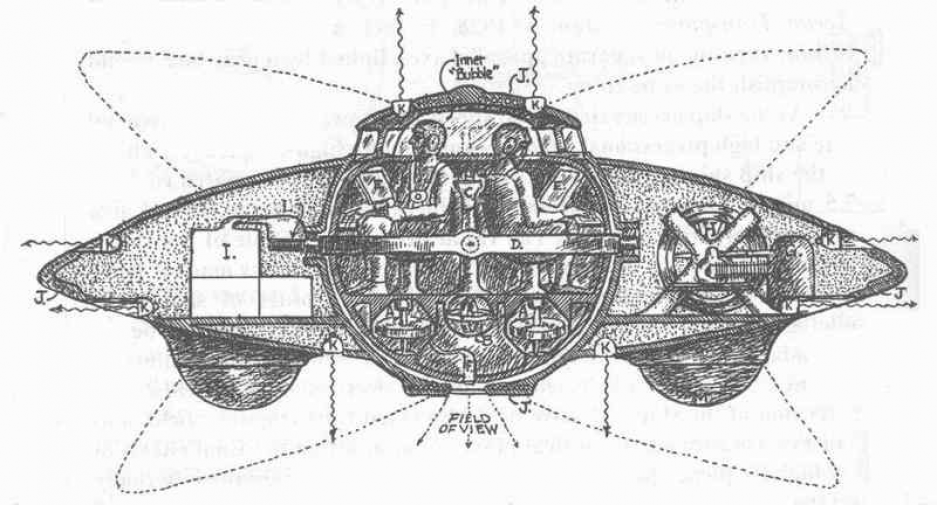
I find this view of religion to be unsupportably literalist and reductive, and I am earnestly puzzled to see scholars of religion not only entertaining it but seeming to take it seriously. The locus classicus of this kind of thinking is the Vision of Ezekiel, which, most famously since Erich von Däniken (and, most creatively, Josef F. Blumrich!), has been claimed by some to be a premodern UFO sighting report, Ezekiel describing a(n) UAP and his interactions with the intelligence behind it according to the concepts and language at his disposal. Von Däniken sums up nicely the literalist reading of the opening of the Book of Ezekiel. He writes in Chariots of the Gods concerning Ezekiel’s likening “the din made by the wings and wheels to a ‘great rushing.’ Surely this suggest that this is an eyewitness report?” (39). There is much, however, that complicates matters. First, however much the Book of Ezekiel is the first written prophecy in the Hebrew Bible, its authorship is uncertain; the book attributed to “Ezekiel” is quite possibly the work of several hands. Then, the vision itself, for all its rococo detail is famously obscure in its complexity, as the many and varied attempts to concretely depict it attest, which suggests the description is perhaps more or other than a flabbergasted one of an alien object. Even if we take the vision to be an “eyewitness report,” the witness himself is not very reliable. As Michael Lieb writes in his invaluable Children of Ezekiel

Scholars marvel at Ezekiel’s experience of bodily paralysis and periods of trances (Ezek. 3:15, 4:4-6); his accounts of levitation (Ezek. 3:12-14, 8:3, 11:1); his cutting, weighing, dividing, burning, binding, and scattering his hair (Ezek. 5:1-4); his sudden clapping of the hands and stamping of the feet (Ezek. 6:11); and his belief in his power to destroy with speech (Ezek. 11:13). (14)

Jacques Vallée would likely point to Ezekiel’s paralysis, trances, and levitation as consistent with the kinds of paranormal after-effects often associated with close encounters. But Ezekiel’s other behaviours (above) are part of a more concerning pattern (if we insist on taking the book at face value):

He is told to shut himself within his house. He is bound with cords, and his tongue cleaves to the roof of his mouth so that he is dumb (Ezek. 3:24-26). He is given to prepare his food with dung (Ezek. 4:15) and to accuse his enemies of worshiping dung balls (the term dung ball is found more often in Ezekiel’s prophecy than anywhere else in the Hebrew Bible). (14-15)

Unsurprisingly, “[s]uch circumstances have prompted some scholars to see in Ezekiel evidence of an especially pronounced pathology.” Today, such an “eyewitness” would not be believed, even by believers in the Phenomenon.

However, such troubles are somewhat clarified when we understand how illegitimate it is to spontaneously take Ezekiel’s vision to be an “eyewitness” report by understanding that an “eyewitness report” is a modern genre of discourse and that of the book of Ezekiel another. As I have been at great pains here at the Skunkworks, it is an error to project an historically, culturally, and socially local communicative convention (here, the “eyewitness report”) onto temporally and culturally distant texts and artefacts. Simply, one need first situate the text in the context of the discursive practices of its day; even if it should, as something radically new, break with these conventions, that departure can only come into view in light of what the text leaves behind. Logically, Ezekiel’s vision is either exoteric (visible to Ezekiel and anyone else within visual range of the phenomenon), esoteric (visible only to Ezekiel, consistent with the vision’s being a variety of religious experience or an hallucination), or, perhaps, a powerfully original work of religious poetry with prophetic import and intent. That is, I propose, the “truth” of the Book of Ezekiel is not in its “facts” but in the consequences of its revelations for the spiritual life of its intended readership, which is to read the book rhetorically (which is unavoidable, even for the “literal”—whatever that might finally mean—reading). It is my contention that precisely such philologico-rhetorical reflection is demanded of all culturally and temporally distant “accounts of encounters with Non-Human Intelligences” and that such accounts cannot be admitted as warranted evidence until that due diligence has been undertaken. Why otherwise learned scholars tend to such literalism reflexively is another, however interesting, matter….

The revision of religion I term gnostic (or, perhaps, neognostic) is founded on the testimony of Experiencers coeval or historical. If we take our concept of gnosis from Hans Jonas’ The Gnostic Religion: the Message of the Alien God and the Beginnings of Christianity (1958), gnosis is an immediate acquaintance with the divine (unlike that knowledge bestowed by faith or theological speculation). Not only is “[t]he ultimate ‘object’ of gnosis…God,” writes Jonas (35), but “its event in the soul transforms the knower himself [sic] by making him a partaker in the divine existence.” Gnosis, then, is a radically-transformative experience of the divine. Surely, the Experiencer (if we take their words prima facie) has experienced a Non-Human Intelligence and been changed by the encounter. In this sense, the tendency I explore here rests on a variety of gnosis. Insofar as this neognosticism rests on testimony distant in time and culture, that foundation is questionable; insofar as it appeals to contemporary, “Western” reports, its founding revelations are a variety of religious experience whose veracity is (to the say the least) contested, not merely on dismissively sceptical grounds. In either case, those who entertain this neognosticism, the conjecture that the history of religion is the history of encounters with Non-Human Intelligences, cannot claim to know this version of religion to be true, they can appeal only to the gnosis of those they designate as Experiencers.

If, however, we “bracket” the question of the (questionable) truth of the speculative revelation at the heart of this neognosticism, certain, curious implications come into view. In nuce, like the appearance of Flying Saucers within the horizon of the Cold War, neognosticism “stands in compensatory antithesis” (as Jung said of the Flying Saucers) not to the threat of atomic warfare (as after the Cold War) but the existential threat of global warming and ecological degradation. This neognosticism then appears reactionary, fleeing the chaos of the present and a threatening future into a premodern, paranoid (however “enchanted) “past;” positing a certainty (gnosis) in the face of anxious uncertainty; and taking flight from time (history) into an a-historicity, a timelessness if not an eternity.

The thesis that modernity is “disenchanted” does not go uncontested. What is less likely to be resisted is the relative material security of life in the so-called developed world. Vaccines and antibiotics defend us from viruses and bacteria that in the premodern world were unknown and often mortal, for example. Urbanization, agriculture, transportation, and communication domesticate the countryside at large, so that the experience of getting lost in a selva oscura differs dramatically from that in Dante’s day. Examples can be multiplied. This is not to say modernity is absolutely secure, the being of Dasein is Sorge, as Heidegger reminds us. But the objects or character of that worry differ markedly from that of premodernity. Relative to today, one might posit that the premodern, “demon-haunted,” enchanted world is paranoid, peopled by unseen, inscrutable agents responsible for all that out of human control (“Nature”). In such a world, one might see religion, its myths and practices, as a means to deal with an uncontrolled, uncontrollable, and, by extension, threatening nature. I do not mean to reduce religion to a kind of bartering (however much the etymology of ‘bless’ suggests at times it is), but rather to suggest one function of religion is to orient the human soul or society in the world-at-large. The present, post-Holocene moment, however, is devastatingly ironic, for it is precisely our harnessing that knowledge and know-how that exorcised those premodern threats that has unleashed a nature now even more menacing and uncontrollable than the one we so temporarily seemed to have tamed. The modern(ized) mind, however, does not fall back into the premodern paranoia (however much it succumbs to its own, “postmodern” versions in the face of occult forces, social and natural, malevolent or indifferent). The neognostic, however, does, believing in an unseen world peopled by Non-Human Intelligences of uncertain intent let alone morality. Jacques Vallée’s Control System Hypothesis is a case in point, as likely to be found in a novel by Thomas Pynchon or William Burroughs (where one does read of “Control”) as arising from the extensive files of a ufologist. Indeed, the neognostic seems all-too-Gnostic, as the classical versions expressed a belief in a malevolent cosmos controlled by daimonic Archons, a paranoid parody of the Babylonian astrological religions. In the face of the anxieties of a social world developed beyond comprehension, whose very natural roots are withering in the heat of the furnace of its own development, the neognostic fears not the real-world, social and natural threats but an Other world whose agents however inscrutable are at least palpable in their ephemeral, however sometimes terrifying, appearings.

Ours is surely an uncertain time, from the furor over “Postmodernism,” to post-truth, “fake news,” and deep fakes, to the disturbingly chaotic climate regime to unfold in the coming centuries, like none Homo Sapiens—indeed the earth—has experienced. In this situation, wherein nothing seems knowable, the Experiencer possesses gnosis, an apodictic certainty. The Experiencer’s gnosis, however, is radically other, in a way less, than their classical forebears’, for whom the experience of the identity of the soul with the essence of the Alien God was at the same time knowledge of “everything that belongs to the divine realm of beings, namely, the order and history of the upper worlds, and what is to issue from it, namely…salvation” (34). The Experiencer, rather, paradoxically is given access via the gnosis of the encounter to a mystery. What is their nature? What do they want? Are they benevolent, malevolent, or indifferent? Are they terrestrial, extraterrestrial, transtemporal, or interdimensional? This mystery, however, is grounded in a certainty, at the very least a self-assuredness, such as that on display at the most recent Rice University Archives of the Impossible conference, when an Experiencer shouted out, “We know there is another world!” Amid the present, real, threatening uncertainty, the gnosis of the Experiencer serves as a First Principle, an Archimedean point, or at least an anchor of real, unassailable knowledge borne of direct, first-person experience (the historical foundations of which certainty, again, are laid down in the inheritance of an historically, culturally local tradition…).

Just as the neognostic flees the disenchanted, out-of-control world for a premodern, enchanted-if-demon-haunted world and exchanges the deeply unnerving uncertainty of the present and foreseeable future for an unassailable if paradoxical certainty, they take refuge from history in an ahistorical simulacrum of eternity. At least since Kant and Heidegger (the first for whom time, with space, is the form of intuition and inner sense; the latter for whom Dasein is not only temporal but historical) the temporal situatedness of human understanding is a given, i.e., one whose concrete determinations are unfathomable, never to be exhaustively brought to the light of consciousness. The consequences of this temporal finitude play themselves out in our brief study of the Vision of Ezekiel. For the neognostic, temporality is assumed to be transcended in the unquestioned (unreflected) obviousness that, as the opening of the History Channel’s Ancient Aliens reminds us, “We have never been alone,” or, in the refrain of the neognostic, “The Phenomenon has always been with us.” On the one hand, perhaps, it is merely a common-sense, naive realism that underwrites this temporal blindness, a belief in human nature, as it were. More profoundly, this certitude in a “perennial philosophy” gestures toward that “other world,” which, if not exactly outside of space and time, lies outside (if however much aside) our own. This neognostic atemporality is, of course, from the point-of-view informed by philosophical hermeneutics (at least), a naive projection and imposition of the present horizon on those of the past, a kind of unconscious epistemic imperialism or colonialism, which blithely liquidates cultural difference in the assumed naturalness of its own universality. In the post-Holocene, unforeseeable but undeniable change aggravates a sense of temporariness to the point of imaginably foreclosing history itself in the misanthropic, schadenfreudlich fantasy of Near-Term Human Extinction. Little wonder the neognostic flees in fancy to some unchanging order amid a world civilization on the wane (just as the Gnostics themselves did).

As any reactionary tendency, neognosticism is unwittingly ideological, affirming the status quo at the hidden centre of society in spite of the marginality of its explicit beliefs. From a disenchanted, disillusioned present threatened by known, terrible forces the neognostic flees to an enchanted but paranoid world of occult agents. Over an abyssal uncertainty, they cling to a thread of gnosis, itself anchored, paradoxically, to mystery. In the face of an epochal shift, a timeless order is affirmed. But these understandable compensations twist around a root grounded in an affirmation of the very conditions that give rise to the disorder that motivates them, however unconsciously, and that is the very character of the Non-Human Intelligence it posits. As I have laid out repeatedly here at the Skunkworks, these “Non-Human Intelligences” are human-all-too human, whether with regards to their anthropomorphism or the fact of mutual recognition. What, further, remains unremarked and unexamined is the use of ‘intelligence’ to designate awareness, consciousness, or, more properly, soul. For what seems at work here is an Abrahamic/Gnostic assumption that centres human awareness as paradigmatic, essentially of the same order if not magnitude as that of God and those other created beings, celestial or infernal, between Man and God, Man being made, thus, in God’s own image. What is decentred here, pushed not only to the margins but out of sight, is the very real “nonhuman intelligence” of all the other nonhuman forms of life presently suffering a mass extinction, a Molochian sacrifice of biodiversity arguably underwritten by a certain strain of just this Abrahamic anthropocentrism that places the human being at the sole centre of creation as master over all other forms of life on earth. In this way, the neognosticism I sketch here colludes with the values that determine the social behaviour that results in the climate and ecological crises that determine its own advent. Ironically, it’s just the discourse that submits this neognosticism to critique of this kind that may rightfully call itself shamanic, if, by the shaman, we name the one who mediates between the human and truly nonhuman world.

A note on the Hyperobject

This reflection does not intend to supplement or contradict the reviews of Unidentified Flying Hyperobject, for example, those of Michael Zimmerman or Travis Dumsday. Rather, it is occasioned by my reading through Madden’s Unidentified Flying Hyperobject in preparation for a session of the SUAPS monthly reading circle. In the course of my preparation, one aspect of Madden’s book that caught my attention is the way he puts to work Timothy Morton’s notion of the hyperobject.

My approach is critical—not fault-finding but probing the conditions for and implications of a notion, position, or practice. For example, conversations around “Artificial Intelligence” (“AI”) tend to be either practical or theoretical. Developers and engineers concern themselves with building, training, and “improving” “AI,” while others reflect on its implications for society or our conceptions of intelligence or consciousness. A critical perspective, however, focusses on the historical, social, and material conditions that determine the phenomenon. In the case of “AI,” one can point to Matteo Pasquinelli’s book The Eye of the Master:  A Social History of Artificial Intelligence or Muldoon’s and Wu’s study “Artificial Intelligence in the Colonial Matrix of Power,” which “theorises how a system of coloniality underpins the structuring logic of artificial intelligence (AI) systems,” bringing into view the “regimes of global labour exploitation and knowledge extraction that are rendered invisible through discourses of the purported universality and objectivity of AI.” Note how practical and theoretical considerations are included in critique, however much their apparent spontaneous objectivity is stripped away in the process.

Madden’s argument strikes me as a bricolage. He borrows freely from Plato, Aristotle, Heidegger, Wilfred Sellars, Jakob von Uexküll, Nietzsche, and others what he needs to jerry-rig a working, speculative framework of his own. This method of construction tends to overlook the implications of its component parts, risking an incoherence (into which it seems to me Madden’s speculations fall, at least in so far as they are presented). But apart from this problem, the notion of the hyperobject possesses some intriguing implications, especially in the way Madden develops it.

With regard to the hyperobject, Madden, following object oriented ontologist Graham Harman, first argues that “If a thing has effects novel with respect to its components (including control of those components) and an identity that survives their replacement, and it controls its parts, then that thing is real—without qualifications” (70). Madden employs Harman’s example of a particular Pizza Hut franchise:  “The entire staff, management, and equipment can be changed over while we still have the same Pizza Hut restaurant” (71). Madden infers that, therefore, “we can make a case that a particular Pizza Hut has a life of its own…things we originally do or set in motion, e.g., a Pizza Hut franchise can actually go their own way independently of us, and even while controlling us.”

The substantial agency of such an object is then transferred to a plane of transcendently large complexity. Madden cites Morton’s description of the hyperobject, its being

…things that are massively distributed in time and space relative to humans. A hyperobject could be a black hole. A hyperobject could be the Lago Agrio oil field in Ecuador, or the Florida Everglades. A hyperobject could be the biosphere, or the Solar System. A hyperobject could be the sum total of all the nuclear materials on Earth… A hyperobject could be the very long lasting product of human manufacture such as Styrofoam or plastic bags, or the sum of all the whirring machines of capitalism. Hyperobjects, then, are “hyper” in relation to some other entity, whether they are directly manufactured by humans or not. (72).

A close, rhetorically-vigilant reading of Madden’s development of Morton’s notion reveals a telling tropology. Madden begins with Harman’s example of the Pizza Hut franchise as, as it were, a synecdochic “part” of the Pizza Hut Corporation hyperobject. Moving on from the passage from Morton, above, Madden then writes of the environment, the economy, and the war in Ukraine as hyperobjects (73). Later, this list becomes “economies, wars, nations, [and] corporations” (74), a passage preceding Madden’s writing of the UFO hyperobject that “maybe…now it’s on the loose under its own steam.”

If we read Madden here both taking him at his word and against the grain we might perceive that the very idea of the hyperobject is a precipitate of the social moment of its articulation, for thinking of the hyperobject socially (as the economy or a corporation) seems indexical of that moment in late capitalism when the sacrosanct, independent agency of the economy resembles some zombie version of Adam Smith’s Invisible Hand and, at least in the United States, corporations are legally persons. That is, it should come as little surprise that this idea of the hyperobject should come to consciousness within a context of social conditions characterized by socially contingent entities’ (the economy and corporations) possessing a fetishized, reified independence and agency, a time marked, further, by the climate crisis (the hyperobject par excellence), a development whose cause can be traced to the metabolic rift that characterizes capitalism’s relation to the natural world from which it extracts wealth and, most immediately and tellingly, to the Industrial Revolution and its steam-powered “Dark Satanic Mills.”

Does this realization imply the notion of the hyperobject is false? Not at all. However, what is revealed is how its articulation is an instance of how social conditions determine consciousness and how the products of that thinking consciousness can work in an unintentional collusion with those conditions under and within which it labours. At the very least, the hyperobject cannot, as if it were a hyperobject itself, pretend to transcend and illuminate (determine) the (social) world that determines its genesis and orients a now vigilant reception of its being put to use.

Drilling down into Brenda Denzler’s “The Discovery of O.I.L. (Other Intelligent Life)”

The Society for UAP Studies has been sharing videos from its last conference, most recently, that by Dr. Brenda Denzler, author of the canonical The Lure of the Edge: Scientific Passions, Religious Beliefs, and the Pursuit of UFOs (2001). I was fortunate enough to get in the last question following her lecture, and I have written briefly on her talk (which you can now read). However, because my intervention touched on matters pertinent not only to Denzler’s lecture but to its presuppositions, which are shared by other luminaries in the field—Jacques Vallée, Jeffrey Kripal, and D. W. Pasulka (with caveats), among others—I want to develop my thoughts on the matter in somewhat greater depth.

Let’s begin our excavation with the end of Denzler’s lecture and the questions and remarks I posed after. Denzler contends that “The authentic study of UAPs [sic] and their NHIs [Non-Human Intelligences]” must go “back to the beginning of the materialist age and the rise of a science with materialism as one of its fundamental premises” (@1:10), “to a world before…the expulsion of the gods and elementals and fairies and djinn and demons and spirits” (@1:06). This return (which imaginably might entail a desedimentation, Destruktion, or deconstruction of the era following on the Scientific Revolution) calls for a revolution in, at least, religious studies.

Mining the wealth of data buried in the world’s religious traditions for insights about the nature of UAP occupants is going to require a hybrid approach. It will mean studying the “gods” themselves for the first time as active actors on the world stage in and for themselves, not just in terms of how they relate to and affect human beings. It will mean using the methods of the social sciences, the physical sciences, and historical-critical scholarship. It will mean putting under the metaphorical microscope the NHIs that our hard-wiring has led us to regard with awe in the past and who still strike us with awe today. It will mean looking at their interactions with humanity in much the same way that we look at political, economic, and cultural interactions between, say, ancient city-states in the Middle East. It will mean treating them first and foremost as independent entities apart from any consideration of the ways in which they may stimulate our religious impulses.

Let me make myself a bit clearer. If we studied whales the way we have so far studied “god/the gods,” we would study traditions about alleged human contacts with whales, devise belief systems that invoke whales as a reason for how things are or should be, perform rituals to honor or appease whales, build monuments in which to ritualize our relationship to them…. Or, in a more modern vein, we would study how the idea of whales has been shaped by human culture and thinking, or how groups of humans have behaved and continue to behave in the name of whales, or the role of beliefs about and practices invoking whales in the rise of commerce in human society, etc. We would know little to nothing about the unique (compared to humans) nature of whales’ skin or anatomy, how they live and move through a medium that we can only visit, how they organize their social life (if any), how they communicate with each other, exactly where in the vast oceans are the areas they call “home” (if any), how they propagate and care for their young (assuming such exist), and how they fit into the larger ecology of reality…. We would know little to nothing about whales as and for themselves, and mostly know only about them as a mirror of ourselves in one sense (theological) or another (sociological).

What’s at stake in Denzler’s proposal are very involved and likely abyssal considerations around just how we are to understand that “wealth of data buried in the world’s religious traditions,” for that “data” is not, strictly, data but texts (as if data as data escapes the differance of textuality…), texts demanding interpretation. It was precisely this issue I raised in the Q&A following her talk, asking if we should read the story of the vision of Ezekiel as an account of (1) an actual experience, whether in an ordinary waking state (in which case others could have witnessed what Ezekiel is said to have witnessed) or an altered state of consciousness (in which case only Ezekiel would have been privy to what he is said to have witnessed, i.e., he would have had a “mystical” or “religious” experience) or (2) as a monumental work of religious poetry (which the symbolic content of his vision strongly suggests). Scholars of Ezekiel and Merkabah mysticism which his writings inspire are in no agreement on this question. Her reply was both sophisticated and telling (@ 1:21:38).

Her response works towards articulating itself as a question. She begins by stating that she wants “to understand the role of imaginative writing in antiquity” (itself a telling formulation). She goes on to reflect that literacy and its immediate, required materials (e.g., papyrus and pen) were for much of history very limited, which leads her to ask, given that scarcity of literacy and its materials “How much of your cultural capital…are you going to spend in writing down things that …are fanciful, things that are poetic?” admitting as she formulates this question that ancient societies in fact invested a lot of their cultural capital in recording fanciful, poetic things (her example is the Book of Psalms). She confesses to not know the answer, but wonders aloud why one would think, e.g., Ezekiel to be fanciful, why we might think “it’s not true?” in the first place. With regard to my posing the example of the Old Testament prophets employing, in general, formulae such as “The Word of the Lord spoke to me,” asking why we should take these words literally instead of rhetorically, as a way to claim prophetic authority, Denzler admits that these formulae “may be rhetorical. It may also be…the rhetoric of that phrase may be bound up in what was originally some kind of experience that did involve, that created, awe and the tendency to worship…”

On the one hand, it would be uncharitable to scrutinize too closely Denzler’s response, whose exploratory provisionality she herself underscores. On the other hand, as any student of psychoanalysis knows, it’s precisely spontaneous speech which is most revealing. Denzler’s response is hardly unreflective, unguarded (“uncensored”), but the spontaneity demanded of it by the situation causes her to reach for certain “ready-to-hand” concepts, concepts that are significantly loaded.

On the one hand, her response is grammatological, focussed on writing, its history and nature. On the other, cannily, her first thoughts are framed economically (materially): the division of labour in ancient societies and their economic base makes the literate an elite and their tools scarce. This tendency of thought determines how she phrases her question: “How much of your cultural capital…are you going to spend in writing down things that …are fanciful, things that are poetic?” But her question, no less, betrays an all-too-modern (i.e. bourgeois) prejudice, for the instrumental (useful, informative, referential, if not efficient and profitable) over the “imaginative,” the “fanciful,” or “poetic.” That the cultural record speaks against this modern prejudice, even she is forced to admit, the example of the Book of Psalms derailing her train of thought. That this prejudice for the referential over the aesthetic is an historically local development is put well by poet Ron Silliman in his essay “Disappearance of the Word, Appearance of the World:”

What happens when a language moves toward and passes into a capitalist stage of development is an anaesthetic transformation of the perceived tangibility of the word, with corresponding increases in its expository, descriptive and narrative capacities, preconditions for the invention of ‘realism,’ the illusion of reality in capitalist thought. These developments are tied directly to the function of reference in language, which under capitalism is transformed, narrowed into referentiality.

What is, indeed, demanded is some digging into not so much “the role” of but the very question of “imaginative writing in antiquity,” especially since, in the West, the very concept of “Literature” as “imaginative writing” is an invention of the Romantic movement, a reaction against the “referential” prejudices of the Enlightenment, which itself is determined by the context of the Scientific Revolution and that wider horizon of the development of capitalism. It should come as little surprise, then, that a similar debate, however reversed, should be found in the Greek Enlightenment in Plato’s famous criticism that the poet’s lie (an accusation, it must be underlined, is spoken by a character in a novel genre, the Platonic dialogue, cast most emphatically not in the language of reference and truth). The very opposition between factual and fictional is not as simple as our modern moment might make it seem, then, but one demanding rigorous, vigilant, reflective “historical-critical scholarship.”

But this modern prejudice for the referential, the factual, the real(istic) is further betrayed in Denzler’s wondering why the question of the fictionality of Ezekiel’s vision or the rhetoricity of the prophets’ claims to authority should arise, as if the immediate, unquestioned reception of their texts should be that they are “true.” In the case of the prophetic books, Denzler’s inclination is to lean toward their words being inspired by “what was originally some kind of experience [my emphasis] that did involve, that created, awe and the tendency to worship…” But the same question could just as well be posed: Why assume the prophets’ words in the first instance refer to an experience? This interpretive stance seems merely a prejudice, one underwritten not so much by the historical-critical scholarship but by more recent tendencies of thought governed by science and capitalism. Given the way the function of language is narrowed down in the present horizon, focussed on “the real” (the defining genre of the capitalist era is, don’t forget, the realist novel), should it come as a surprise that Christian fundamentalism and its “literal” reading of scripture grows from the soil of Nineteenth-Century America? Taking antemodern and antewestern texts to be in the first place “literal” or “referential” is a reflex conditioned by our modern, capitalist horizon, not necessarily the linguistic practices of antemodern, nonwestern cultures.

Even more fundamentally, I’d wager that at the foundation of Denzler’s thinking, here, is an Enlightenment realist ontology and pre-philological notion of language. Denzler seems to assume that “reality,” the cosmos or nature, is a system of self-identical objects (including thoughts, concepts or ideas) whose characteristics or “truth” is independent of human observation or thought and that language is a referential system that mirrors or otherwise represents these objects and their order, correct reference determining the truth if not meaning of our utterances about the world. From this perspective, “imaginative,” “fanciful,” or “poetic” language lies, is false, because it fails to transparently refer to the real world, condemned even more (as it is by Francis Bacon) because of its luxurious self-regard in its stylistic ornamentation that obscures the efficient communication of clear and distinct ideas or truths. Moreover, there seems at work a vaguely Empiricist prejudice, perhaps seeped into and through the tradition of religious studies, that the ultimate datum of knowledge is experience, that religion is inspired by numinous experiences (as per her inclination that the inspiration behind the prophetic books may well “be bound up in what was originally some kind of experience that did involve, that created, awe and the tendency to worship”). Ironically, one might detect in Denzler’s formulation here Rudolf Otto’s The Idea of the Holy, an overtly neo-Kantian work intent not so much on discussing the “reality” or nature of the holy but in investigating the human capacity for the experience of it, quite apart from any claims or assumptions about its reality or nature. There is, therefore, an even more profound irony is just how much Denzler’s thinking is determined by “the beginning of the materialist age and the rise of a science with materialism as one of its fundamental premises,” precisely the historical juncture she would have us revise.

Methodologically, what these reflections entail is that any attempt to pursue Denzler’s proposed research program, “mining the wealth of data buried in the world’s religious traditions for insights about the nature of UAP occupants,” to study “the ‘gods’ themselves…as active actors on the world stage in and for themselves” is first and foremost a hermeneutic project. Its primary “data” is texts, which need first be understood, i.e., interpreted, a task which traditionally falls under hermeneutics, both as the art of specialized interpretation (here, of “religious” texts, a category calling for no little reflection) and of interpretation in general, especially since Schleiermacher (the work of Hans-Georg Gadamer, especially concerning “effective history,” and Hans-Robert Jauss’ Reception Theory are not ungermane, as what’s precisely at stake is the reception of these texts over time). Denzler herself admits that her research program “will mean using the methods of… historical-critical scholarship,” but, counter to the syntax of her original statement, which lists the social and physical sciences before the historical-critical, I contend that the very possibility of the application of the former must attend on the determinative labour of the latter.


Seventeeners and Believers

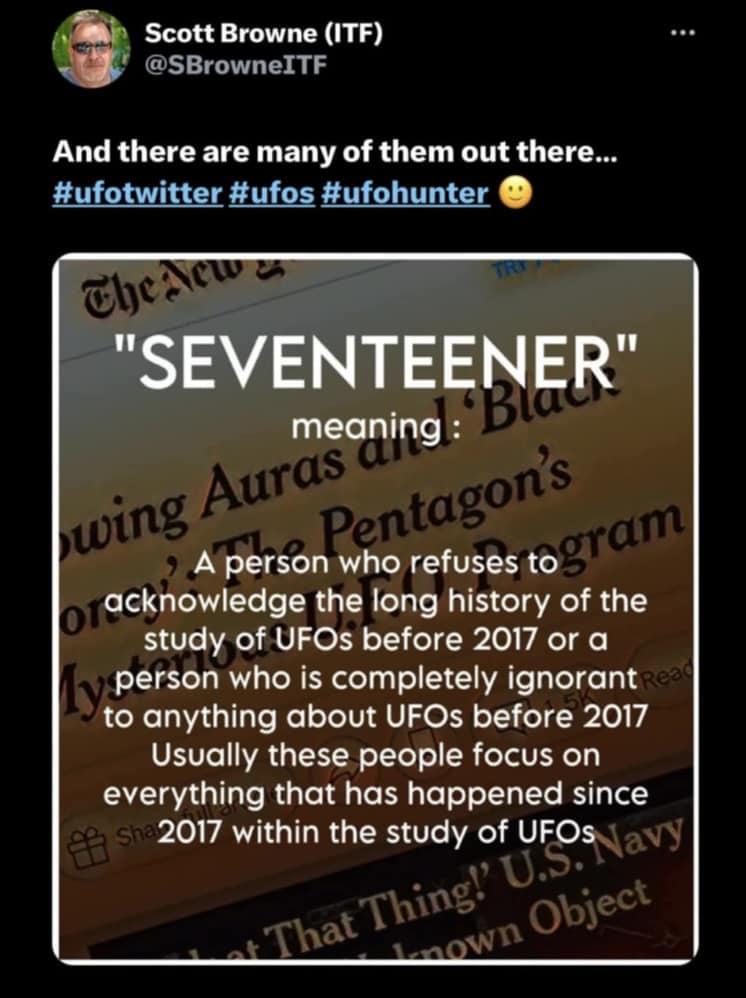
There’d be little argument I think that interest in the Flying Saucer / UFO / UAP topic experienced a florescence following the New York Times‘ publishing the Cooper, Blumenthal, and Kean article “Glowing Auras and ‘Black Money’: The Pentagon’s Mysterious U.F.O. Program” at the end of 2017. In the years since, not only have new blogs, podcasts, and YouTube channels popped up but scholars and scientists have put their shoulders to the wheel and new academic associations and conferences have been established, the Society for UAP Studies, the Sol Foundation, and the Archives for the Impossible among them, along with research initiatives, such as Harvard University’s Galileo Project and the Interdisciplinary Research Center for Extraterrestrial Science (IFEX) at the Ludwig-Maximilians University in Würzburg, Germany. Of no less note are the ways international government agencies have taken an interest; the US government created the All-domain Anomaly Resolution Office (AARO) and NASA commissioned its own UAP Independent Study, for example.

For myself, however, a boyhood fascination was rekindled in 1994 when I was struck (like Saul on the road to Damascus) by how the countless stories about UFOs and aliens seemed a dream expressing the anxieties and aspirations of late Twentieth Century technological society. Was it any wonder, I thought, that women under hypnosis should tell stories of being experimented on by egg-headed, grey-faced, cold-blooded doctors at the same time that the Human Genome Project, the prospect of human cloning, and in vitro fertilization procedures were all under development and making the news? As I devoured an ever-growing pile of books on the subject, like many who came to the matter post-2017, I was at first moved to accept the reality of the phenomenon, even the consistencies in reported alien abductions possessed a prima facie believability. However, as the years passed, and I came across those rarer analyses and mundane explanations of particular, famous cases, my credulity waned, not that the question of the reality of the phenomenon was ever my first concern, being more impressed with what this newest mythology revealed about the society that cultured it; moreover, debates about any one case, especially the more famous ones, tended to be both endless and evermore convoluted (not unlike the discussions around the assassination of John F Kennedy) but also at times drew on fields outside my wheelhouse, such as physics. That rabbit hole, for my (poetic, cultural critical) purposes, was a waste of time. Then came 2017…

The very coinage of ‘seventeener’ speaks to the frustration felt by those long interested in the topic with much of the recent talk about it, not only among “amateurs” (those bloggers, podcasters, and YouTubers) but, more seriously, among the learned and elected. The whistleblower claims of David Grusch are a case in point. As longtime researcher Kevin Randle observes “some of us have been around long enough that we can figure out what crashes Grusch has been told about.” Nevertheless, Grusch testified before a relatively-uninformed American government oversight subcommittee for which word of “a multi-decade UAP crash retrieval and reverse engineering program” was an eyebrow-raising revelation. This post-2017 interest also emboldens “believers” in the “reality” of “The Phenomenon.” Younger scholars, for example, such as Hussein Ali Agrama, after having begun researching the topic in 2015, concludes (somewhat smugly) that “by all possible yardsticks of reality”, as they used to say, ‘Flying Saucers are real!'” At the most recent Society for UAP Studies conference, anthropologist Brenda Denzler (author of the canonical study The Lure of the Edge: Scientific Passions, Religious Beliefs, and the Pursuit of UFOs) gave a keynote address wherein she essayed the Interdimensional Hypothesis, remarking uncritically the work of Michael Masters, the Schirmer abduction case, and Jacques Vallée’s and Paoloa Harris’ yarn concerning the 1945 Trinity Crash (I respond to her talk, here). This year’s upcoming Archives of the Impossible Conference is focussed on UAP, as the conference’s website explains, “an aspect of the phenomenon [of the impossible] receiving increasing coverage in the media as new whistleblowers are stepping forward to share credible testimony regarding their interactions with the Impossible. Officials operating within political and legal circles on the Hill have been paying attention and are beginning to take the subject matter seriously. Plausible deniability is, apparently, no longer plausible” (my emphasis). Finally, this coming April, the University of Durham’s Law Department has organized a one-day symposium “Grounding the SETI and UAP debate: Law, evidence and anticipated futures;” where one paper by Jia Wang is titled “Monopolizing high-tech in the hands of powerful humans after contact with extraterrestrial civilizations.” Talk about putting the cart before the horse. At the same time, even those skeptical of whether “flying saucers are real” recycle questionable notions, e.g., attributing the debris collected at Roswell to a Mogul balloon, an explanation Kevin Randle has vigorously disputed (and, to my mind, put to rest).

That, despite my interest being the meaning and ideological implications of the UFO mythology, I am nevertheless irritated by if not drawn into discussions about “the reality of phenomenon” speaks to the complexity of the matter, a complexity, it seems to me, overlooked by too many. It hardly follows I advocate a debunkery, such as that practiced “canonically” by Donald H. Menzel or Philip Klass (itself an aspect of that aforementioned mythology). Rather, one needs humbly acknowledge the debate around and, yes, research into, the nature of the phenomenon has been ongoing since 1947, that compelling stories have been told and observations made, along with equally persuasive explanations, both scientific and sociopsychological (in this latter regard, interested parties would do well to peruse the work of Martin Kottmeyer, here). A fine-grained grasp of the the history of the Flying Saucer / UFO / UAP returns it to its provocative, manifold mystery, which, in turn, opens a way to continued conversation and reflection beyond mere belief or disbelief. The most recent study by Knuth et al. is doubtless more grist for the mill…

Varieties & Trajectories of Contemporary UAP Studies: Reflections on the most recent Society for UAP Studies’ Annual Conference

[N.b. Due to WordPress’ incessant fixing features of its platform that aren’t broken, early, incomplete drafts of this post inadvertently appeared. As of 14h00 Sunday 1 September 2024, the more-or-less final version of this post here appears. Only inadvertent typos that have escaped my tired eyes need be corrected…]

The weekend of August 16-18 2024, the Society for UAP Studies (SUAPS) held its annual, online conference. This year, unlike last, I attended only those talks, keynote and plenary, that touched on the work here at the Skunkworks: Dr. Brenda Denzler’s “The Discovery of OIL [Other Intelligent Life],” Maya Cowan’s “Observatories and Experiencers,” Dr Bertrand Méheust’s “The Problem of Elusiveness,” Professor Travis Dumsday’s “Understanding UAPs [sic]: Surveying Some Non-Naturalist Ontologies,” Dr. Kevin Knuth’s “Simulating the Characteristics of Extraterrestrial Civilizations that Encounter Earth,” and the sessions presenting the results of the concurrent workshops in the humanities and social sciences. (The abstracts for the talks can be accessed by clicking on the hyperlink to the conference’s webpage, above). And, unlike last year, I won’t be commenting on each talk; rather, I want to address a set of concerns these talks and the discussions around them raised about and around the nascent field of UAP studies.

First, it was refreshing to hear in Ted Peters’ contribution to the report of the Humanities Workshop an explicit critique of what Peters termed the “mythologies” around technoscience. Peters fingers specifically the conflation of (biological) evolution and (technological) progress, the belief, assumption, or presumption that the longer a species has been around the more technologically sophisticated it will be (a conflation echoed reflexively by Kevin Knuth who referred to the evolution of technologically-advanced societies in my brief conversation with him after his presentation). Moreover, the belief that technoscience will solve the problems industrialization and technology have unleashed and that, therefore, advanced extraterrestrial civilizations will have solutions for our most pressing environmental problems is subjected to scrutiny and found wanting. Peters (and, I guess, the workshop’s participants) stops short, however, in pursuing the more general, social and “spiritual” (geistig) implications of this critique of “technoscientism,” implications with social, postcolonial, and ecological import. The workshop’s reflection was truncated in this way, I think, because of the near-exclusive concern of the conference (if not the majority of the Society…) with the nature (“being”) of UAP, neglecting the implications of how UAP are being thought for how we think of ourselves, society, and world….

Most of the central concerns I have were raised in Brenda Denzler’s talk, an avowedly personal take on the matter. Basically, Denzler laid out her version of the Interdimensional Hypothesis, the contention that UAP and encounter experiences ultimately stem not from an extraterrestrial source but from one originating in another dimension. She began with consciousness’ being an epiphenomenon (mental states, though not identical with physical states, nevertheless arise from and depend upon them), and, from there, speculated that if consciousness evolved on earth (as it clearly has), then it is imaginable it might have evolved in another dimension, as well. Aside from her uncritically adopting the very notion of “other dimensions” (a deeply-complex topic in need of much elaboration and reflection, see, for example, Martin Kottmeyer’s brief essay “Does ‘Interdimensional’ Mean Anything?”) Denzler seems to take at face value much of what I (and others) term the “UFO mythology.” She references, without comment, the Schirmer abduction case and seems to accept Vallée’s and Harris’ yarn concerning the 1945 Trinity Crash, as well as maintaining that “the phenomenon has always been with us,” as evidenced by stories of “UAP” and encounters with nonhuman intelligences worldwide and throughout time. She ended her talk, urging researchers to study these Nonhuman Intelligences not as mere stories and beliefs but as real entities, arguing that if we only ever studied whales in terms of their effects on culture, as merely cultural phenomena regardless of their reality, we would never have learned what marine biologists have about them.

As I remarked in the question-and-answer following the presentation by the Humanities Workshop, the topic of “consciousness” and “mind” has become a hot one in the field, but, from the point-of-view of someone acquainted with the philosophy of mind and the reflections on “consciousness” since Kant down to the phenomenological movement and the critique of reductionist theories by Dieter Henrich and Manfred Frank, much of the discussion seems frustratingly muddled. Case in point: too often, “consciousness” and “mind” are conflated and thought of as things, following, I imagine, in a rough-and-ready fashion, Descartes’ distinction between res extensa and res cogitans, things or stuff in space and thinking things or stuff. In the wake of Kant’s Critique of Pure Reason and the subsequent concern with the nature of self-consciousness, Fichte was the first to mock one critic for thinking of consciousness as a thing. Phenomenologically (more-or-less, phenomenology being a variegated school of thought) consciousness is a relation, being always intentional. One would wish, at least, that all interlocutors had read Gilbert Ryle‘s The Concept of Mind, however dated, not to mention Markus Gabriel’s I Am Not a Brain: Philosophy of Mind for the 21st Century, for a start, however much the matter surely transcends its philosophical treatment, as Jeffrey Kripal, Dean Radin, and the folks at IONS would likely observe. Happily, the response to my comments confirmed that, at least, the complexity of, if not confusions around, the topic had been a matter of discussion in the workshop.

Falling more within my personal, professional purview is the belief that cultures throughout history and around the globe have stories about visions of what today are termed UAP and encounters with Nonhuman Intelligences. The question I posed to Dr. Denzler was how we could be certain we understood the stories this belief depends on, why, for example, we should read the story of the vision of Ezekiel as an account of an actual experience, whether in an ordinary, waking state (in which case others could have witnessed what Ezekiel is said to have witnessed), an altered state of consciousness (in which case only Ezekiel would have been privy to what he is said to have witnessed, i.e., he would have had a religious experience), or whether the Book of Ezekiel is a monumental work of religious poetry (which the symbolic content of his vision strongly suggests), Ezekiel, like Dante or Blake, for example, turning to poetry to communicate his urgent, compelling religious message. Scholars of Ezekiel and Merkabah mysticism which his writings inspired are in no agreement on this question. Denzler’s response (admittedly offhand) was less than satisfying, which was that, because literacy was at a premium throughout most of world history, the literate would not waste their elite skill on merely fanciful matters. Her answer is, of course, one steeped in European Enlightenment prejudices, and one hardly confirmed by the historical record. But my query is more general: how do we read texts linguistically, culturally, and historically distant? I pursued the matter with a simpler example: in many of the prophetic books of the Bible, the author claims, generally, “the Lord spoke to me.” How do we determine whether these words report an actual experience or are merely a rhetorical formula intended to secure an audience and authority? Denzler could offer no answer. I expanded on this topic in the question-and-answer following Professor Travis Dumsday’s presentation, that explored, in part, the implications of Animism for the epistemology and ontology of UAP and attendant phenomena. My contention, there, was that to impute “epistemologies” let alone “ontologies” to ante-European cultures risks committing an interpretive (if not colonialist) violence to the cultures swept up in a concept as general as “animism,” one whose contemporary sense goes back only to Sir Edward Burnett Tylor’s 1871 book Primitive Culture (n.b. the utterly outmoded title). A most interesting if brief conversation ensued… This matter is a common one at the Skunkworks: a preliminary articulation of the argument can be read, here, which, I contend, deeply problematizes if not undercuts the belief in the universality of the phenomenon.

Finally, a more general problem haunts UAP studies, formulated quite pithily by historian Greg Eghigian: “In this field, there are no authorities.” Throughout the conference, I was increasingly irked by the repeated invocation of certain authors, whose works, though cited, were not even summarily subjected to the slightest, vigilant scrutiny: Michael Masters (referred to for his Extratempestrial Model), Jeffrey Kripal, D. W. Pasulka, and Jacques Vallée, among them (I even seem to recall the Sol Foundation being mentioned…). (Interested parties are invited to click on these last three names for what I have written on them here at the Skunkworks). One is tempted here to invoke the slogan from the X-Files: “Trust no one.” On the one hand, surely, in so nascent a field, bold, creative thinkers are needed, such as Vallée and Kripal; on the other, every thesis need be subjected to the most rigorous reflection and scrutiny. The field of UAP studies, if it is to find firm footing must follow the example of Husserl, who, himself, followed all the more radically that of Descartes (a foundational thinker, along with Francis Bacon, for the emergence of science-as-we-know-it), thinkers whose methodical bracketing and questioning of all inherited knowledge were the conditions for what breakthroughs they might be said to have made. I would go even further, that a no less scrupulous unearthing of determining and guiding presuppositions needs be undertaken, whether in the manner of the Destruktions carried out by Dilthey or Heidegger, the deconstructions of Jacques Derrida, or the desedimentations of Adorno. Only such a vigorous back-and-forth, leaping into the unknown and freeing ourselves from the supposedly known, will be sufficient to begin to catch a glimpse of the object at the focus of UAP studies.

Limina’s Inaugural Symposium 2023

Limina Journal of UAP Studies will be having its inaugural symposium in cyberspace February 3rd, 4th, and 5th 2023 9am – 5pm EST.

This virtual-only symposium brings together an international array of key thinkers in the fledgling academic study of unidentified aerospace phenomena (UAP) to discuss fundamental methodological, epistemological, and ontological questions surrounding the UAP phenomenon.

It will include an exploration and critical assessment of crucial social, political and cultural issues connected with this elusive phenomenon. In addition to talks presented by a subset of our distinguished participants, there will be several panel discussions on a variety of impactful UAP-related topics.

Major UAP research organizations and data-gathering teams will be hosting virtual booths in the exhibition hall, giving attendees a chance to directly connect with the exhibitors. In doing so, Limina hopes to encourage a cross-fertilization of ideas and an ecosystem of exchange among groups dedicated to the empirical study of UAP.

A quick glance at the three-dozen participants will likely raise a few delighted eyebrows among the congnoscenti, a wide-ranging group sure to tackle the phenomenon in the serious, multidisciplinary manner it demands. Even my humble self will be moderating a panel (with the esteemed Michael Zimmerman) on the knotty interface of STEM and the Humanities with regard to the UAP question(s).

Read all about the conference here. Register (!) here.