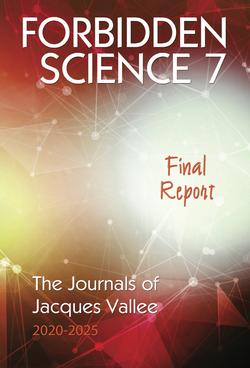
[Earlier this year, Matthew Kibbey, the new publisher/editor of Fate magazine, generously asked if I might submit to the launch of the magazine under his editorship. I had, on hand, the latest and last volume of Vallée’s journals, which I offered to review. Below, one can read the review in its entirety; a judiciously edited version appears in the latest number of Fate.]
The month the final volume of Jacques Vallée’s journals appeared (June 2026), the man himself, at that year’s Contact in the Desert conference, announced it would be his final public appearance.
Anyone interested in UAP or UFOs (still Vallée’s preferred term: “The witnesses I kept interviewing…had not seen phenomena; they had seen hard objects” (8)) will likely feel a certain grief. Grief, too, permeates this last book of Vallée’s journals. The loss of colleagues, friends, and family and the encroaching infirmities of old age, aches and pains or the need for hearing aids, sound like a refrain throughout the volume’s near 500 pages.
Added to that grief is an impatient frustration—with the stubbornness of the mystery which seems no more resolved after decades of dogged investigation; the failed promise of the latest upsurge of official interest; the attendant and on-going machinations of intelligence agencies and black projects; and the limitations of the newest cohort of researchers. Nevertheless, in keeping these journals, Vallée “felt a responsibility to describe what progress [he] could see from the noble efforts of others, and to say what [he] thought as clearly as [he] could, as long as [he] could” (7).
One challenge in presenting what Vallée describes is remarked by Vallée himself, who quotes another diarist: “There’s what you registered in the moment that seemed worth writing about, and there’s what you see between the lines, years later, reviewing that moment” (448). What Vallée registers in the moment is his life: his collaborations, friendships, and loves; his travels between California and France; his investments as a player in Silicon Valley; observations on the American and French economies, politics, and lifestyles; the 1,000+ days of COVID, the Russian invasion of Ukraine, and the deepening climate crisis; and, of course, his and others’ efforts to penetrate the mystery of the UFO. The reader, of course, is one of those who sees “between the lines years later,” picking out what is of interest to them, which, for most of the book’s readers, will be the UFO topic.
And there is much of interest. The story of the hard scientific research that Vallée engages in with Garry Nolan and Larry Lemke on “material UFO samples” runs through the volume, research resulting in the first peer-reviewed paper on the topic in the journal Progress in Aerospace Sciences in January, 2022, an important achievement in removing the stubborn stigma that still accrues to UAP. As well, the journals climax with the Sol Foundation’s third conference in Baveno, Italy, where Vallée presents his and his collaborators’ research into the 1966 Haynesville, Louisiana case (also published in Progress in Aerospace Sciences June, 2025).
Much of the journal concerns, too, the research with Paola Harris into the purported crash of an avocado-shaped object in New Mexico in 1945 and the publication of their findings in Trinity: The Best-Kept Secret in 2021 (since republished in an updated edition as Trinity: The Scientific Proof of UFOs). This work stands, however, in stark contrast to the two papers, above. On the one hand, the case has arguably been thoroughly demolished by journalist D. D. Johnson, whose damning criticisms have yet to be answered. On the other, regardless of one’s opinion of Garry Nolan, for example, Valleé’s collaborators on the articles published by Progress in Aerospace Sciences are accredited scholars, while Harris, among other things, teaches “on-line classes in Exopolitics for Dr. Michael Salla’s Exopolitics Institute for which she is the International liaison director,” not the most glowing of endorsements (and nowhere admitted by Vallée).
There are many fellow-travellers who play major and minor parts in the story: Eric Davis, “Hal” Puthoff, “Kit” Green, Robert Bigelow, George Knapp, and newcomers Jeremy Corbell, Ross Coulthart, Tom DeLonge, Lue Elizondo, James Fox, Tim Gallaudet, Dave Grusch, Paul Hynek, Leslie Kean, Colm Kelleher, Jeffrey Kripal, James Lacatski, Avi Loeb, Christopher Mellon, Diana Pasulka, Daniel Sheehan, Jay Stratton, Travis Taylor, and Beatriz Villaroël. Some are lauded, while few are subject to much scrutiny, let alone criticism. Vallée’s silence in this regard might be mere tact, but their various failings should, one would think, be remarked if they muddy the waters of investigation and research. A case in point, which is remarked, is Lue Elizondo’s 2024 “televised expedition to Sicily” to follow-up on a story that “UFOs had supposedly downed a military aircraft with mysterious beams, then strange phenomena ignited houses” (388), concerning which Vallée drily observes “If you bother to check the facts (but who does anymore?), you’ll find that the ‘downed military craft’ is a fiction” (389). Then, in March 2025, Vallée will reflect on Garry Nolan’s belief in “psionics”: “Am I the only one who remembers the ‘official hoaxes,’ like the false data planted by Bill Moore and the prestidigitation of Sandia in 1985?” (426).
Such critical vigilance is more reminiscent of the author of Revelations (1997), which cast a withering gaze on tales of crashed flying saucers, alien abductions, and cattle mutilations. With this earlier incarnation in mind, one is puzzled to read of Vallée’s appearing to believe a story told him by “Gilbert” (“a discrete master remote viewer at the level of Uri Geller and Ingo Swann” (164)), who, he tells him,
was taken inside a small mountain to an underground room, well-lit and cared for by men and women in uniform with no designation of rank or unit….
He was led to the presence of an entity, over six feet tall, with very few features except for light emission from various parts of its ‘body’ so that Gilbert thought what he saw might be covered by a test article, a wired uniform or a safety container for the being rather than the body of an actual Alien.
Gilbert then proceeds to “communicate” with the Alien via “question-and-answer sequences, where he was left to interpret answers that came in the form of light combinations “ (429-30). How, one might ask, does Gilbert’s experience substantially differ from that of Bob Lazar, for example, subject, at least according to the Vallée of Revelations, to an elaborate charade, complete with being transported to a remote, secret lab and tasked to work on retrieved alien artefacts?
Precisely such dissimulation on the part of known and, more worryingly, unknown parties is a red thread that runs through the journals. Vallée’s work for Robert Bigelow is a case in point. The opening pages of the journal for 2020 concern the leak of “the 494-page, ten-month report provided by BAASS [Bigelow Aerospace Advanced Space Studies] to the DIA [Defense Intelligence Agency] at the conclusion of the first-year option of the AAWSAP [Advanced Aerospace Weapon System Applications Program] contract” (24). One particularly sore point is the fate of the Capella database of 240,000 cases that Vallée meticulously began to design and compile during his work for BAAS in 2008, left undeveloped and unfinished when the project’s government funding was not renewed. As late as 2025, Vallée asks “Who killed Capella at mid-term although it was a properly vetted and funded, well-run project? Also, why?” (412). He goes on to wonder “Was the Capella project cutoff because full deployment of the later [undeveloped] phases of software (the AI) would have exposed both the deeper nature of the phenomenon and its illegal manipulation by powerful hidden interests?” (413).
Parallel to the machinations of these “hidden interests” is the public engagement with the phenomenon: the documentaries of James Fox (The Phenomenon and The Program), “the shenanigans on Skinwalker Ranch” (27), To The Stars Academy of Arts & Sciences (TTSA) (“preparing new books and pursuing TV projects…but their ambitious claims about science seem to have withered” (17)), and the various U.S. government initiatives—task forces, committees, and hearings—whose results might be summed up as “little more than political games and blurry images from aircraft” (8). Nevertheless, despite this legacy of suppression and secrecy and official incompetence and obfuscation, Vallée, now retreating “from the visible research,” remains
confident that innovation would remain alive in the ranks of such organizations as Dr. Garry Nolan’s SOL Foundation, John Priestland’s “uNHIdden” organization in London (the world’s only group concerned with the mental and physical health of witnesses), and the extraordinary Archives of the Impossible at Rice University pioneered by Dr. Jeffrey Kripal[,]
these “the new leaders, and the places from which profound changes could emerge” (9).
At the end, the mystery of the UFO remains. Attempts by Vallée to return hypnotically to his own fateful sighting of a soucoupe volante (flying saucer) in his youth results in a telling image: “recalling the days of Pontnoise, [his] parents, the garden, the church… [he] drifted even further into the recall of the object, its odd immobility in the air, but [he] couldn’t break beyond that, or go deeper” (458). The “remembered” flying saucer, like the UAP that eludes our understanding today, hovers, distant, out of reach, escaping the desire to get a closer look, to probe its nature, to get at its ultimate truth.
This final volume of Vallée’s journals completes an important document in the history of ufology. There’s little doubt the journals are a rich source of insight into the labyrinthine story of the investigation of refractory mystery, one that can still fascinate the population at large, scientists and scholars, and militaries and intelligence agencies. Though his (public) journals have come to an end, Vallée’s personal story, of course, is not quite over. As he writes, “there’s still time to think new thoughts, publish some records, and complete a life” (384). In his withdrawal into private life, the rest of us are left with a legacy, one Vallée tells us himself how to receive: “My journals should remain simply a source for inquiry and discrimination, one man’s special view of a vast, unknown field” (456).

