
Sightings Friday 18 August 2023

Our radar, this past week, was relatively quiet.

At least the sound and fury of the Grusch Affair is already diminishing, though dismissals and apologia continue to pop up….
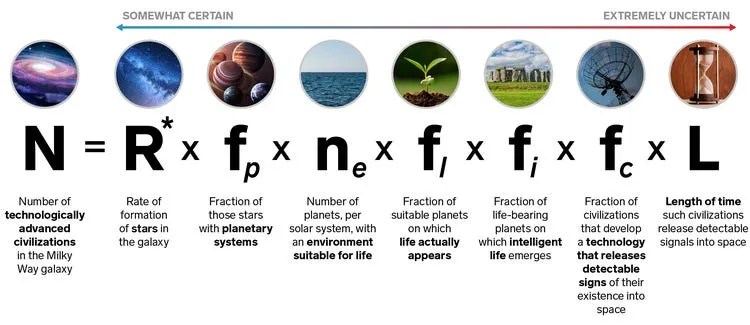
A share of a substack article on the Search for Extraterrestrial Life (SETI) served to spin a short discussion thread over at the UFO Updates Facebook Page. Jim Geshke’s is a garden variety survey of the Fermi Paradox (that, given the immensity of the cosmos life should be plentiful, but we have yet to detect any sign of it). What engaged me was the article’s catchline, that great, unexamined premise, “Intelligent life almost certainly exists elsewhere in the universe…”.

Geshke presents the stereotypical argument, that

Plenary numbers would seem to make the probability a near certainty. British rock star physicist Brian Cox recently estimated there are 2 trillion galaxies in the observable universe. Those galaxies contain 200 sextillion stars…To calculate the estimated number of planets just add about nine more zeroes. Those numbers are incomprehensible [sic]. Common sense stacks the odds overwhelmingly in E.T.’s favor.

At least Geschke is canny enough to add, in the same breath, that “as physicists and cosmologists will testify, common sense doesn’t really apply to the Universe.” The Drake Equation is brought in, which, again, is admitted only tentatively, as “Drake [had only] strung together a series of educated guesses.” Finally, the article considers the Rare Earth Hypothesis, that life’s arising is a very complex affair, so complex, it may have only occurred on earth. These caveats suggest that “Intelligent life does not necessarily exist elsewhere in the universe.”

That the catchline repeats an idea more complex than is often grasped, readers here will understand; the very idea of “intelligent life” is densely packed. Once I’d communicated those complexities, and after I cleared up the distinction between criticism (probing an argument’s soundness or validity) and critique (revealing a position’s limits, assumptions, and their implications), my interlocutor raised a pertinent question: What are the consequences of scrutinizing that catchline’s claim?

On the one hand, a scrutiny of the idea reveals that SETI, anyway, as a search for technosignatures, is a search for ourselves, and not even “ourselves”, but that culture represented by the SETI researchers themselves, namely that of the world’s so-called “advanced” (“First World”) societies. The anthropocentricism at work here is also ontotheological, i.e., in one regard, arguably, guided by a number of possible metaphysical presuppositions, one of which, the Great Chain of Being, which places humankind at the apex of life on earth, is Abrahamically theological, rooted in the myth that God created Man in His own image. Said ontotheological anthropocentrism blinds those possessed by it to the “intelligence” and, therefore, the value of all the other forms of life on earth, which are reduced to raw materials, mere means to human ends, with glaring, disturbing consequences. And, of course, aside from these strictly cultural determinations, searching for “ourselves” also naturalizes and universalizes the haphazard natural and cultural sequence of events that led to the possiblity of SETI in the first place, i.e., it is “ideological.”

However much these considerations (the heart of the work here at the Skunkworks) do not touch on the truth or validity of thoughts about extraterrestrial, intelligent life, they do have “scientific,” methodological value. I have essayed the thought that even The Drake Equation is guided by the cultural, ideological prejudices outlined above. What values we input into its variables, if not some of the variables themselves, are less than strictly “scientific.” Admittedly, the matter is more complex, but the question stands. Moreover, it’s been proposed that the tests for life carried out by the two Viking landers in the mid 1970s may have in fact killed organisms the test had not considered. Astrobiology and SETI, then, need rethink and recalibrate just what they are looking for….
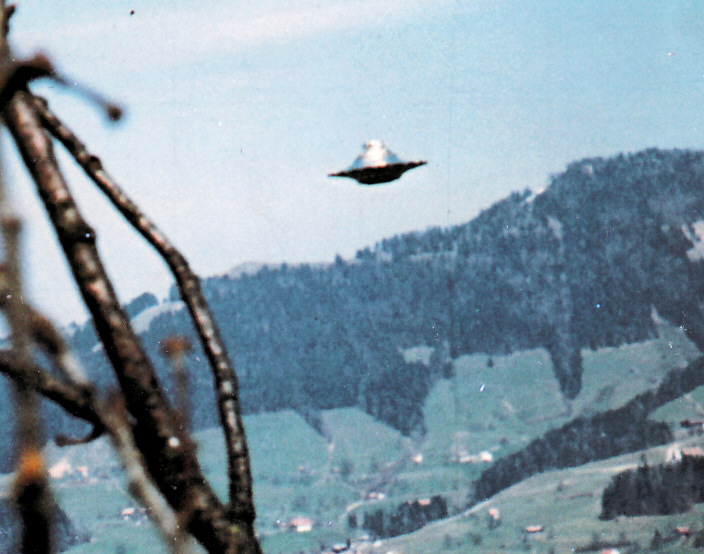
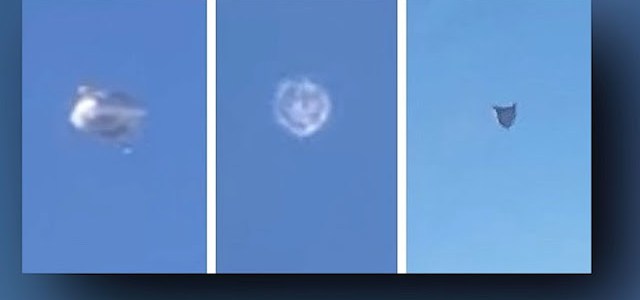
What journalist Chris Wiley goes looking for in his New Yorker article “The Enticing Mysteries of U.F.O. Photography” is “high-quality photographic proof” of the reality of UFOs. His article is a brief review of the most famous UFO photos. He consults Leslie Kean, who dishes up the famous photo of a Black Triangle taken during the Belgian Wave of ’89-’90 (“The shooter came forward in 2011 and said that he had hoaxed it”), another taken during the Hudson Valley wave of the mid-eighties (“Nobody’s been able to locate and interview the police officer who actually took it”), and the famous Trindade Island photo from 1958, which Kean cannot finally vouch for, either. In the course of his search, Wiley is shown, too, the pair of pictures taken in 1950 in McMinnville, Oregon, by farmer Paul Trent, and the no-less notorious Costa Rica Lake Cote aerial survey photograph from 1971. Finally, the Calvine photo, recently released by David Clarke, is presented for inspection, and Wiley ends with a nod to Billy Meier’s famous pictures and the iconic poster on Fox Mulder’s office wall.

Despite Wiley’s coming up empty handed, what’s touched on here is profound, the epistemic status of the photograph as proof. In the earliest days of the medium, its authority was invoked to prove the reality of psychic phenomena, namely those of the séance, levitations and ectoplasmic manifestations. It was precisely this aura of authority that George Adamski later played on with his famous photos, which he offered as proof of his sightings and, by extension, contacts with Venusians. But even when photos are indistinct or questionable, they invite the amenable viewer to believe. As Mark Pilkington remarks, the Costa Rica Lake Cote photo, for example, is “a classic example of seeing what you want to see—which is the key to the whole U.F.O. story.” Thus, UFO photographs grant insight as much into the psyche of the viewer as provide evidence of advanced earthly aeronautic technology let alone extraterrestrial visitiation.

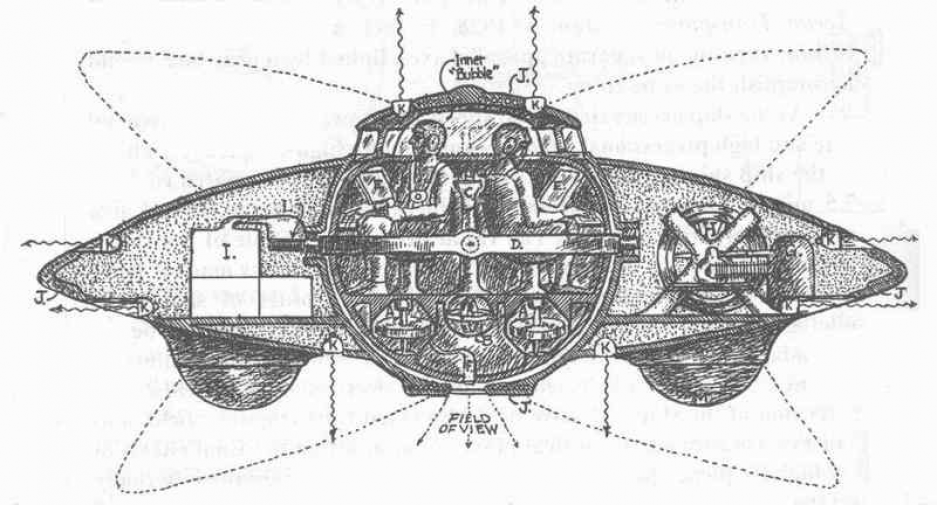
Indeed, the authoritative aura of the photograph has evaporated in recent years, first, with the advent of CGI, (as film make James Fox tells Wiley, “if you see a photograph of an object with clearly defined edges, it’s probably a fake”), and all the more with, as Wiley writes, “forecasts of an A.I.-fuelled disinformation apocalypse.” But once UFO photos, among so much else, become simulacra with a vengeance (copies without an original), then they can appear in a new light, merely as pictures. Anyone who sat in the darkened theatre and witnessed the spectacle of Close Encounter of the Third Kind (especially at an impressionable age) surely came away impressed by the sheer aesthesis of the phenomenon, its colours, its movement, its sounds, and grandeur. Gazing at UFO photos-as-simulacra with an art historical eye, one might be persuaded one is viewing a kind of Outsider or Folk art (such as that by Charles A. A. Dellschau), perhaps a new genre of religious depiction. Indeed, the aesthetic dimenson of UFO photographs (and related representations) has been appreciated for some time. For example, Barry Blinderman and Bill Conger curated The UFO Show at the University Galleries of Illinois State University in 2000, and art historian John F. Moffitt published a tome studying just this aspect of the phenomenon in 2003, Picturing Extraterrestrials: Alien Images in Modern Mass Culture. Nor is Diana Walsh Pasulka the first to note the religious dimension of such artistic inspiration and devotion….


Sightings Friday 11 August 2023

As in the past weeks, the Grusch Affair continues to send out ripples and froth that obscure the more profound depths of the phenomenon.

Ballester-Olmos, et al, published their relatively down-to-earth review of the recent U.S. National Security Subcommittee’s hearing on UAP:

We don’t know whether to label it as ridiculous or shameful. Under the guise of a bipartisan initiative, the real scenario is a group of mostly Republican politicians seemingly trying to undermine the Democrat administration, using the tenuous pretext of UFOs this time around.Whether they are naive, misinformed, driven by ideology, or simply gullible remains unclear

Nevertheless, the appetite for the matter unsated, The Hill has organized a panel, We Are Not Alone: UFOs & National Security for 17 August 2023, with three of those “Republican politicians” and, finally, someone who knows something, historian Greg Eghigian. The Hill‘s own Marik Von Rennenkampff and Baptiste Friscourt at UAP Check have both recently published articles, more interesting for their logic than their content….

The most turbulent development was the paranoid reaction to The Intercept‘s revealing Grusch’s history of PTSD and related mental health issues, Grusch’s defenders impugning that his records had been leaked as part of a smear campaign (they weren’t: “The records were not confidential, medical, nor leaked. They are publicly available law enforcement records obtained under a routine Virginia FOIA request to the Loudoun County Sheriff’s Office and provided by the office’s FOIA coordinator”). Logically, Grusch’s mental health history can hardly be said to discredit his testimony (that would be a very weak ad hominem argument), no more than his being autistic. More concerning is his business affiliation with Gary Nolan’s Sol Foundation, whose director is Chris Mellon, which associates Grusch all the more glaringly with those most prominent in promoting the UFO (rebranded as UAP) mythology post-2017….

Friscourt in his article for UAP Check invokes a common, ufological / astrobiological argument: Statistical studies show that we can’t be alone;” if we have launched space probes, “others probably did it, as we are statistically unlikely to be special;” “Once you consider the amount of possible life out there, extended over billions of years, statistics make it simple: the existence of [extraterrestrial spaceships piloted by] non-human bodies actually makes sense.”

I have posed here the question as to whether an argument for life on other planets, let alone so-called intelligent life, let alone “technological” life, can be made on purely statistical, probabilistic, mathematical grounds. And it is a question. The further the argument moves from the question of mere life on other planets, it seems to me less compelling. And even if such an argument can be validly made, it can still be asked if it isn’t oriented, guided, or otherwise “determined” by ideology (an unconscious affirmation of the universal naturalness of the social formation of the so-called “advanced” (capitalist) societies) or what I have called “a metaphysical residue,” an inherited idea of “essence” or Eternal Recurrence.

Ideas don’t fall from heaven. At birth, a human being is “thrown” into a time and place not of their choosing, one wherein they take up mostly unconsciously what German philosopher Hans-Georg Gadamer has called “Tradition”. Human beings’ being historical in this radical sense explains how it is certain notions orient, guide, and otherwise determine their actions, perceptions, and thinking. This “throwness” helps explain, further, in one regard, how ufological and astrobiological thinking can be seen to be guided by distantly-inherited ideas, such as a dim echo of Plato’s Forms.

A recent Big Think article by Prosanta Chakrabarty suggests another such guiding idea: the Great Chain of Being, “still how many people understand (or rather misunderstand) evolution — that is, as a linear process with bacteria and plants at the bottom as ‘primitive’ and a straight line from fish → amphibians → reptiles → mammals and then humans as a distinct category at the top.” The fetishization of instrumental rationality (what is seen as giving us “technology”) let alone human intelligence is a case in point: it surely sets (technoscientific) human intelligence above all others. Moreover, the linearity of the Great Chain harmonizes with the “Platonic” idea that intelligence is measurable on such a linear scale, such that we can imagine aliens or A.I.s “more” intelligent than present-day Homo Sapiens (a linearity that gets in turn extended to technological sophistication, equally supporting, e.g., Maitreya Raël’s fancies about his alien teachers’ being “25,000 years ahead of us,” European explorers’ belief in their superiority to the indigenous peoples of Turtle Island, or even the Kardashev Scale).

That ufological or astrobiological thinking might well be said to be possessed by this scheme is an index of its being ontotheological, an inescapable consequence of its arising within the horizon of modernity, one in the grip of the Platonic-Christian inheritance, that fateful confluence of Greek ontology and Christian theology. It’s only once this “ufological / astrobiological unconscious” is revealed that that grip might begin to be loosened. Perhaps the nascent science of UAP studies (let alone the ufologically-minded) needs undergo a kind of conceptual psychoanalysis to free it from this perverse narrowness of vision before it is mature enough to join the family of full-fledged sciences.

Sightings Friday 4 August 2023

The Grusch Affair continues to suck up the air in ufological space. The usual suspects continue to keep the story spinning (see this “roundtable” with George Knapp, Jeremy Corbell, Ross Coulthart, and Bryce Zabel, for example). In the mass(er) media, News Nation (…) isn’t much better, bringing together “experts” Sean Cahill, Steven Greer, and Avi Loeb for a yack. At least PBS for its part went to a journalist author of a forthcoming book on the matter, Garrett Graff. Even more serious thinkers are scratching their heads: Bernardo Kastrup (in a not very informed or profound manner) and Mike Cifone more scrupulously.

Those who swallow Grusch’s tale do so, it seems, for the most part, because they want to believe or on the grounds of the man’s credentials. Anyone who watched to the end a recent conversation between Mick West and Steven Greenstreet, however, would have been treated to a link that waves five red flags with Grusch’s story. The one that should catch the eye of everyone interested in the topic is that “in accordance with protocols, Grusch provided the Defense Office of Prepublication and Security Review at the Department of Defense with the information he intended to disclose.” Nothing Grusch has said is considered secret by the U.S. Department of Defense. So, is he blowing a whistle, or smoke?…

Some, such as those I’ve noted here earlier, Luke Harrington and Caitlin Johnstone, are able to look awry at the matter to consider its societal implications aside from the question of the factual truth of Grusch’s claims. Günseli Yalcinkaya, too, insightfully raises the point that “In this new and uncharted era of disinformation, it’s easy to see how stories of technologies of unknown origins, non-human intelligence and unexplained phenomena can fan the flames of cover-ups and conspiratorial thinking…” Thus, “it’s hard not to question the motives behind how this information is being fed to us – and why.”

Yalcinkaya is informed enough to recognize that the suspicion of cover-ups goes back to the beginning (however much she points to Roswell as the watershed event…). In fact, it’s in 1950 Frank Scully publishes tha archetypal crash-and-retrieval tale Behind the Flying Saucers; Donald Keyhoe publishes The Flying Saucer Conspiracy five years later, a title that underlines suspicions he’d been voicing from the start, in The Flying Saucers are Real (1950). In this regard, she quotes Mark Pilkington: “This UFO belief is intrinsically tied to notions of a government and military cover-up, and is powerful and pervasive within society,” a society wherein (as Yalcinkaya writes) “social media chips away at any notion of a consensus reality,…which amplifies fringe beliefs and makes it harder to distinguish what’s real or not.” Cannily, she observes that “Even the positioning of UAP sightings as classified information plays into this narrative, with officials capitalising on our collective distrust of mainstream media to uncover hidden truths,” this skepticism toward mainstream media further eroding a shared sense reality. “It’s important to consider why these conversations are entering the mainstream now” she goes on to write, “and it’s not a coincidence that it’s during a time when space tourism is on the rise and conversations around AI and non-human intelligence are reaching their peak and posing very real existential threats.” However much I find there to be more pressing concerns than those Yalcinkaya remarks, we would surely agree that The Grusch Show serves to keep “us distracted from anything more shadowy beneath the surface.”

Aside from distracting from graver problems (I’ve remarked Tim Burchett’s and Anna Paulina Luna’s skepticism about global warming…) and further dissolving consensus reality, the Grusch Affair stirs a deeper, troubling current, a particular, bipartisan suspicion of government. The roots of such distrust go to the very founding of the Republic, and, unsurprisingly, sprout after the Second War, one flower of which is precisely the myth of a UFO cover-up as articulated by Keyhoe. More acutely, “Big government” has been the target of Neoliberal attacks: Ronald Reagan famously stated that “government is not the solution to our problem; government is the problem.” This overt ideology has been behind the drive to rollback those gains made by working people after the war, particularly in the institutions of the welfare state. The consequences of such thinly-veiled laissez faire capitalism have not been for the best. And, at a time when then nations of the earth need work together over decades to mitigate and adapt to climate change (and other threats to life on earth), such a distrust of public institutions is, to say the least, counterproductive.

There is, morever, a blindness at work in this suspicion. “If there’s not a cover-up, the government and the Pentagon are sure spending a lot of resources to stop us from studying it,” Burchett told The Hill.  His Republican colleague, Luna, adds, “We know that enormous sums of money are being spent on UAP-related activity, whether it’s retrieval/recovery, research and reverse-engineering, or just security for whatever the government is hiding.” This exclusive focus on government is curious, given that Grusch claims that “recoveries of partial fragments through and up to intact vehicles have been made for decades through the present day by the government, its allies, and defense contractors” [my emphasis]. The private sector, therefore, is no less guilty of a cover-up than government. Indeed, corporations have shown themselves no more transparent, when quarterly profits are at stake. Big Tobacco lied about nicotine’s being addictive, Big Oil knew about global warming, Boeing’s cutting corners crashed several 737 Max aircraft, and, more recently, Johnson and Johnson ignored research that linked its talcum powder to cancer. Ironically, it’s only via public institutions, such as the courts, that such corporate malfeasance can be brought to justice (not to mention the role of the much-maligned mainstream media in investigating corporate deceit).

Ideology (in the sense I use the term here) is revealed in such contradictions and omissions. By these same fissures and silences, UFO talk, as a social phenomenon, can’t help but betray, too, the “necessary fictions” that keep in place and reproduce the present order. “Disclosure,” therefore, is a mere distraction, from the true cover-up, of what’s at work in social reality, a reality of which UFOs/UAP are inescapably a part.

Talk of “nonhuman biologics” doubtless to many brings to mind “extraterrestrials” (however much the more informed might as much think of cryptoterrestrials, extradimensionals, or extratemporals). Wade Roush, in the excerpt from his book Extraterrestrials, surveys ideas about “the plurality of worlds” from the ancient Hellenic philsophers Leucippus and Democritus on down to the present day. Leucippus and his student are often credited with founding Atomism, “the belief that the visible universe consists of tiny, indivisible, indestructible atoms, churning in the void without purpose or cause.” Atomism, later, grounds the ethics of Epicurus and orients the great, scientific-epic poem of his follower Lucretius, On the Nature of Things. Roush quotes a telling passage from the poem:

If store of seeds there is
So great that not whole life-times of the living
Can count the tale …
And if their force and nature abide the same,
Able to throw the seeds of things together
Into their places, even as here are thrown
The seeds together in this world of ours,
’Tmust be confessed in other realms there are
Still other worlds, still other breeds of men,
And other generations of the wild.

Surely striking is how much the thinking here resembles that of contemporary astrobiology. The spatiotemporal immensity of the cosmos and the universality of the physical laws that govern it imply a likelihood of “Still other worlds, still other breeds” of life, sapient and “wild.”

I’ve proposed that the line of thought that posits that chemistry gives rise to life, which evolves to awareness and intelligence, which in turn develops technology is metaphysical, Platonic. And the deep, historical roots of the basic astrobiological schema, as evidenced in Lucretius’ poem, suggests, possibly, a no less deep, subterranean inheritance of related ideas in the sciences that are part of today’s Search for Extraterrestrial Intelligence (SETI). One could as well recognize in the thinking at work in Lucretius and SETI a version of the Eternal Recurrence of the Same, that the churning of matter over vast periods of time gives rise to the same patterns, especially if the universe is thought to be in a state of constant creation. The important question, in this regard, is if the thinking here is merely probabilistic or if this strictly statistical thinking is not, at the same time, however unwittingly, determined by a stubborn, metaphysical residue. Interestingly, Henri Poincaré posited that “certain dynamical systems, such as particles of gas in a sealed container, will return infinitely often to a state arbitrarily close to their original state.” Surely a matter for further research…

Sightings: Saturday 29 July 2023

The one story that took up all the air in the room this past week was surely that of the U.S. National Security Subcommittee’s hearing on UAP. To anyone familiar with UFOs before the latest watershed moment of 2017 what was presented was of little interest (a “Nothing Burger” in the words of Luis Cayetano…). The ignorant (West and Greenstreet have some words on that….), believers, and world media, nevertheless, gobbled it up. Those a little more informed were less than impressed, Jason Colavito in his deliciously derisory manner, Mick West and Steven Greenstreet delving into what is left out of the story, and veteran Kevin Randle weighing in….

Some commentators have thought a bit more deeply, probing past the tiresome question of the factual truth of these latest, post-2017 UFO/UAP stories, taking into account their historical context and possible social function. Like myself, Caitlin Johnstone is unpersuaded, for example, that the “securitization” of the UAP in recent months is part of a ploy by the defence establishment to secure even more funding. As Johnson goes on to observe:

what really stinks about all this UFO stuff is the timing. Here we are in the early stages of a new cold war which features a race to militarize space, and we’re hearing congressional testimony about mysterious vehicles posing a threat to US airspace which have the ability to go up and down between earth and space very quickly. That smells off.

I mean, does it really sound like a coincidence that we’re seeing all these news stories about UFOs and aliens at the same time we’re seeing news stories about a race between the US and China and Russia to dominate space militarily?

Johnson remarks that the U.S. Space Force was inaugurated the same year that UAP reappeared on the radar of the journalistic, public consciousness, 2017. As Johnstone says,

it just seems mighty suspicious… how we’re being slowly paced into this UFO narrative (or UAP narrative for those hip to the current jargon) right when there’s a mad rush to get weapons into space. I can’t actually think of any other point in history when the timing of something like this would have looked more suspicious.

These suspicions prompt Johnstone to wonder “Are we being manipulated at mass scale about aliens and UFOs to help grease the wheels for the movement of war machinery into space?”

As much as I appreciate Johnstone’s more down-to-earth conjectures, I don’t find her case very compelling. The American drive to “Full-Spectrum Dominance” begins before the turn of the century, and its role in American defence strategy, spending, and development has been well-noted by those attending to such matters for as long. Moreover, given the very real and palpable security threats of China, among others, I find it unpersuasive that the best-funded military on earth need restort to propaganda invoking far-fetched stories of aliens, crashed flyings saucers, and their reverse-engineering to legitimate its weaponization of space. More persuasive are the points brought forward by Luke Harrington in the article linked above and remarked here last week. As West and Greenstreet observe about the hearings, no one involved was very well-informed on UFOs; here, the U.S. government, at least, failed to be “critically-thinking.” This absence of intellectual vigilance opens the doors to an “infiltration of pseudoscience and conspiracy theory into the halls of American government,” which “unscrupulous defense contractors could seize [as an] opportunity to pilfer the national security budget,” a much smaller-scale scam than the one Johnson proposes, and one for which Harrington provides a real-world example…

Unsurprisingly, the “Grusch Affair” with its claims concerning nonhuman entities prompts reflections on “First Contact.” A characteristic line-of-thinking is that such an encounter between humankind and an extraterrestrial civilization would be profoundly disrupting and potentially even catastrophic for human culture. Ed Simon trods this well-worn path:

As Sagan wrote in his 1985 novel Contact, an awareness of extraterrestrial life would serve to inculcate the “power of the planetary perspective.” It would, as Sagan told Studs Terkel in 1985, “de-provincialize” humanity. In other words, we’d experience ontological shock.

This ontological shock would be different from mere discovery or invention; it’s not even synonymous with what the philosopher Thomas Kuhn called a “paradigm shift,” when scientific consensus is amended by some revolutionary new theory. Rather it’s an apocalypse—in the sense of the word’s original Greek meaning of “unveiling”—whereby the true nature of reality is radically altered. In light of the reporting in the Debrief and the steps toward disclosure being taken in Washington, it’s reasonable to say we should prepare ourselves for the possibility of that very experience.

“That very experience”, happily, is one that has been increasingly scrutinized, not from the perspective of the STEMcentric cultures of the “advanced societies” of the “First World,” but from that of the colonized, an example being a recent article in The Conversation by scholars Shorter, TallBear, and Lempert. Here, Shorter et al. take to task the colonialist unconscious (ideology) at work in SETI, unmasking the biasses and prejudices underwriting its “scientifically-objective” thinking about listening for alien life and managing First Contact and its fallout.

Both stances, however, make a number of assumptions, determined by the analogy that governs their reflections. Aside from the whole matter of the very idea of a technologically-advanced, extraterrestrial civilization (…), there is the assumption that human beings and the alien Other would immediately recognize each other as their respective Others. Such mutual recognition was already not so simple in the encounter of Europeans with the inhabitants of Turtle Island. In anthropological hindsight, surely, each culture recognized the other as “human” if foreign; however, Symbolically, we know, at least from the European side, those they encountered were quickly dehumanized and instrumentalized, e.g., in Columbus’ gold mines in the West Indies.

But what warrant is there to assume an analogous mutual recognition in the case of interspecies contact? On the one hand, the case of interspecies relations on earth does not hold out much promise; on the other, the science-fictional assumption of SETI is that that recognition would be underwritten by both species’ possessing mutually-recognizable technology. This is to assume a lot about “technology”: would the aliens recognize our artifices as technology, especially once the idea of linear, technological “progress” has been demystified? Could we recognize theirs? My favourite example is the Star Trek movie, The Voyage Home, wherein Cetacean aliens come to earth to search for their whale-kind long since left in earth’s oceans, utterly oblivious to all Homo Sapiens so proudly (and vainly) believes to be the marks and wonders of its technology on and off the surface of the earth.

The contribution of the perspective of scholars such as that of Shorter, et al. is its serving as a site of critique for the entire instrumental, technoscientic foundation of SETI, ufology, much of science fiction, and the ideology of the “advanced” societies. In harmony with the work that goes on here, the value-free neutrality of STEM, especially in its material institutions, is called into question, along with the ideas of being more-or-less technologically-advanced and those of “intelligence” and even life. As I have argued here at length, the alien Other is in reality an unconscious and impoverished reflection of the human being, but no less revelatory for all that….
Sightings: Friday 21 July 2023

A number of stories in the past week or so registered a blip on our radar…

Uninteresting were those related to the Grusch affair. What’s remarkable, however, in the U.S. government’s interest in the implications of Grusch’s shopworn fantasies is how quickly elected officials who long resisted the evidence for anthropogenic global warming so quickly swallowed whole hog stories of crashed, recovered, and back-engineered UFOs and their pilots…
James Carrion is no more impressed than we here at the Skunkworks, writing that

Today, the whole world seems to be playing UAP limbo, where with every new revelation of crashed UAPs, reverse engineered craft, off-world objects, SAPs hiding from Congressional oversight, leaked UAP videos and other wild and unsubstantiated claims streaming out of every allegedly hyper-top-secret orifice – the evidence bar is lowered incrementally.

He goes on to mock in detail the frothy crest of this latest surge of interest in UFOs/UAP. Carrion’s canniest observation comes near the end of his blog post, “Welcome to the modern world, where the spectacle has become more important than the truth….” Here, he echoes, however consciously, the theses of Guy Debord’s The Society of the Spectacle and Jean Baudrillard’s forays into Hyperreality, topics addressed here, if in a more focussed manner…

Nigel Watson had done us all a great service by reviewing the recently published, interdisciplinary volume The Reliability of UFO Witness Testimony. Watson’s two-part review can be read here and here; the review includes a link to the free download of the the book.

For the most part, Ballester-Olmos’ and Heiden’s book falls outside the purview of our concerns here, focussed, as it is, on the question of the veracity (factual truth) of what witnesses recount. On reviewing the book’s voluminous contents, it is imaginable one more article could have been squeezed in as a “dangerous supplement” that would have unmasked the ideological function of technoscience at work in perceiving UAP as “technologically-advanced” alien spaceships, but that, I wager, would be a hard sell…

Luke Harrington offers a pointed critique of recent U.S. government interest in UAP, bringing much of the post-2017 hoopla down to earth in the process.

His thoroughgoing article “Cutting the Chaff: Overlooked Lessons of Military UAP Sightings for Joint Force and Interagency Coordination” observes how a lack of such coordination has led to misidentifications and the deaths of military personnel (e.g., Thomas Mantell’s chasing a Sky Hook balloon) and, consequently, how the recent response of various U.S. government and military agencies to UAP, “their uncritical securitization” of the issue, only aggravates this problem (not to mention that “Responding to the recent public and political frenzy over UFOs as if they were hostile incursions into American airspace elevates such objects to the public security agenda alongside a number of more important issues like terrorism, climate change, and the coronavirus pandemic”). This securitization “distracts from the importance of communication and coordination in joint force or interagency operating environments,” wastes “the military’s time and the taxpayer’s money by disrupting normal military operations,” “could lead to a further deterioration in Sino- or Russo-American relations or, in a worst-case scenario, even a new arms race,” and “undermines the military’s goal of creating a critically thinking force.”

To make his case (and it’s here that Harrington’s approach dovetails into that of those authors collected by Ballester-Olmos and Heiden), he examines the famous 2004 Nimitz Incident as an example of misidentification precipitated by the lack of interagency coordination he has his sights on in his article. Interested or curious readers are encouraged to read his analysis, which, in the end, implies that “a more logical explanation of the event [than, e.g., alien incursion] points to a complex confluence of unrelated, comprehensible, known causal factors, including a recently upgraded Aegis radar system and an inability to filter out naturally occurring phenomena like ice or meteors.”

Aside from other consequences of the UAP fascination in the military and government, Harrington fingers two that we have remarked here. First, by allocating “taxpayer money to superfluous UAP research programs

unscrupulous defense contractors could seize the opportunity to pilfer the national security budget. One American defense contractor that capitalized on a similar funding opportunity to study UFOs and wormholes used their $22 million contract to produce a 2009 report full of amateurish drawings, including one depicting Albert Einstein using a wormhole to meet the dinosaurs.

More “culturally”, the gullibility displayed by America’s military and elected representatives in this regard might serve “to materially undermine the American military much in the way the Nazi preoccupation with the occult served to undermine the German military-industrial complex at the end of World War II,” leading, possibly, to “a further infiltration of pseudoscience and conspiracy theory into the halls of American government, [which] poses personnel problems related to the use and potential abuse of security clearances.” Harrington’s insight here is one ufologists have remarked, most notably Jacques Vallée in his Revelations….

Daniel Uvanovic essays a provocative answer to the Fermi Paradox in his Big Think article “How the pursuit of pleasure could doom all intelligent life to a blissful extinction”. Uvanovic observes that “[d]espite biological links between procreation and emotional rewards, humans have devised ingenious methods to separate them,” for example, contraceptives, pets, and “virtual romantic relationships” (think of the film Her).

He goes on, first, to imagine an “Emode technology,” “that gives the user unparalleled control over their emotions. With an Emode, you can (1) experience the entire spectrum of human emotions; and (2) choose how you feel at any moment, irrespective of the circumstances you are in.” He then uses this thought experiment to illuminate existing forms of his imaginary technology, “any tool, method, or mechanism that a person uses to alter their emotional state. In contrast to the Emode ideal, a typical emode would operate within a limited spectrum of emotional states and possess a limited degree of effectiveness in eliciting said states,” such as television or sex toys, “everything from cocktails and pop songs to meditation and prayer.” He provisionally concludes at this point that “[o]ur emotions and our intellect, the two pillars of our humanity, ensure that emode technology is constantly evolving [my emphasis], and it seems likely that we can expect an abundance of increasingly potent emodes in the years ahead.”

He connects these hedonic possibilities possessed by populations in the so-called developed world (Europe, the Americas, and Asia) to these populations’ declining birthrates and proposes that once such development reaches global levels, “[a]s people continue to find fulfillment in non-reproductive pursuits, the choice to have children becomes less emotionally compelling,” and asks, “Is it possible that this dynamic could ultimately drive our species to extinction, an unintended consequence of our pursuit of happiness?”

From this point, the vector of his speculation is fairly clear. He presumes that “evolution by natural selection ultimately produces only sentient intelligence. This assumption stipulates that sentience, characterized by the capacity to experience positive and negative emotions, is a necessary aspect of any intelligence that possesses agency and can innovate technology.”

With these assumptions in place, we can trace the evolutionary arc of intelligent life: (1) a long period of evolution by natural selection, a process fueled by random mutations, repeated over countless reproductive cycles until a sentient species emerges with sufficient intelligence to develop technology; (2) a brief technological phase, during which the species advances its technology in pursuit of improved quality of life, diminishing its reproductive drive in the process; and (3) eventual extinction, typically through a gradual decline in population — a blissful fade-out.

However interesting Uvanovic’s ideas about “emode technology” and declining birth rates, readers even remotely acquainted with the line of thinking here at the Skunkworks will recognize the weaknesses of his speculation. Among many problematic assumptions, he conflates “intelligence” with the “thinking” (instrumental reason) characteristic of a tiny minority of one species on earth. Moreover, he fails to distinguish between the natural if aleatoric process of evolution and far more contingent, social story of the concrete appearance of the present First World order, fudging exactly why or how the evolution of “sufficient” intelligence leads an organism to develop technology. Indeed, Uvanovic’s unconscious conflation of the natural and social is evidenced by his writing about how “emode technology is constantly evolving”, noted above; that a metaphorical (?) use of the expression appears unremarked is precisely an index of this repressed identification of natural and cultural history in his thinking.

More tellingly, his first reducing “intelligence” to that of, e.g., an AI developer, leads to an irony in his conclusion: “It is intriguing to think of intelligent life — unlike plants and microbes — as an evolutionary dead end.” Once we surrender the anthropocentric hubris that equates “intelligence” with human instrumental reason, “intelligence” appears in most organisms on earth, including all those our intelligent, technological societies are driving into extinction, those “[animals,] plants, and microbes,” perhaps as a foretaste of our own self-destruction…

Finally, Mike Cifone in his report from the last Archives of the Impossible conference, remarks a “flash talk” by Georgy Mamedov he unfortunately missed, “Dialectical Notes on the Human: Marxism as the Impossible, and the Impossible Through a Marxist Lens”. When I read the title, my interest, too, was piqued.

However, instead of presenting the “analytical argument” he had originally intended to, Mamedov delivered a more elusive, at times ironic, autobiographical talk, a paratactic narrative that wove personal experiences, love letters, and quotations into what critic Roland Barthes would have termed a “text”, something the reader needs play around with and labour to make sense of on their own. There is the suggestion of a red thread that appears and disappears of the dialectic of love and hate; “the impossible” orbited by his talk might imaginably be that of the possible love of the hateful, which brings to this reader’s mind, anyway, French philosopher Alain Badiou’s observation that “love is the minimal form of communism”…

We look forward to his presenting that analytical argument.

Sightings: Saturday 11 June 2022: We are not alone

Today’s synchronicities prompt today’s offering.

First, The Guardian posted a review of Philip Ball’s forthcoming The Book of Minds: How to Understand Ourselves and Other Beings, from Animals to Aliens, which is concerned with expanding the concept of intelligence to include the animal and even plant, a project readers here will recognize. Especially remarkable is the review’s concluding passage:

…most of our fantasies about advanced alien intelligence suppose it to be like us but with better tech. That’s not just a sci-fi trope; the scientific search for extraterrestrial intelligence typically assumes that ET carves nature at the same joints as we do, recognising the same abstract laws of maths and physics. But the more we know about minds, the more we recognise that they conceptualise the world according to the possibilities they possess for sensing and intervening in it; nothing is inevitable. We need to be more imaginative about what minds can be, and less fixated on ours as the default. As the biologist JBS Haldane once said: “The universe is not only queerer than we suppose, but queerer than we can suppose.” Our only hope of understanding the universe, he said, “is to look at it from as many different points of view as possible.” We may need those other minds.

Like, wow. Has Ball been a visitor, here?

Secondly, the Johns Hopkins University Press kindly shared an article from one of its periodicals, Josh Schuster’s “Critique of Alien Reason: Toward a Critical Interplanetary Humanities”. Schuster’s nod to the title of Kant’s magnum opus; the invocation of critique, as such; and the urge toward an expansion of the purview of the humanities (as per Jeffrey Kripal’s efforts) all echo concerns here at the Skunkworks.

Schuster examines the recursive relation between the potential discovery of an Extraterrestrial Intelligence (ETI) and that discovery’s consequences for our self-understanding and understanding of life on earth in general, but no less (which is important, here), the ways “The science of the search as well as the cultural and civilizational questions embedded in any possible contact event are connected [if not determined] fundamentally to established philosophical positions towards cosmology, alterity, and co-existence.” Among these evolving positions is the growing awareness “that we require a contemporary—and more-than-human—political model for how to share the planet as a whole,” not only with humankind, but all the earth’s other lifeforms, an essential thesis here at the Skunkworks. The urgency of this question is underlined by humanity’s marked, indeed catastrophic, failure to share the earth, either with its own kind or its animal and plant Others. In this regard, Schuster draws the inference—one often drawn here—that “The ironic failure to connect SETI and the search for inhabited exoplanets to habitability crises on Earth…means that SETI research is at risk of continuing to repeat the failure to share the biodiverse [and racially, culturally diverse] Earth.”

Schuster draws our attention to one fundamental flaw in SETI, rooted in its cultural embeddedness: “The long history of treating Black and Indigenous bodies as Other and alien is encoded in historical conceptualizations of extraterrestrial otherness,” a not uncomplicated matter. Shuster draws out the implications of this embeddedness: “The meaningfulness of SETI, in other words, does not depend alone on whether or not there is actual contact with ETIs. What SETI most compellingly offers is a place for public reflection on and enaction of a commitment to planetary sharing and cosmological commons.” Such reflection brings into play the recursiveness Schuster is at pains to illuminate:

Thinking humanistically about the planet, …would include thinking of what can be called the interplanetary humanities in the context of a potential plurality of worlds. SETI research and thinking envisaged thus would play a role in understanding Earth as a planet among planets and in shaping the trajectory of planetary thinking in the environmental humanities. The result is that the scientific and cultural implications of SETI will help inform the humanistic thinking about our planet and vice versa.

Deliciously, in this regard, Schuster lays out Kant’s “rational alienology” as discovered and originally researched by Peter Szendy, not to present it in and for itself but as “an opportunity to sketch out some of the basic conceptualizations that are implicit in what [Schuster discusses] as a chiasmus of Kant’s thinking of SETI and philosophy.” One implication of Kant’s reflections Szendy teases out is the startling insight that “thinking SETI does not necessarily mean actually thinking about aliens, but recognizing methodologically and formally how human consciousness imbricates within itself an alien consciousness. This alien consciousness is ultimately in a paradoxical way deeply intimate yet radically unthinkable at the same time.” Delightfully, “Szendy finds similar implications … in the work of Carl Schmitt, Edmund Husserl, Derrida, and Emmanuel Levinas, each of whom entertains at key moments how the alien point of view from exoplanetary space fundamentally changes conceptualizations of dwelling, cosmopolitanism, and human being on Earth.”

Schuster concludes his study with a reading of Ted Chiang’s “The Great Silence,” which “piercingly reflects on how the desire to look up at the skies and contemplate alien contact frequently corresponds to a refusal to look down and around at the forms of contact among interspecies others on Earth,” a frequent theme addressed here at the Skunkworks. Indeed, Schuster articulates a not uncommon thesis we ourselves has posited here:

The Fermi paradox, embedded in the Anthropocene, may be explained by the irony that the science and technology that allow a civilization to become spacefaring also relies on extractivism, exploitation, and climate-changing processes that undermines that planet’s life. Instead of asking aliens how to escape the bottleneck of the Anthropocene, it would be easier to ask counsel of our animal neighbors. The only way out of this paradox, as Chiang’s parrot recognizes, is that SETI must be folded into multispecies relations and multispecies relations into SETI. [my emphasis]

Here’s to more such chance encounters, not because their authors are likeminded, but because of what they bring and contribute to a shared, urgent body of concern.

Sightings: Saturday 11 December 2021: The “alien” in “alienation effect”: concerning poetry, Martians, and related matters.

Regular readers here might be surprised to be reminded of Skunkworks’ raison d’être, namely, to showcase the work that goes into a long poem project attempting to portray the infinite stories of UFOs as a mythology, somewhat after the fashion of Ovid’s Metamorphoses (that so artfully collated and presented the mythology of his time and place) and somewhat in the manner of Ezra Pound’s Cantos or Charles Reznikoff’s Testimony ( among other exemplars). Some of these attempts are readable here at the Skunkworks via the “poetry” tag.

In this regard, it’s a pleasure today not to have to compose something of my own, but direct readers to an article by Tony Trigilio, the author of Proof Something Happened, a poetic treatment of the Barney and Betty Hill abduction, viewed by many to be the archetype of the experience. In his piece, “Writing What You Don’t Know”, Trigilio describes composing this latest book (among others), referring, along the way to other poets who have dealt—quite explicitly—with “Martians”: Craig Raine, Robert Hayden, and Jack Spicer. As he writes, his book

does not attempt to solve whether something physically happened to the Hills that evening. The poems take no stand on the possibility of extraterrestrial life and alien abduction. The collection presumes only that the three hours of “missing time” the Hills experienced in the White Mountains truly did happen psychologically, whether caused by an alien abduction or something else on the fringes of the known. As the poems explore the aftermath of that evening in 1961, they emphasize the Hills’ struggle to understand their terrifying dreams and disjunctive flashbacks…

Such experiences, or, more importantly, how the come to occupy a place on the margins of culture, “arcane” in Trigilio’s terms, serve, ironically, to reveal as much about the heart of culture, if in a refracted, “alienated” way.

Sightings: Sunday 5 December 2021: Why it matters how we think about intelligence and technology

Watching a certain kind of article turn up on my news feeds gets a little like binge-watching The Walking Dead or one of its numerous spinoffs: how many times can one watch another zombie shamble into view to be dispatched? Surely, some readers here might justifiably feel the same when the topic of the search for extraterrestrial intelligence (SETI) or the very notion of an advanced, extraterrestrial civilization is raised and cut down.

Until such time as I can win a forum for my arguments as public as that of a certain Harvard professor of astrophysics I can’t help but persist in the exercise, at least to keep my brain fibres warmed up and limber and my critical machete honed. On (in?) the other hand, it might be time to clarify what my reflections on this topic intend…

Two articles that caught my attention this week and that provide good opportunities in this regard are Joelle Renstrom’s from Wired “Looking for Alien Life? Seek Out Alien Tech” and another from FuturismScientists Say There May Be ‘Humans’ All Over the Universe“.

Nanosats

Renstrom’s article collates ideas already addressed here (that SETI might prove more fruitful were it to search for technosignatures rather than signals from extraterrestrial civilizations) along with remarks and reflections from Seth Shostak and Susan Schneider that speculate about the implications for SETI of an extraterrestrial species’ having become post-biological: “Maybe they experienced what many scientists believe is in store for Homo sapiens—the merging of biological beings and machines. Maybe they’ve become nanosats. Maybe they’re data or are part of a digital network that functions like a collective consciousness….”

The critical fissure, however, is right there in that first sentence: “Maybe they experienced what many scientists believe is in store for Homo sapiens”, and even more in the article’s subtitle: “Shifting the search for extraterrestrial life from biological to technological signs could break us out of anthropocentrism and help guide humanity’s future.” Ironically, the “paradigm shift” Renstrom outlines (“shifting the search for extraterrestrial life from biological to technological signs”) is itself anthropocentric, modeled as it is on the self-understanding of one, very recent and by-no-means global, culture of Homo Sapiens. The unconscious narcissism (anthropocentrism) is evident in the way Renstrom outlines his argument:

If we assume that biological life of some sort emerged on other planets, then we can also make some educated assumptions about how that life evolved—namely, that other species also invented technology, such as tools, transport vehicles, factories, and computers. Maybe those species invented artificial intelligence (AI) or virtual worlds. Advanced ET may have reached the “technological singularity,” the point at which AI exceeds human or biological intelligence. Maybe they experienced what many scientists believe is in store for Homo sapiens…

Despite the fact we have yet to determine how life arose on earth and have yet to detect it off-world (provided we could even recognize it when we encountered it…), one would have to be perversely stubborn not to be moved if not convinced by the sheer number of even earth-like planets so far discovered not to grant the assumption that life-as-we-know-it has emerged elsewhere in the cosmos. But note the leap Renstrom makes: “namely, that other species also invented technology, such as tools, transport vehicles, factories, and computers.” Aside from the far-from-unquestionable concept of technology at work here, that equates technology with (or reduces it to) tool-use, how is it an “educated assumption” that life gives rise to technology, especially that exemplified by factories and computers not to mention the complex society and culture that underwrite them? It is, from the available evidence, not only anthropocentric to imagine life develops technology (in a more educated sense), but chauvinistic, in as much as one (perhaps short-lived) inflection of human culture (namely that of the so-called “advanced” societies) is posited as a norm or model. The critical move occurs when a vector of “development” is projected from the present into an imagined future (“what many scientists believe is in store for Homo sapiens…”). If evolution, governed by the laws of nature, is so chance-ridden as to be unrepeatable, how much moreso the story of human culture? That is, “histories” that naturalize cultural patterns, e.g., the advent of technology and its “progress”, are arguably self-serving narratives of the cultures that compose them (i.e., depicting these cultures and their order as somehow necessary or destined to be) let alone of the ruling classes of those cultures whose privilege is premissed on precisely the pretense of their cultures’ being part of the inevitable, natural order of things.

“…human-like evolution has occurred in other locations around the universe”.

But what if those natural laws of physics, chemistry, and biology that govern evolution entailed that the morphology of life were more harmonious if not uniform, such that extraterrestrial, humanoid organisms were well within the realm of possibility? The theory of evolutionary convergence posits, roughly, that similar conditions can and will entail similar evolutionary developments. Mammals and cephalopods both possess eyes, though they do not share a common, eyed ancestor; likewise, birds, bats, insects and pterosaurs all developed flight independently. On these grounds, evolutionary biologists believe that “they can ‘say with reasonable confidence’ that human-like evolution has occurred in other locations around the universe“.

But some evolutionary biologists cannot resist the temptation to take the next step. An example is Ari Kershenbaum, the author of The Zoologist’s Guide to the Galaxy who conjectures:

Some planets are just going to have simple life on them. Many, maybe even most. But let’s assume that we found a planet with something we would call intelligent life. No one gets intelligence just because it would be a cool thing to have; their ancestors must have benefited from that intelligence. If they reached the stage where they can build a radio telescope, then they must have been through the stages where it was advantageous to be curious, where it was advantageous to communicate.

Kershenbaum’s speculation seems offered in a blithe spirit, but it’s precisely its light-heartedness that betrays the shallowness of the thinking at its foundations. First, there is the failure to reflect on “intelligence”; for Kershenbaum, it’s merely what “we would call intelligent life”, apparently an “intelligence” like our own, or, more precisely (and narrowly), like that ability to solve technical problems, instrumental reason, that leads to the construction of radio telescopes. It’s as if, e.g., David Stenhouse hadn’t published his Evolution of Intelligence in 1974 (!) that sought to articulate intelligence as “adaptively variable behavior,” a conception that recently has been applied to research into plant cognition. More gravely is the way Kershenbaum’s conjectures dovetail from evolution (natural selection) to culture, as if the latter were unproblematically reducible to and explainable by the former….

undermining a position…

For the most part, discussions around UFOs, Unidentified Aerial Phenomena (UAP), and SETI are divided between “believers” (UFOs are manifestations of the technology of extra-, ultra, or cryptoterrestrials, interdimensionals, or time travelers…) and “skeptics” (UFOs are a purely social or psychological phenomenon). Many who have encountered what I write here at Skunkworks slot it into the latter category, but, in doing so, really misread me.

At the end of the day, the questions posed by, e.g., The Galileo Project, are to be answered empirically. It may be that someday unequivocal evidence of nonhuman technology will be secured. However, at the same time, it is a legitimate question to ask just how such technology will be recognized as technology in the first place, just as it’s a legitimate question how we might recognize intelligent life (let alone life) if and when we encounter it offworld, let alone be recognized by that intelligent Other as its Other. What’s at stake in these questions is not a matter that can be resolved empirically, through observation or experiment; such questions address the concepts that are at the very basis of thinking about extraterrestrial life: What is technology, life, intelligence? As such it falls to philosophy to reflect on the assumptions and implications of the unconscious (assumed) content of these concepts as it is at work in the discourse about UAP and SETI.

The implications of how life, intelligence, technology, and related matters are thought are not merely “academic”, but reveal how the society and culture that deploy these concepts thinks about itself and other forms of life, human and otherwise. Speculations about advanced, extraterrestrial civilizations or the future of our own are more science-fictions than evidence-based predictions, and, as such, function as mirrors that show ourselves to ourselves but in an indirect, distorted or estranged, way; like dreams, they may be said to reveal the unconscious of how we think about the world, and, like the unconscious, such thinking is not, strictly, rational. Indeed, these ideas can be shown to function ideologically, making seem inevitable and natural (and thereby defending and entrenching) a way of life that in fact is contingent and that favours one species or social group. Perhaps in this light what I write above is now more understandable:

It is…not only anthropocentric to imagine life develops technology but chauvinistic, in as much as one (perhaps short-lived) inflection of human culture (namely that of the so-called “advanced” societies) is posited as a norm or model… If evolution, governed by the laws of nature, is so chance-ridden as to be unrepeatable, how much moreso the story of human culture? That is, “histories” that naturalize cultural patterns, e.g., the advent of technology and its “progress”, are arguably self-serving narratives of the cultures that compose them (i.e., depicting these cultures and their order as somehow necessary or destined to be) let alone of the ruling classes of those cultures whose privilege is premissed on precisely the pretense of their cultures’ being part of the inevitable, natural order of things.

Thus, speculations about extraterrestrial life, intelligence, and civilization are in fact inextricable from and revelatory of the most urgent crises facing life on earth, climate change, environmental degradation, extinction, and the role of humankind (or certain of its societies) in this crisis. How we imagine extraterrestrial life is how we think about life on earth, the other species with which we cohabit it, and the ways of living with them that Homo Sapiens has invented over the millennia.

Sightings: Saturday 27 November 2021: Mantes, Disinfo; Hyperreality, Irony

In a Facebook group I’m given to haunting, one member posted a number of photos of mantes (that’s (one) plural for ‘mantis’), observing, e.g., “Yet another photograph of a praying mantis that at the same time reminds me of how modern Western fantasy artists depict fairies AND extraterrestrials.”

Whether anyone else might make the same connection, what struck me is how I first took the claim: it’s not that (as in a sighting or encounter report) the alien Other (fairies or extraterrestrials) look like mantes but that the mantis resembles them.

At first I was reminded of the (post)modern phenomenon of hyperreality, where it’s not the original that legitimates or “grounds” the representation, but, in our media-saturated society, the other way around. The American novelist Don DeLillo provides a good example:  in his novel about the Kennedy assassination, Libra, a woman in the crowd that has come out to see the president says excitedly, “Oh! He looks just like his pictures!”.

The poster’s thinking is prima facie hyperreal in as much as it gives primacy to the representation (the pictures of fantasy artists) over the real object (the mantis) those representations are modelled after, i.e., what’s important about the mantis is its resemblance to artistic depictions, not how the mantis might inspire these representations or the encounter reports and folklore that the artists in turn interpret. Reality or its ground might be said to flow not from the real object to its picture, but from the picture to the real object.

But the poster’s thinking is both more uncanny and complex: it’s not the picture that makes the pictured real as in hyperreality, but, the representations of those liminal beings (fairies and extraterrestrials), whose very reality is questionable, that evokes the unquestionably real thing (the mantis). That is, the relation here is more ontological (the questionably real brings to mind the unquestionably real) than hyperreal (the picture grounds the authenticity of the depicted).

But what has been overlooked here is that it’s not mantes-as-such that bring to mind the artistic renderings of ETs and the Fae, but photographs of mantes that evoke artistic depictions. Strictly, one kind of picture brings to mind another kind; the photographs (themselves artistic renderings) bring to mind non-photographic artistic renderings. Is the resemblance between extraterrestrials and fairies on the one hand and mantes on the other, or is it between how mantids, liminal and real, are represented artistically? Is the poster moved by the resemblance between the insect and the reported morphology of certain alien Others or by conventions of artistic representation in different media?

What’s wound together here are two curious considerations. On the one hand is the transparency of media of representation, how attention is paid to what is pictured rather than the medium or manner of that picturing, an aesthetic anesthesia endemic to our time wherein the photographic has long since replaced the drawn or painted, but a moment no less of the erosion in our reflexive faith in photographic evidence (never mind realism) in an era of CGI and Deefakes. On the other is the no less thought-provoking resemblance between descriptions of nonhuman entities, extraterrestrial or otherwise, and their all-too-human or all-to-earthly morphology. This latter consideration doubtless has something to do with how anomalous experiences are made sense of and the provocative ways species and race are bound up with thinking about extraterrestrials….

A not unrelated development is the announcement that the Airborne Object Identification and Management Synchronization Group (AOIMSG) is to replace AATIP (Advanced Aerospace Threat Identification Program). The more excitable among the UFO community are persuaded this shift in (American) official stance toward Unidentified Aerial Phenomena is another move in that dance-of-many-veils called Disclosure.

A more historically-informed perspective, namely Kevin Randles’, judges “that we are looking at Twining 2.0, meaning there really is not much new here. We are in the summer of 1947 when the Pentagon didn’t know what was happening and began an investigation. The only real difference is that this seems to be more transparent… though the Navy has classified the sighting reports.”

A no-less deflationary stance is taken by a regrettably-pseudonymous author at Medium, “INFO_OPS” who makes the case that this most recent “UFO mania” beginning with the bombshell series of articles in The New York Times at the end of 2017, the subsequent creation of To The Stars Academy, down to this most recent announcement “is the result of a coordinated defense or intelligence influence operation.”

However much INFO_OPS’ adopting a pen-name (not unlike “Q”) raises the question of whether or not their contributions are any less part of “a coordinated defense or intelligence influence operation”, both their and Randles’ interventions underline that things are not as they seem, that the “official-version-of-events” is just that, a version of things, whose index-of-refraction, however much it seems transparent, is not.

This hermeneutics of suspicion can be applied not only to official statements about the phenomenon but to the phenomenon itself (or, at least, how it is itself represented in the form of sighting and encounter reports). Jacques Vallée has over decades consistently argued that the provocative irrationality of persistent features of the phenomenon mitigates against the theory that we are dealing with visitors, explorers, or invaders from other planets, dimensions, or times. Such high strangeness demands we reorient or reconfigure the categories by which we make sense of the world in order to integrate and assimilate the phenomenon’s bizarre behaviour. However, it’s precisely how destructive (if not deconstructive) the phenomenon is of our existing worldview in just this way that stages the phenomenon’s theatricality: the phenomenon is no longer what it appears to be (an alien spaceship surrounded by its crew collecting soil and plant samples, for example) but enacts a meaning beyond itself.

Such dissimulation, by government, media, or the phenomenon itself, bears a resemblance to literature, whose language is characterized precisely by its not saying what it means, operating by what critic Paul de Man termed “irony”. And there is surely no less (conventional) irony in the behaviour of the ufophilic or -maniacal. Their ardent desire for the truth, which would finally dispel the mystery, is the very reason they are so readily seduced by the bluffing and stonewalling of officialdom, the outright deception of intelligence operatives, the stories or tales of journalists, hoaxers, or outright hucksters, and, finally, perhaps—a la Vallée—the very phenomenon, a state of affairs that dates back to the earliest days of the modern phenomenon (post-1947), as can be read in the pages of Donald Keyhoe‘s books, that the Air Force possesses evidence of the truth of the matter but suppresses or misrepresents it until such time as the powers-that-be deem the general public fit to have the earth-shaking secret revealed. Instead of such revelation (or “disclosure”), we have experienced an endless deferral, a mindboggling efflorescence of reports, photographs and films, ‘zines, articles, books, documentaries, movies, and so on, in a word text, a situation summed up aptly in Derrida’s famous (and generally misconstrued) claim that “il n’y a rien en dehors du texte“…

Sightings: Saturday 6 November 2021: Science / Magic, “adaptively variable behavior” and related matters

This past week what caught the eye and/or sparked a thought was Arthur C. Clarke’s Third Law, Magic, and Science, and an Indigenous confirmation of the views I recently brought to bear against The Galileo Project and the attendant paradoxical implications of Star People….

I don’t often nod to other websites (Skunkworks should have a blog roll…), but a recent post at Curt Collins’ The Saucers That Time Forgot gives me the opportunity to draw attention to some of those I follow.

Collins’ post addresses Arthur C. Clarke’s famous Third Law: “Any sufficiently advanced technology is indistinguishable from magic,” pointing out how “Almost from inception, the phrase has been used and abused to the point of cliché.” In doing so, Collins not only helps to clear away some of the fuzzy thinking that obscures the UFO phenomenon, but raises another topic of broader if not graver import.

Anyone familiar with the writings of Renaissance scholar Frances Yates will know how entwined magic and science are, mixed together as they are in the foment of Hermeticism and related movements just before the foundations of the Royal Society (the original Invisible College) were being set down. Both seek to control nature and their respective natures are much more closely related than the pedestrian history or philosophy of science would comfortably admit with their story of the triumphant emergence of enlightened, rational natural science from the obscure mysticism of alchemy and its ilk.

Today, Newton’s interests in alchemy, astrology, and labours to interpret Biblical prophecy are better, if not well, known. What is less known (but not to readers of Yates) are Descartes’ and Francis Bacon’s interest if somewhat unclear involvement in Rosicrucianism. This mutual implication of Magic and Science (and, by extension, technology) is happily the topic of serious research, a good primer of which can be found at independent scholar Andreas Sommers’ Forbidden Histories (which can be followed, too, on Facebook). Sommers’ Essential Readings is a small library sufficient to deconstruct in the rigorous sense the Science/Magic (or as Sommers terms it, the Natural Magic / Scientific Naturalism) binary.

Interested parties are also urged to check out the The Renaissance Mathematicus, which regularly and with much gusto takes the piss out of received ideas about the emergence of science from the Humanist dogmas of the Renaissance….

Pursuant to my critique of Loeb and his kind who identify intelligence with human, instrumental reason, the recently-published volume, The Mind of Plants: Narratives of Vegetal Intelligence, was brought to my attention (synchronicitously or otherwise…). Edited by Dennis McKenna, the book collects short essays, narratives and poetry by authors from the humanities, social, and natural sciences on plants and their interaction with humans. YES! Magazine published an excerpt from Robin Wall Kimmerer‘s contribution, “Hearing the Language of Trees”, wherein she writes:

The story of intelligences other than our own is one of continual expansion. I am not aware of a single research study that demonstrates that other beings are dumber than we think. Octopi solve puzzles, chickadees create language, crows make tools, rats feel anxiety, elephants mourn, parrots do calculus, apes read symbols, nematodes navigate, and honeybees dance the results of cost-benefit analysis of sucrose rewards like an economic ballet. Even the slime mold can learn a maze, enduring toxic obstacles to obtain the richest reward. The blinders are coming off, and the definition of intelligence expands every time we ask the question.

The ability to efficiently sense, identify, locate, and capture resources needed in a complex and variable environment requires sophisticated information processing and decision making. Intelligence is today thought of as “adaptively variable behavior,” which changes in response to signals coming from the environment.

Kimmerer’s position here harmonizes sweetly with that taken by my last post and Justin E. Smith’s argument concerning intelligence I condense there.

Kimmerer’s Indigenous perspective is one where “human people are only one manifestation of intelligence in the living world[;] [o]ther beings, from Otters to Ash trees, are understood as persons”, all of whom share “a past in which all beings spoke the same language and life lessons flowed among species”, a worldview at curious odds with that one chronicled by, among others, Ardy Sixkiller Clarke, whose stories relate encounters with humanoid sky gods, giants, little people, and aliens among indigenous people. One is tempted to wonder why a world already inhabited by manifold intelligent creatures, intelligence freed from an anthropomorphic fetish, contains, too, nonhuman but nevertheless all-too anthropomorphic intelligences….

Sightings: Monday 1 November 2021: Plus ça change…

As I observed in the last Sightings post, ufology as that myth-of-things-seen-in the-skies, despite apparent, dramatic developments (novelties), seems to orbit in an eternal-recurrence-of-the-same, which is characteristic of myth as such; myth posits an eternal (ever recurring) order…. That being said, some recent developments caught my attention.

The Galileo Project for the Systematic Scientific Search for Evidence of Extraterrestrial Technological Artifacts (headed by Avi Loeb) recently named Christopher Mellon and Luis Elizondo as Research Affiliates. (I assume these two names and their respective place in recent ufology are not unfamiliar.) I’ve elaborated a number of critiques of the thinking underwriting Loeb’s views concerning extraterrestrial technological artifacts (the most developed can be read here). However ideologically invested Loeb’s ideas, their scientific value remains an open question, depending on Project Galileo’s ultimate—empirical—findings. But it’s precisely the project’s scientific reputation that is thrown into question by its affiliation with Mellon and Elizondo, given their respective backgrounds in intelligence and their overt statements and innuendos concerning UAP (Unidentified Aerial Phenomena). Given Mellon’s and Elizondo’s enthusiastic participation in the drama of “Disclosure”, the scientifically-minded might be excused for wondering just how much of value the two can bring to, e.g., “assessing the societal implications of the data, if any extraterrestrial technological signatures or artifacts are discovered.” One’s tempted to imagine that once History’s The Secret of Skin Walker Ranch has run its inevitable course it might not be replaced by a new reality series, The Galileo Project….

The appointment of Mellon and Elizondo to a research project searching for artifacts of extraterrestrial technology underlines, again, the near hegemony a certain thinking about extraterrestrial life (and, by extension and most importantly, life on earth) holds in both the popular and more specialized imaginations, e.g., that of SETI (Search for Extraterrestrial Intelligence) researchers. Corey S. Powell’s Aeon article “The search for alien tech” reveals both in how SETI research has recently expanded in the wake of the discovery of exoplanets and most acutely in his own reflexive (unconscious) rhetoric just how strong the grip of this thinking is.

Powell describes how “each age has featured its own version [of] yearning for contact with life from beyond, always anchored to the technological themes of the day”. Roughly in the latter half of last century SETI was essentially the search for a demonstrably alien, artificial signal somewhere in the electromagnetic spectrum, whether visible (e.g., laser) or invisible (e.g., radio). However, with the discovery of how to detect and study exoplanets, the search was able to broaden its horizon to include the chemical fingerprints of life and technology, bio- and technosignatures. These latter include, for example, the specific light reflected from solar panels, chlorofluorocarbons (CFCs, “highly versatile compounds that are used as solvents, refrigerants, foaming agents and aerosol propellants”), or “nitrogen dioxide, a byproduct of combustion or high-temperature manufacturing,” namely, the kinds of technosignatures human activity leaves in earth’s atmosphere. However, as Powell remarks “Alien technology could take so many forms that it is impossible for the human mind to consider or even imagine them all.” The search for technosignatures, therefore, expands to include “mechanical technosignatures”, such as a Dyson Sphere, or the kinds of artifacts The Galileo Project is on the hunt for.

There is an irony, however, in, on the one hand, admitting that “Alien technology could take so many forms that it is impossible for the human mind to consider or even imagine them all” and, on the other, the tellingly offhand comparison Powell makes discussing technosignatures:

We spew pollutants, belch factory heat during the day, and light up our cities at night. We can’t help it, any more than bacteria can help emitting methane. By extension, any advanced aliens could be expected to visibly alter their planet as an inevitable byproduct of creating a manufactured, industrial civilization.

Powell’s comparison levels the difference between the waste products of an organism’s metabolism and those of social, techno-industrial processes, human or alien, whose societies are thereby (if not therefore) imagined (if not thought) to be organisms writ large. Powell’s rhetoric here (con)fuses the natural and the social, natural history and history proper (Adorno’s critique of the distinction notwithstanding).

Powell’s rhetoric is part-and-parcel with that thinking that governs SETI in general and the Extraterrestrial Hypothesis concerning the origin of UFOs, the (Platonic) idea that life is not shaped only by biology but by some teleology that launches it on a vector to develop the kind of intelligence homo sapiens imagines it possesses, which, in turn, necessarily expresses itself as tool-use and technological development along the lines laid out by “First World” historians (who imagine that the world’s present-day “advanced” societies represent a goal or end of history…). Astrobiologist Jason Wright et al. keep strange company when they imagine alien technology millions or billions of years old (and presumably as much in advance of our own); Maitreya Raël tells us, too, that his Elohim are 25,000 years in advance of us….

More gravely is how this confusion of natural history and history proper evacuates the possibility of even thinking of self-directed social change (societies are ultimately as mindlessly instinctual as colonies of bacteria) and thereby serves a politically “conservative”, reactionary function. David Wengrow makes a not unrelated point with regard to how reigning, inherited narratives of cultural development work as myths (there’s that word again) to drain away the potential for even imagining alternate futures or change. Wengrow rehearses this restraining view of human history as follows:

We could live in societies of equals, this story goes, when we were few, our lives and needs simple. In this view, small means egalitarian, in balance with each other and with nature. Big means complex, which involves hierarchy, exploitation and the competitive extraction of the Earth’s resources. Now, as the human population approaches eight billion, we are left to draw the obvious dismal conclusions. There is no sense fighting the inevitable. Between entrenched neoliberalism and the pressures of our grow-or-die economy, what hope do we really have of making progress? [my emphasis]

Or, as Fredric Jameson so memorably put it: “It’s easier to imagine the end of the world than to imagine the end of capitalism.” Happily, as Wengrow points out and explains “nothing about this familiar conception of human history is actually true.”

The myth that possesses the imagination of believers in or speculators about advanced, extraterrestrial civilizations is as scientifically and philosophically problematic as it is socially consequential. On the one hand, we don’t even know how life appeared on earth, but what we do know, however, is that its evolution has been a precarious, chance-ridden, unpredictable process. On the other, the story of human culture and society is even more aleatoric and varied, underwritten by what Wengrow terms “the spark of political creativity” or philosophers, more generally, “freedom”. Accounts of life, “intelligence”, “development”, or “progress” that merely posit the (self-serving) self-understanding of one culture on earth as the outcome of some natural, necessary, universal process serve to only reify, naturalize and entrench, the social relations of that culture, now at a moment when its unnaturalness, borne out by the daily mounting evidence of its unsustainability (to put it in the most “objective” terms), is most in need of unmasking.

Sightings: Monday October 4 2021: A Not-so Great Silence

Things have been so quiet here at the Skunkworks (six weeks without a post) it prompted a tactful and warmly-received inquiry as to our well-being!

Posting here has slowed for a number of reasons. Materially, after nearly two years without a functioning library, the custom-made bookcases ordered over a year ago are almost finally installed, which has entailed the sorting, schlepping, alphabetizing, and shelving of more than 2,400 books. The ufological library’s soon no longer being a pile of books in the corner will at least facilitate a return to some of the projects undertaken here, e.g., a continuation of the study of the books cited in Jung’s Flying Saucers, categorized as “Jung’s Ufological Bookshelf”, along with some tardy notices if not reviews of recent ufological and ufological poetry books….

Admittedly, other concerns have imposed themselves. Apart from the more philosophical, ideology-critical reflection that goes on here, the raison d’être of the Skunkworks is to make public (and to make me publicly accountable for) the on-going composition of the mytho-ufological epic, Orthoteny (e.g., the last post, “Alexander Hamilton’s Prototypical Cattle Mutilation Tale” that shared a part of that epic, from On the Phantom Air Ship Mystery). Editing and submitting at least two other, unrelated poetry manuscripts and their component poems have also eclipsed for the moment much of the work that goes on here at the Skunkworks. Moreover, readers who recall the last two “Sightings” (4 July and 26 June) will also likely remember how these posts’ concerns, however related to the UFO mythology, were as much if not more the climate emergency (I’m working on an essay about the belief in near-term human extinction) and the ongoing liquidation, cultural and physical, of Canada’s First Peoples (30 September 2021 was the first National Day for Truth and Reconciliation in Canada).

But, more acutely, is the striking irony that as the phenomenon wins more “official” legitimacy (whether from various branches of the U.S. military and intelligence establishment or even scientifically, in the form of Loeb et al.’s Galileo Project) its cultural significance is all the more staid. As the cognoscenti have observed, in terms of governmental interest, we’ve been here before, nor does the Galileo Project push forward or, more importantly, deepen the research of SETI. How many times need I reiterate the ideological underpinnings of the search for technosignatures or extraterrestrial technological artifacts?

Indeed, these recent, dramatic (at least among some circles) developments, within the modern (post-1947) history of the phenomenon, seem an instance of an “eternal recurrence of the same”, that characteristic of myth that sees history as a pattern of eternally repeating structures. (Little wonder the circularity of the flying saucer reminded Jung of the mandala…). This aspect of the development of the mythology seems to have reached a limit point with the publication of Vallée’s and Harris’ Trinity. As I have argued the book seems a repressed work of science fiction, a provocative characterization of the UFO mythology itself (a discourse whose literality is unstable, questionable and problematic). It’s as if at the moment when the literality of the phenomenon seems to be approaching institutional acceptance (a moment in the unfolding of Disclosure?), its symbolic, mythological (if not ideological) significance presses against that literality to near a bursting point.

The “Disclosure” we are pursuing here is the presentation if not revelation of just that Symbolic, ideological content of the UFO mythology, “the myth of things seen in the skies”, and therein and thereby the myth (ideology) that underwrites, sustains and inspires the civilization and its worldview that finds it easier to imagine the end of the world than its own transformation, no small task and one, like poetry, alienated and distant from the march of “current events”.

Sightings: Sunday 4 July 2021: The Great Divide, the Climate Emergency, and UFOs/UAP

One fairly consistent observation among American UFO people in the frothing wake of media attention to the recently released Preliminary Assessment on UAP is how the topic is now not only taken relatively seriously but how this interest is shared across the Great Divide in American politics and culture (Republican vs. Democrat, Conservative vs. Liberal), both among politicians (e.g., Marco Rubio (R) and Harry Reid (D)) and television networks (Fox and CNN). Now, Marik von Rennenkampff, an opinion columnist for The Hill, proposes an even stronger possible role for the topic in his piece How transparency on UFOs can unite a deeply divided nation.

Von Rennenkampff argues that “the UFO mystery could ultimately transcend the deep polarization of the post-Trump era,” regardless of what Unidentified Aerial Phenomena (UAP) ultimately turn out to be. On one reading, the Preliminary Assessment leaves it open that, as President Trump’s final director of national intelligence John Ratcliffe claims, “there are technologies that we don’t have and frankly that we are not capable of defending against” or, that as Chris Mellon, et al. maintain, these technologies may be extraterrestrial. “If Ratcliffe is correct and analysts ruled out mundane explanations or advanced U.S. and adversarial technology, the government’s high-level assessments would fuel a remarkable discussion, drawing in Americans from across the political divide,” thinks von Rennenkampff. Alternatively, “if a thorough investigation, driven by intense bipartisan interest, ultimately determines that balloons, drones, birds or plastic bags explain the most extraordinary UFO encounters, the upshot is that America will [still] be less politically and culturally fractured,” precisely because of “the intense bipartisan interest” this latest iteration of “the UFO mystery” will have inspired.

Von Rennenkampff seems caught up by an enthusiasm for the phenomenon that has clouded his reasoning. On the one hand, one has to wonder how serious the public interest in “the UFO mystery” is. Surely, some believe UAP are “real” as fervently as they do the earth revolves around the sun or the earth is flat, but many, imaginably, even among the roughly half the American public who will say “that UFOs reported by people in the military are likely evidence of intelligent life outside Earth” do so because there is nothing at stake in entertaining the idea. On the other, Rennenkampff is correct to posit that should a large majority of the American populace get taken by the question of the nature of UAP America will be less culturally fractured…on precisely this one point, but it hardly follows that the country will be less politically divided on questions of, e.g., reproductive or labour rights, race relations, gun control, the division of church and state, the environment, taxation, or foreign policy.

At the end of his column, von Rennenkampff writes something that can be read as his dimly realizing the vacuousness of his own thesis: “As large swathes of the country face a drought of ‘biblical proportions’ and all-time temperature records are demolished, an unlikely shot at uncovering ‘breakthrough technology’ is worth eroding the deep fault lines dividing America.” Von Rennenkampff’s very rhetoric undermines his proposal. A drought of “biblical proportions” would, in a country with as many fundamentalist Christians as the U.S., make a profound, urgent impression on just that populace keyed to perceive it, a demographic more likely to respond to such a sign from heaven than lights in the sky. Furthermore, to “erode” a fault line would be to deepen it, unless the author has in mind some biblical deluge that would wash away the earth on either side. His very language testifies against the spuriousness of what he intends.

Moreover, the contrast between the gravity of undeniable, sustained drought and killer heat and the flight of fancy of that “unlikely shot” is stunning. Von Rennenkampff’s wager seems to be that UAP are “real”, that they represent either an earthly or unearthly “breakthrough technology” (at least aeronautically), a technology that can be harnessed to practically address the climate emergency, and that the public might be tricked into uniting to tackle this undeniable existential threat by the fascinating lure of a seemingly mysterious technology (ours or theirs or theirs) when it fails to acknowledge what in fact is right in front of its eyes wreaking death and havoc. And if he and we lose this wager, and “a thorough investigation, driven by intense bipartisan interest, ultimately determines that balloons, drones, birds or plastic bags explain the most extraordinary UFO encounters,” what then?

The bitter irony is that Americans are unable to come together in the face of a relatively concrete public health emergency, to agree on and follow the public health measures, e.g., masking and vaccination, to bring the present pandemic under control, much less to come to terms with the reality posed by drought, dangerously high temperatures, and increasingly powerful and destructive tropical storms and hurricanes. If Americans can’t unite in the face of such immediate, dire threats, the political potential of UAP is a will o’ the wisp.

In a not unrelated vein, some readers of last week’s Sightings may have been mystified or miffed by my linking and referring to a leaked draft of the latest IPCC report in the context of and in contrast to the big ufological news of that week, the release of the ODNI Preliminary Assessment on UAP. The comments on a recent opinion piece in The Guardian, “Canada is a warning: more and more of the world will soon be too hot for humans”, however, included some very telling and pertinent remarks that are more assured of the assessment’s implications: “We now know that humans or non-humans have objects that can move around at very high speeds without giving off a significant heat signature”, and

The US govt just confirmed the existence of UFOs. They are either human or non-human (i.e., not swamp gas, ‘system errors’ etc). These UFOs move in ways that defy currently known technology…. ‘States and businesses’ could get on with researching this now known direction of technological travel,

and most tellingly, in light of the “recent UFO disclosure…We now know for sure the technology exists [to mitigate green house gas emissions]—time to see what it can do and how it might reduce the environmental footprint of humanity”.

Here is a demographic convinced that humankind has either developed or encountered “a breakthrough technology” adaptable to solving its energy and environmental challenges. But its seeing this technology as a way to solving the climate emergency is as muddle-headed as von Rennenkampff’s wager. If the technology is nonhuman, then the possibilities of our exploiting it for our own ends are vanishingly small (the claims of Michael Salla and Steven Greer notwithstanding); if the technology is human (which the Assessment is far from affirming), it doesn’t follow it is even applicable or scalable to solving global warming. Both fanciful hopes are akin to the more mundane if speculative technofixes proposed by geoengineers: they all fixate on development’s solving the problems that attend development when the painful truth of the matter is that we already possess immediately deployable ways to reduce both green house gas emission and carbon dioxide in the atmosphere (e.g., the hundred plus solutions set out by Project Drawdown) whose primary obstacle to being implemented is political, namely those parties with vested interests in maintaining an ecocidal status quo from which they profit (and who are among the first to promote technofixes that leave social relations favourable to their flourishing untouched): they are, in a word, ideological.

What’s remarkable about these two instances of “the UFO imaginary” is how their intended touching down on real world concerns is in actuality a flight into fantasy. The overwhelming, seeming intractability of urgent, real world problems makes some of us, understandably, avert our gaze heavenward, seeking answers that cost us nothing to these problems that seem to threaten everything.

Sightings: Saturday 26 June 2021: Contact, the Great Silence, and the Preliminary Assessment

Amid the breathless suspense leading up to Friday’s release of the ODNI Preliminary Assessment on UAP, I spun a discussion thread with a persistent interlocutor around the theory that UFOs are extraterrestrial spacecraft, aka the Extraterrestrial Hypothesis or ETH. In the course of that back and forth, he linked a YouTube video on the matter. Aside from the ETH, the video’s interviewees pursued two lines of thought that touched on other, more urgent concerns…

“Culture Shock”: Kent Monkman’s “The Scream”

It’s a commonplace in ufology and the more scientifically-formal search for extraterrestrial intelligence (SETI) to contemplate the consequences of contact between humankind and a much more technologically-advanced extraterrestrial species (not race) in terms of that between Europeans and the indigenous peoples of the Americas, Australia, New Zealand, etc. For example, Tyler Cowen, a student of “Nahuatl-speaking villages in Mexico”, making the comparison, refers to “the Aztec empire, which met its doom when a technologically superior conqueror showed up: Hernan Cortés and the Spaniards.” The devastating consequences of this encounter are almost always couched in terms of “culture shock”, the approach adopted for instance by Dolan and Zabel in their A.D. After Disclosure.

It is perhaps no accident that those who speak in these terms are white, North American men; how such speculations are framed by interested parties outside this demographic in the rest of the world, I am unsure. What is striking about thinking of the consequences of contact in terms of culture shock is that it passes over if not represses the more painful facts of the matter implied in Stephen Hawking’s more laconic observation: “We only have to look at ourselves to see how intelligent life might develop into something we wouldn’t want to meet.”

The topic is timely because when we Canadians, for example, “look at ourselves” in the light of two fields of unmarked graves recently discovered on the grounds of residential schools what is revealed is that the disruption of the cultures of the First Nations is not so much due to some catastrophic shift in world-view, however radically unsettling, but the overt and covert violence of settler colonialism, i.e., that the very foundation of the Canadian nation state is premissed on the liquidation of the indigenous population as a means to exploiting the natural resources within its borders unhindered. Canada’s First Nations didn’t experience a spiritual crisis encountering the French, Dutch, and English, but have suffered being displaced from their lands and resources through violence or subterfuge and having their children forcefully removed to residential schools whose explicit purpose was summed up by Duncan Campbell Scott, deputy superintendent of the federal Department of Indian Affairs from 1913-32: “I want to get rid of the Indian problem.…Our object is to continue until there is not a single Indian in Canada that has not been absorbed into the body politic, and there is no Indian question, and no Indian department…” The shock to their culture was the result of intentional cultural genocide.

There is a not unrelated paradoxical irony at play in the way that one will hear in the same breath blithe speculations about civilizations thousands if not a billion years ahead of our own and reflections on “the Great Silence”, that we have yet to discover some bio- or technosignature of extraterrestrial life of a sufficiently-advanced extraterrestrial civilization.

Anyone familiar with the work that goes on here in the Skunkworks will be familiar with the implications of that first idea, but, here, I want to remark two other problems with this notion of so long-lived a civilization. On the one hand, one might ask “Whose culture?”, i.e., how to conceive of a culture or civilization that transcends the life of its biological substrate, the species of which it is a culture; a culture that outlives the species whose culture it is stretches the imagination, even moreso if that substrate is imagined to be transbiological, as such “artificial life” (if it can be said to possess a culture at all) would be more likely to change at an even greater rate than a biological species does under the pressures of natural selection. On the other hand, if we “look at ourselves” we find that one of the longest-lived, continuous cultures on earth is that of the aboriginal peoples of Australia, about 60,000 years. What underwrites the longterm stability of such cultures, however, is their having found a sustainable form of life, one rooted in a more harmonious relation to earth’s life support systems than that ecocidal relation characteristic of the so-called advanced, high-tech societies.

When it comes to the Great Silence, in an early articulation of an idea now termed “the Great Filter”, Sagan and Shklovsky in 1966 accounted for it by proposing that perhaps “it is the fate of all such civilizations to destroy themselves before they are much further along,” Unlike the pattern of repression that characterizes thoughts about contact, in this case UFO discourse has been explicitly related to existential threats to human civilization if not homo sapiens itself, from Jung’s proposals in his Flying Saucers: A Modern Myth of Things Seen in the Sky to George Adamski‘s Venusians and Klaatu of the classic film The Day the Earth Stood Still to recently revived stories of UFOs interfering with nuclear missiles to Vallée’s and Harris’ recent Trinity: The Best-Kept Secret the UFO has been associated with the danger posed by the advent and proliferation of nuclear weapons. More recently, beginning especially with the growing number of abduction stories in the 1980s, the mythology has come to weave itself into the more general ecological crisis, with abductees reporting they have been shown scenes of environmental destruction (a theme taken up by the 2008 remake of The Day The Earth Stood Still). Unsurprisingly, e.g., believers in and proponents of Disclosure (official transparency about the reality of and longstanding relations with extraterrestrial civilizations) maintain that zero-point or free-energy extraterrestrial technology can replace our stubborn reliance on fossil fuels. However much the UFO orbits these existential threats, the fantasies this association gives rise to by way of solutions are as weighty as the angel hair that used to fall from the flying saucers: either the extraterrestrial intervention is prophetic (revealing a truth, however much we already know it) or the solution to the problems technological development brings with it is just more technology. In either case, it seems, to paraphrase Fredric Jameson, it’s easier to imagine the end of the world than to imagine an end to the social order than underwrites present-day technological change, capitalism.

In all these speculations about technologically-advanced extraterrestrial civilizations one can discern a play of revelation and concealment. On the one hand, thoughts about contact or the Great Silence relate and are related to mundane, human matters: the history of colonization during the Age of (so-called) Discovery or the resilience and sustainability of culture and civilization especially under the strain of increasing ecological pressures. On the other hand, on inspection, these reflections betray a repressed, social content that is the mark of the ideological. The (on-going) material violence of European colonization becomes a merely spiritual shock; “civilization” is abstracted from the bodies of the civilized, as if it might be possessed of some immaterial immortality, while, simultaneously, the real, long-lived cultures on earth are overlooked precisely because their form of life contradicts the self-estimation of the advanced societies as having superseded these more primitive contemporaries (i.e., precisely that these cultures are our contemporaries, that they are, therefore, no less modern than ourselves is what must be denied); and the solution to the problems “development” causes is thought to be ever more development, reinforcing the status quo at the base of the problem.

Just as UFOs or Unidentified Aerial Phenomena (UAPs) appear to fly free of gravity and the physical laws of inertia and momentum, so too the thinking about or related to them frees itself from the material base (society, culture, and nature) of its ideas to flit around as nimbly, but, just as the countless stories of UFOs might be said to constitute a myth, a collective dream, the truth of these speculations is no less their grave, unconscious, repressed, all-too-earthly content.

As for that preliminary assessment on UAP? What of it? Here’s something on a leaked draft of a report on an arguably more urgent matter…

Sightings: Monday 24 May 2021: Polarized Politics, Propaganda, and Post-Truth Populism

Sometimes bits of ufological and related news catch my attention. Either due to my time/energy or interests, these may not be provocative enough to inspire a whole post, so, on such occasions, under the category “Sightings”, I at least try to leave some trace of the thoughts these ephemera did in fact prompt. This week, there are three…

“…the issue is entirely political…”

That the topic of UFOs (UAP) is charged is surely an understatement. As an element of Twentieth and Twenty-first Century world culture, the UFO hovers over fields from science to religion, national security to science fiction, and even politics, in various senses both popular and more philosophical, gets caught up and drawn into its vortex.

Amid the increasingly bigger media splash UFOs are making since the breakout New York Times articles is the appearance of the topic on CNN’s Cuomo Prime Time, where Sean Cahil and Christopher Mellon as well as Mick West were recently interviewed. Apart from the question of just what the videos in question actually show, that the so-called “mainstream media” is covering UAP (UFOs) prompted the following comment on a Facebook group I belong to: “this is no longer a scientific issue. Now that 60 Minutes has made UFOs mainstream the issue is entirely political. Already we have the left wing CNN vs. the right wing FOX News. Now Chris Cuomo vs. Tucker Carlson,” an angle on the politics of American media shared by Robert Sheaffer: “On the right, we have Tucker Carlson on Fox News, and the New York Post. On the left, we have the Washington Post and The New York Times.” (Though I’m unsure just how, e.g., Cuomo’s and Carlson’s views on the matter significantly differ …).

The commenter’s take is backed up by a relatively recent Gallup poll conducted in the first half of August 2019. published just this month (May 2021): “Which comes closer to your view: some UFOs have been alien spacecraft visiting Earth from other planets or galaxies, or all UFO sightings can be explained by human activity on Earth or natural phenomenon?” Again, apart from the unremarkable (if not problematic) question itself, what’s curious is the very first remark concerning the poll’s findings: “This is one topic on which Republicans and Democrats agree: 30% of the former and 32% of the latter describe UFOs as alien spacecraft from other planets. Belief is a bit higher among political independents, at 38%.”

That a topic, however “popular”, such as UFOs should get caught up in the cultural polarization that characterizes U.S. society presently in a social media comment is not too surprising, but when the question of an individual’s identifying as “Republican” or “Democrat” becomes a default question for, in this case, a Gallup poll, “politics” becomes an sign of a more grave, social malady. (With regard to the question of what someone believes about UFOs, why should party allegiance trump, e.g., education, religion, race, or income?). Clearly, UFOs are not political—a matter of social consequence—the way that gun, abortion, or voting rights are; it’s just that, in American media, any topic that catches its attention is immediately parsed in this all-too-familiar, polarized fashion.

There are, however, more profound senses in which the UFO is political, or, more properly, can be understood politically, i.e. ideologically. On the one hand, one can speak of Left or Right “ideologies”, the explicit set of beliefs and values adhered to by a group, the “everyday” (popular, vulgar) sense of the term. ‘Ideology’, however, denotes more usefully precisely those beliefs about society and its values that are unspoken and often shared across the (vulgar) political spectrum, assumptions that demarcate and maintain that social context within which differences, such as those between American Republicans and Democrats, play out…

On the one hand, Trotskyist Posadists and paranoid, right-wing reactionaries, such as Bill Cooper, both believe that UFOs are spaceships from a technologically-advanced, extraterrestrial civilization, but their (vulgar) ideological differences obscure the radically ideological content of the belief that UFOs are advanced, unearthly technology. The Extraterrestrial Hypothesis as such is ideological. As I formulated this thesis most recently:

However much technology is not essentially bound up with capitalism, it is the case that technology as we know it developed under capitalism as a means to increase profit by eliminating labour, a development that has only picked up steam as it were with the drive to automation in our present moment. When this march of progress is imagined to be as natural as the precession of the equinoxes, it is uncoupled from the social (class) relations that determine it, reifying the status quo. In this way, popular or uncritical speculations about technologically advanced extraterrestrial societies are arguably politically reactionary. But they are culturally, spiritually impoverishing, too. This failure, willed or otherwise, to grasp our own worldview as contingent legitimates if not drives the liquidation of human cultural difference and of the natural world. Identifying intelligence with one kind of human intelligence, instrumental reason, and narrowing cultural change to technological development within the lines drawn by the self-regarding histories of the “advanced” societies, we murderously reduce the wild variety of intelligence (human and nonhuman alike) and past, present, and, most importantly, potentially future societies to a dreary “eternal recurrence of the same,” a world not unlike those “imagined” by the Star Trek and Star Wars franchises wherein the supposed unimaginable variety of life in the cosmos is reduced to that of a foodcourt.

Something’s going on, but we don’t know what it is…

The recent media attention being paid to UAP focusses on videos and photographs all leaked from the U.S. Navy, whether 2015’s “Gimbal” and “Go Fast” videos, 2004’s “FLIR1” or “Tic Tac” video, the more recent “Pyramid” footage, or the “Metal Blimp w/ payload”, “Sphere”, and “Acorn” photographs (the featured image for this post, above) or now a video of a USO or “transmedium” vehicle from the USS Omaha. All these are problematic in two, provocative ways. First, none, on close examination, very persuasively show anything unusual let alone unearthly. The three photographs arguably picture party balloons (the Metal Blimp, a shark, and the Acorn, a Batman balloon) or something just out of focus (the Sphere). The Pyramid appears to be nothing more than a camera artifact. And the Gimbal, Go Fast, Tic Tac, and USS Omaha videos have their proposed mundane explanations, too. More troubling is how this video/photographic evidence is simultaneously officially stamped as “authentic” (taken by military personnel) but their provenance remains in the dark. So, many have posed the question as to why such unimpressive, officially-sanctioned “evidence” is being released, disseminated, and spun the way it is (among them, most recently, Andrew Follett).

From the first ripples of this splash (that gave us History’s Unidentified) to the present waves (or foam) of interest and commentary, the purported Unidentified Aerial Phenomena (UAP) have been presented as potential threats. Setting aside the proposals of Steven Greer and Michael Salla (…), that this spin is part of the preparation for a false flag alien invasion, others propose that the threat narrative is a way for the military industrial complex to secure greater support or funding. But this proposal is unconvincing, given the famously bloated defense budget of the U.S. that withstands every attempt to deflate it even a little. There’s already a Space Force, and, given that the threats posed by Russia, China, and even global warming are all officially acknowledged and monitored, what need would the Pentagon have to resort to such easily-debunked evidence of UAP incursions to make a case for itself? It’s precisely the shoddiness of the proffered “evidence” that seems to persuade only hardcore believers, themselves only a fraction of that roughly a third of Americans who will entertain the idea that UFOs are extraterrestrial spaceships, that gives me pause for thought. Even if these UAP are spun as earthly, foreign aerospace developments (as would seem to be suggested by the news about questionable patents for exotic propulsion systems, also part of the story), already-accepted real-world threats are hardly aggravated by unpersuasive video or photographic evidence, however “official”…

Time will tell, or, as is often the case when it comes to UFOs/UAP, it won’t, creating an abyss for neverending speculation to fill Google’s YouTube servers and swell the bookshelves of UFOphiles…

It’s just so much more complicated…

Finally, first in response to a blog post by Christ Rutkowski, then at the prompting of The Anomalist‘s Bill Murphy, I essayed some thoughts on the causes and character of the kind of thinking that goes into our post-truth iterations of New World Order, etc. conspiracy theorizing. I stand by the genealogy and the psychological and social aspects of the phenomenon I sketch, but, the matter being very complicated, I failed to remark two, essential dimensions. First, the disruption of our sensus communis has been undertaken by agents both domestic and foreign: there would be no “post-truth” crisis were it not for Trump and his ilk echoing, in their own farcical way, the Nazi rhetoric directed against die Lügenpresse and foreign (and now domestic) actors working to misinform and increasingly polarize the citizenry. More profoundly, the advent of digital and social media is overwhelmingly pertinent, both as a general condition governing the dissemination of information, both in terms of its content and velocity, and as the technology weaponized by the aforementioned actors. As well, I assumed anyone interested in the topic would be familiar with the ways that propaganda (from Operation Mockingbird to the Iraqi WMD scandal) and government secrecy (from Watergate to “deep events” such as the Kennedy Assassination and 9/11, among many other instances) had long tilled the soil for the crop we reap today.


Sighting: Sunday 25 April 2021: Justin E. Smith’s “Against Intelligence”

I don’t know how he does it. Philosopher Justin E. Smith, very much my contemporary, and even once a faculty member of my alma mater here in Montreal, not only functions as an academic in a French university, teaching, researching, and writing articles and books, but he maintains a Substack account where he posts juicy essays weekly. With regards just to that writing, he tells us

In case you’re curious, I spend roughly six hours writing each week’s Substack post, taking the better part of each Saturday to do it. This follows a week of reflection, of jotting notes about points I would like to include, and of course it follows many years of reading a million books, allowing them to go to work on me and colonize my inner life nearly totally.

At any rate, his latest offering harmonizes sweetly with our own obsessive critique of anthropocentric conceptions of intelligence. You can read his thoughts on the matter, here.

Sightings: Saturday 8 November 2020

Production continues slow here at the Skunkworks, due to personal reasons, the fact that the facility is still in the process of settling in to the new digs (thanks to the way the pandemic slows everything down), and, most pointedly, that, despite a lot happening in the field, very little has in fact changed or developed (more on that, below). To remedy the relative dearth of postings, here, therefore, I’ve resolved to try to post, more-or-less regularly, short takes with little commentary, less demanding to write, of what’s caught my attention the past week or so.

What strikes me first is the aforementioned present steadystate of ufology or of the phenomenon and its mytho/sociological import in general. On the one hand, I’ve speculated that the UFO as a vehicle of meaning, a sign, is as endlessly suggestive as any work of art, or even, more extremely, essentially mysterious. But, for a sign whose signifier never lands on its signified, the UFO’s significance seems little changed since the advent of flying saucers more-or-less post-1947.

Ufologically, no developments I’m aware of present data that has not been on the record since the phenomenon’s earliest days. The recent furour around the topic’s appearing in the mainstream media and its being taken seriously by the American government that has given rise to excited rumours about “Disclosure” are hardly unfamiliar to the cognoscenti with Donald Keyhoe’s oeuvre (well-thumbed) on their bookshelves. Exemplary is the second season of History’s Unidentified, which, in terms of the topics it addresses–UFOs near nuclear and military facilities, black triangles, sightings by commercial airline pilots, etc.–is as eye-rollingly dull as Elizondo & Co.’s speculations are risible, e.g., that black triangles observed flying slowly back and forth over the American back country are conducting a mapping operation, when we, with our relatively primitive technology, have been using much less obtrusive spy satellites for decades. Even the suggestion that UFOs (now UAPs), whether foreign or extraterrestrial, may pose a threat to national security is hardly new and is all-too-easily understood as an expression of America’s anxiety over its waning influence in a world that has moved on from its brief moment of monopolar power following the collapse of the Soviet Union and Communist Bloc, even if it’s more likely an unimaginative bid to inspire drama and interest in the series.

Even culturally there is little that strikes me of note. Reviews of the recent documentary The Phenomenon (for example, here and here) hardly move me to rent it, seeming as it does to be a somewhat introductory review of the well-known story pushing the “reality” of the titular phenomenon and (uncritically) its possible extraterrestrial origin. On the other hand, 2018’s The Witness of Another World at least focusses on a single, compelling close encounter case not within the border of the United States, probing more its meaning for the experiencer than seeking to uncover the material “truth” underwriting the experience. In this regard, the documentary is in line with two academic books of note, D. W. Pasulka’s American Cosmic and David Halperin’s Intimate Alien. Both develop lines of inquiry into the religious and collective psychological significance of the UFO, respectively, but neither in a way that introduces any new findings, none new to me, anyway. Pasulka’s work proposes to trace the links between religious sentiments, technology, and the UFO, but doesn’t add to or extend very far the existing literature. Likewise, Halperin develops Jung’s theses about the UFO’s expressing human, all-too-human anxieties and aspirations in a modern guise, but neither presents a reading of Jung’s views in this regard much less a grounding defense of why we should take his approach seriously, merely assuming its applicability. I have addressed these misgivings, in general and more specifically, here.

One development of especial interest here at Skunkworks has been the appearance of three ufologically-themed books of poetry (reviews forthcoming!). First is Judith Roitman’s 2018 Roswell rewardingly read in tandem with Rane Arroyo’s earlier (2010) The Roswell Poems. Though these works went under the literary radar, two more recent books have earned a higher profile. Mei-Mei Berssenbrugge’s A Treatise on Stars, framed in part by a New-Agey exploration of the imaginative implications of Star People was a finalist for 2020’s National Book Award, and Tony Trigilio’s treatment of the Hill abduction Proof Something Happened was chosen for publication by Marsh Hawk Press in 2021 by no less than the esteemed avant-garde American poet Susan Howe. UFO poetry, seriously!

The one other datum that caught my attention of late was an article from The Baffler shared by a member of the Radio Misterioso Facebook page, “Donald Trump, Trickster God”. For my part, I am unsure just how to take the author’s contention that Donald Trump is a “personification of psychic forces”, namely one of the faces of the Trickster archetype, Loki. The article’s tone, ironic and hyperbolic, suggests it’s as much a satire of the failure of the conventional wisdom to explain the rise and enduring popularity of Trump, or, at least of those who represent the failure of such wisdom (“political reporters, consultants and pundits”, “sober, prudent, smartphone-having people”) as an explanation of his demagogic power. Corey Pein, the author, marshals Jung’s explanation of Hitler’s rise to power (set forth in Jung’s essay, “Wotan”) to shore up his own analogous attempt to understand the advent of Trump. Jung famously essayed the UFO phenomenon using the same approach (and that Halperin and Eric Ouellet have since developed), a labour I find of creative if not explanatory value. On the one hand, one needn’t invoke myth, either in its inherited or newly-minted guise, to understand, e.g., the rise of Hitler: a passing acquaintance with German history and a viewing of Leni Riefenstahl’s The Triumph of the Will should suffice. Where Germany suffered a humiliating defeat, the Nazis offered the Germans pride in their culture and new military might. Where the populace had suffered terrible unemployment and want due to the postwar hyperinflation and the Great Depression, the Nazi regime gave it work and food. Where the nation had drifted aimlessly in the rudderless chaos of the Weimar republic (Germany having been one country for less than a century and having had little to no acquaintance with democratic institutions), der Führer offered it leadership and focus. Finally, the distraught and desperate Germans did not side with the international Communists but with the nationalist socialism the Nazis represented because of the atavistic sentiments the Nazis revived and cultured, and, most importantly, because the German corporate class, fearing Communism, sided with the Nazis and bankrolled them. These conditions, combined with the Nazis’ still unrivalled evil genius for propaganda, offer a more down-to-earth, compelling, and useful illumination of a very dark moment in European history. Of course, such explanations go only so far; there remains an obscure, singular residue of irrationality that resists explanation, but, if one is seeking a theory that might offer some praxis, better to take a materialist rather than a metaphysical or mythological approach. Happily, as I write this, the day after Joe Biden seems to have won this year’s election, with luck, the joke is on the Trickster…