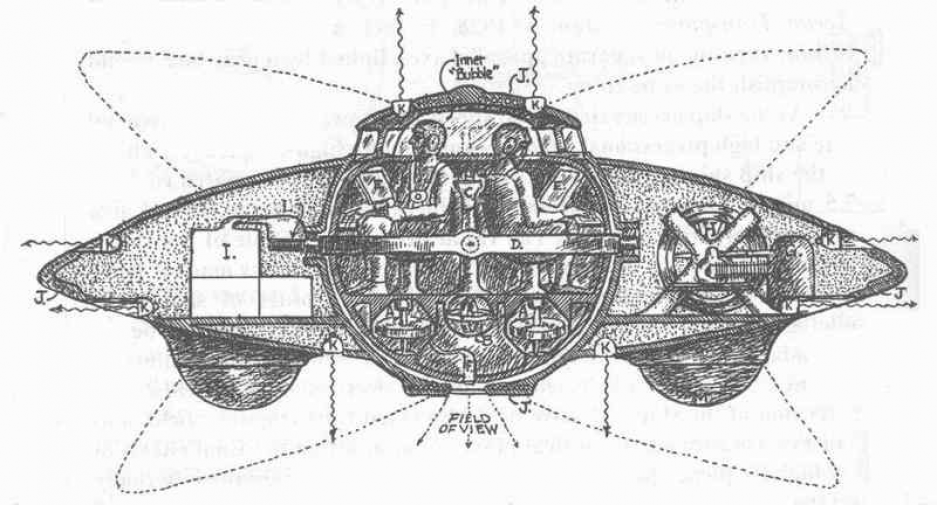

In my most recent “Sightings” post, I remark Ed Simon’s “We’re About to Find Out What We Really Know About UFOs,” which repeats a well-worn thesis about “First Contact” between humankind and a (more) technologically-advanced, extraterrestrial civilization:
The moment of “first contact” between humans and extraterrestrials has been extensively imagined in science fiction and in entertainment (and, of course, among UFO enthusiasts who claim such events have already occurred). Central to the depiction of an auspicious meeting between two radically different cultures or species is the sense of mass disorientation, collective anxiety, and “ontological shock” (a term coined by philosopher and theologian Paul Tillich to describe what happens when one’s entire sense of reality is disrupted)….
This ontological shock would be different from mere discovery or invention; it’s not even synonymous with what the philosopher Thomas Kuhn called a “paradigm shift,” when scientific consensus is amended by some revolutionary new theory. Rather it’s an apocalypse—in the sense of the word’s original Greek meaning of “unveiling”—whereby the true nature of reality is radically altered.
I noted the not-unproblematic, too-easy conflation at work in depictions “of an auspicious meeting between two radically different cultures or species,” a disjunction that calls for circumspection. “A meeting of two, radically-different cultures” describes well that between, e.g., Europeans and the indigenous peoples of what the former termed the “New World;” the science-fictional First Encounter scenario would be between two, radically-different species (however much the alien species might be imagined to possess a culture—and it would have to (however much the notion of “culture” here occludes the material formations of the society at the foundation of that alien species’ technological sophistication…)).
Simon’s too-easy conflation passes over the problem of mutual recognition I note in my previous post and elsewhere: one can as easily imagine that even if the alien Other is “technological” it may well fail to perceive Homo Sapiens as its alien Other. To say too much too quickly (though I have argued this point extensively), what underwrites the believability of the science-fictional, First Contact scenario, what makes it easy for us to entertain, is that the alien Other is a fun-house mirror-image of ourselves, and not even, strictly, of Homo Sapiens, but one, recent and far-from-global societal inflection of Homo Sapiens….
But what I want to probe here is the notion of “ontological shock” invoked by Simon and most others with regard to the First Contact scenario. First, I would recast if not update Tillich’s “ontological shock”. Philosopher Slavoj Žižek is instructive in this regard, in his work on the 9/11 attacks and related matters, Welcome to the Desert of the Real. There, he contrasts “everyday social [lower-case ‘r’] reality” with that “Real” that explodes our expectations concerning that “average everydayness”, such as the 9/11 attacks or Ernst Jünger’s experience as a storm trooper in the Great War of “face-to-face combat as the authentic intersubjective encounter.” In general, the irruption or intrusion of the Real recasts, redefines, and reconfigures what we had taken for normal or possible or “real”.
There is a small but growing bookshelf of works concerned with the sociocultural implications of the unquestioned discovery of extraterrestrial life, among them Steven J. Dick’s edited collections The Impact of Discovering Life beyond Earth and Astrobiology, Discovery, and Societal Impact, as well as Extraterrestrial Intelligence: Academic and Societal Implications edited by Andresen and Torres. That being said, one wonders just how much of an “ontological shock” such a real discovery or encounter would be, the putative Reality of such an event’s being, as noted above, merely (“mirrorly”) a distorted real. That is, the condition of possibility of our recognizing this Other as an Other is not its Otherness but its resemblance to ourselves. There is thus an ineluctable dialectic if not paradox in the very possibility of such an encounter: to encounter the alien is possible ony insofar as the alien is familiar or recognizable.
Moreover, the possible alienness of the Other is, at this point, somewhat worn and, imaginably if not arguably, blunted. The Eurocentric cultures have lived in a context of First Contact in their imaginary for millennia. The idea and problematic of the Plurality of Worlds is perennial, from Lucian’s A True Story (Second Century CE) to the astral travels of Swedenborg down to our own science fiction and the ubiquitious image of the Grey. Indeed, this thematic is so much part of the cultural air we breathe, ufologists have long suspected in the modern, post-1947 era, that such science-fictional material, especially the tele-cinematic, has been part of a program of slow Disclosure. More generally, nearly if not all cultures have stories about our cohabitating with nonhuman others. We need not take these stories literally, but, in light of the prevalence of this thematic, as History’s Ancient Aliens says, it’s not too far off the mark to admit that, in a very real sense (i.e., in our everyday reality…) “We have never been alone.” In light of the logic of First Contact (the Other’s needing to be recognizable) and the empirical fact that, at least in the Symbolic order, we have already undergone First Contact long ago, it seems not illegitimate to wonder how “Real” the news of First Contact would turn out to be. The recent film Don’t Look Up is instructive: if humankind is nonplussed about the very real, unprecedented threat of climate change to organized society if not human survival (in the most pessimistic scenarios), how much less would be the shock of learning “we are not alone”, an idea which has been in the air for as good as forever?
A recent, actual “ontological shock” was supplied by the theory of evolution, for which Homo Sapiens are only one species among others. Darwin’s work, preceded by the geological discoveries that suggested earth was much older than 6,000 years, deeply disrupted the real of Nineteenth Century societies, in a way which seems now remarkably forgotten, at least for the most part. The shockwaves, however, continue, in research into animal and plant intelligence and the consequent call for animal rights (from the Society for the Prevention of Cruelty to Animals founded in 1824 to the work of philosopher Peter Singer) and the granting of legal rights to rivers and lakes, for example. These developments in real interspecies relations constitute arguably an irruption of the Reality of other species into the real, wherein they are presently brutalized instrumentalized. It is no accident that this re-orientation is one from Eurocentric (Abrahamicapitalist) worldviews to values present in more traditional, indigenous ones, this latter too-often no less repressed, oppressed, and murderously abused than the Nature with which they were often identified (as, for example, in the doctrine of Terrus Nullius).
Despite the recent journalistic and governmental surge of interest in UAP and nonhuman intelligences, the UFO/UAP is possessed of a relevance to culture and society more profound than the cynical, deceptive ploys at work since, most notably, 2017. The very idea of these technologically-advanced, nonhuman intelligences, whether in the fevered comments, posts, and podcasts of the ufomaniacal or the more rational research protocols of the Search for Extraterrestrial Intelligence, rises from the unconscious (ideology) of earth’s “advanced” societies. An analysis of these societies’ imaginary unmasks a narcissistic, self-serving (-preserving) idolatry that blinds their members to the possibility of a Real, progressively real encounter with those Other lives that have always lived with us, those species of life whose Reality we have perverted and domesticated into a comfortable, abusive reality.
 Skunkworks