There’d be little argument I think that interest in the Flying Saucer / UFO / UAP topic experienced a florescence following the New York Times‘ publishing the Cooper, Blumenthal, and Kean article “Glowing Auras and ‘Black Money’: The Pentagon’s Mysterious U.F.O. Program” at the end of 2017. In the years since, not only have new blogs, podcasts, and YouTube channels popped up but scholars and scientists have put their shoulders to the wheel and new academic associations and conferences have been established, the Society for UAP Studies, the Sol Foundation, and the Archives for the Impossible among them, along with research initiatives, such as Harvard University’s Galileo Project and the Interdisciplinary Research Center for Extraterrestrial Science (IFEX) at the Ludwig-Maximilians University in Würzburg, Germany. Of no less note are the ways international government agencies have taken an interest; the US government created the All-domain Anomaly Resolution Office (AARO) and NASA commissioned its own UAP Independent Study, for example.
For myself, however, a boyhood fascination was rekindled in 1994 when I was struck (like Saul on the road to Damascus) by how the countless stories about UFOs and aliens seemed a dream expressing the anxieties and aspirations of late Twentieth Century technological society. Was it any wonder, I thought, that women under hypnosis should tell stories of being experimented on by egg-headed, grey-faced, cold-blooded doctors at the same time that the Human Genome Project, the prospect of human cloning, and in vitro fertilization procedures were all under development and making the news? As I devoured an ever-growing pile of books on the subject, like many who came to the matter post-2017, I was at first moved to accept the reality of the phenomenon, even the consistencies in reported alien abductions possessed a prima facie believability. However, as the years passed, and I came across those rarer analyses and mundane explanations of particular, famous cases, my credulity waned, not that the question of the reality of the phenomenon was ever my first concern, being more impressed with what this newest mythology revealed about the society that cultured it; moreover, debates about any one case, especially the more famous ones, tended to be both endless and evermore convoluted (not unlike the discussions around the assassination of John F Kennedy) but also at times drew on fields outside my wheelhouse, such as physics. That rabbit hole, for my (poetic, cultural critical) purposes, was a waste of time. Then came 2017…
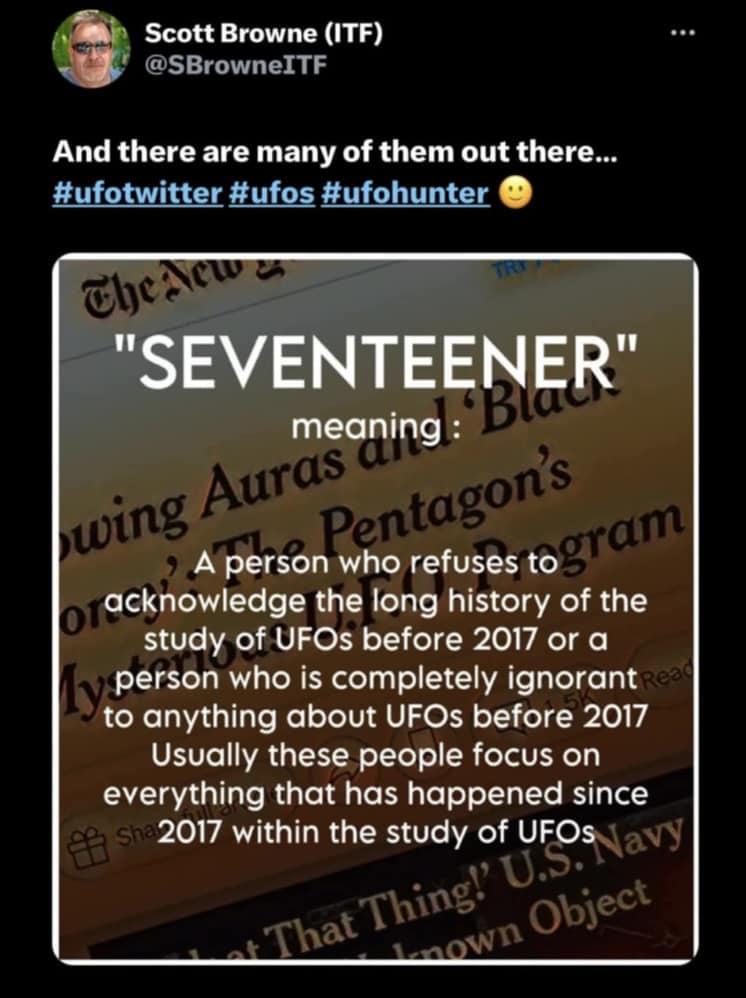
The very coinage of ‘seventeener’ speaks to the frustration felt by those long interested in the topic with much of the recent talk about it, not only among “amateurs” (those bloggers, podcasters, and YouTubers) but, more seriously, among the learned and elected. The whistleblower claims of David Grusch are a case in point. As longtime researcher Kevin Randle observes “some of us have been around long enough that we can figure out what crashes Grusch has been told about.” Nevertheless, Grusch testified before a relatively-uninformed American government oversight subcommittee for which word of “a multi-decade UAP crash retrieval and reverse engineering program” was an eyebrow-raising revelation. This post-2017 interest also emboldens “believers” in the “reality” of “The Phenomenon.” Younger scholars, for example, such as Hussein Ali Agrama, after having begun researching the topic in 2015, concludes (somewhat smugly) that “by all possible yardsticks of reality”, as they used to say, ‘Flying Saucers are real!'” At the most recent Society for UAP Studies conference, anthropologist Brenda Denzler (author of the canonical study The Lure of the Edge: Scientific Passions, Religious Beliefs, and the Pursuit of UFOs) gave a keynote address wherein she essayed the Interdimensional Hypothesis, remarking uncritically the work of Michael Masters, the Schirmer abduction case, and Jacques Vallée’s and Paoloa Harris’ yarn concerning the 1945 Trinity Crash (I respond to her talk, here). This year’s upcoming Archives of the Impossible Conference is focussed on UAP, as the conference’s website explains, “an aspect of the phenomenon [of the impossible] receiving increasing coverage in the media as new whistleblowers are stepping forward to share credible testimony regarding their interactions with the Impossible. Officials operating within political and legal circles on the Hill have been paying attention and are beginning to take the subject matter seriously. Plausible deniability is, apparently, no longer plausible” (my emphasis). Finally, this coming April, the University of Durham’s Law Department has organized a one-day symposium “Grounding the SETI and UAP debate: Law, evidence and anticipated futures;” where one paper by Jia Wang is titled “Monopolizing high-tech in the hands of powerful humans after contact with extraterrestrial civilizations.” Talk about putting the cart before the horse. At the same time, even those skeptical of whether “flying saucers are real” recycle questionable notions, e.g., attributing the debris collected at Roswell to a Mogul balloon, an explanation Kevin Randle has vigorously disputed (and, to my mind, put to rest).
That, despite my interest being the meaning and ideological implications of the UFO mythology, I am nevertheless irritated by if not drawn into discussions about “the reality of phenomenon” speaks to the complexity of the matter, a complexity, it seems to me, overlooked by too many. It hardly follows I advocate a debunkery, such as that practiced “canonically” by Donald H. Menzel or Philip Klass (itself an aspect of that aforementioned mythology). Rather, one needs humbly acknowledge the debate around and, yes, research into, the nature of the phenomenon has been ongoing since 1947, that compelling stories have been told and observations made, along with equally persuasive explanations, both scientific and sociopsychological (in this latter regard, interested parties would do well to peruse the work of Martin Kottmeyer, here). A fine-grained grasp of the the history of the Flying Saucer / UFO / UAP returns it to its provocative, manifold mystery, which, in turn, opens a way to continued conversation and reflection beyond mere belief or disbelief. The most recent study by Knuth et al. is doubtless more grist for the mill…

 Skunkworks
One thought on “Seventeeners and Believers”